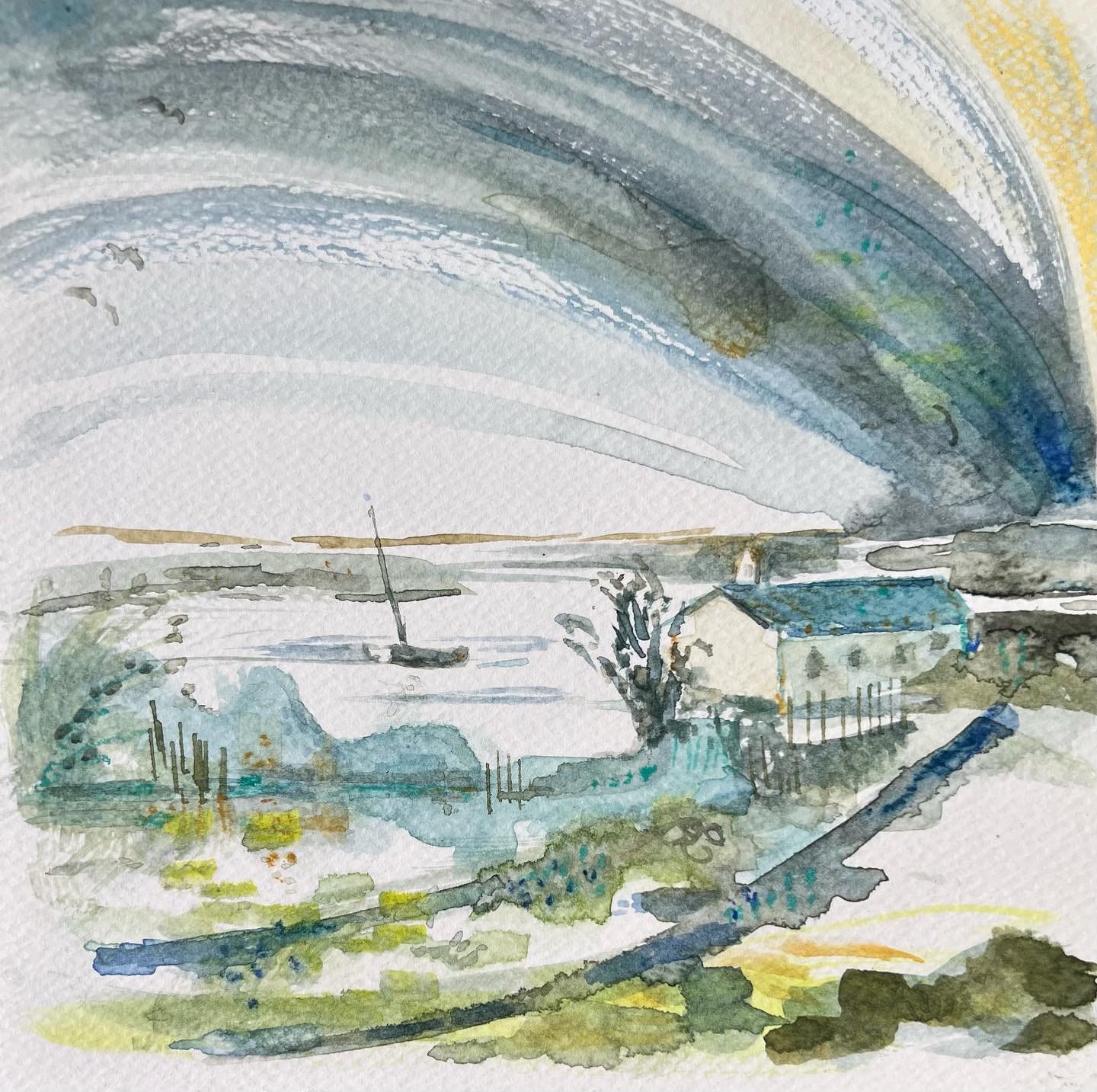
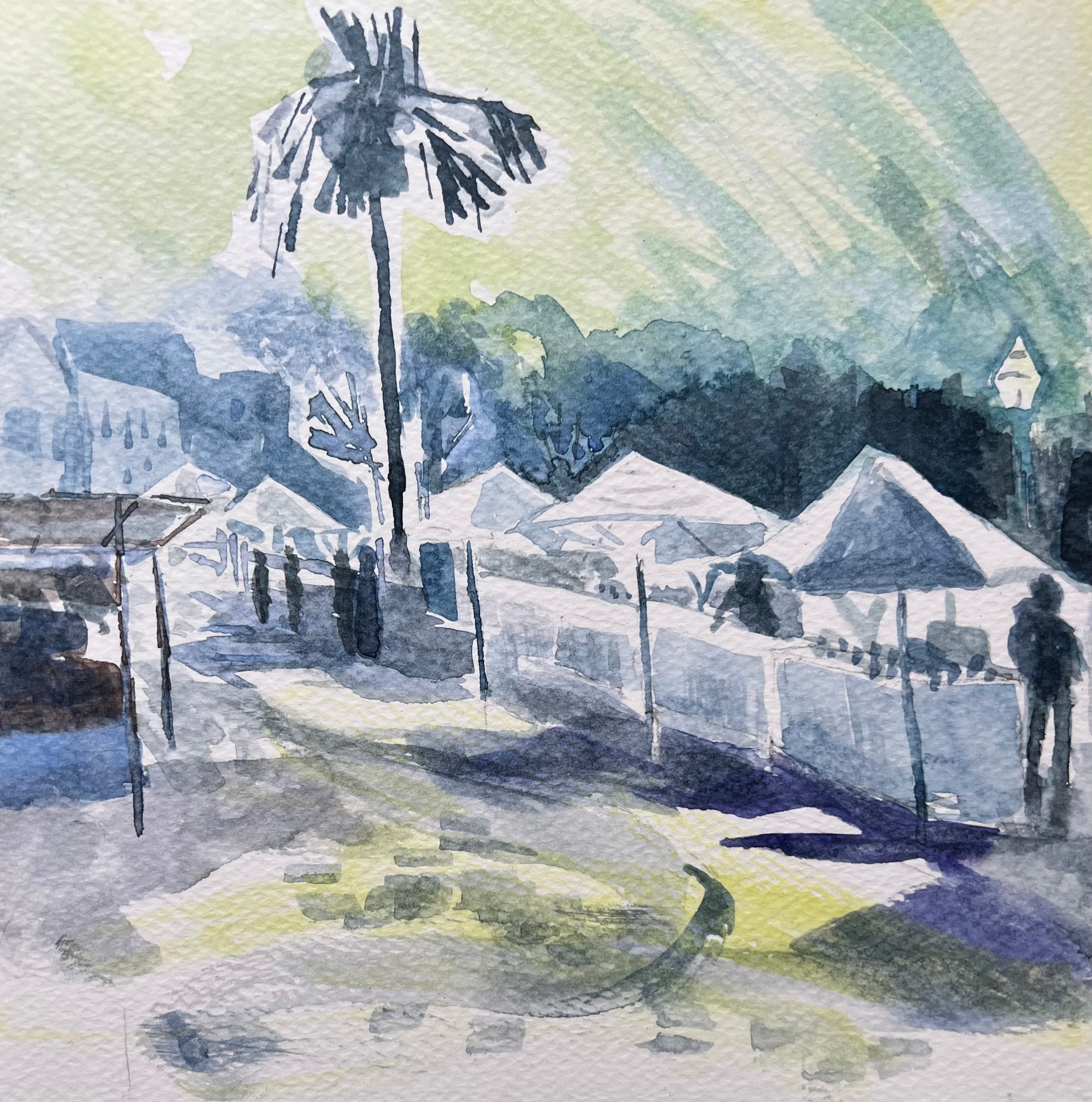
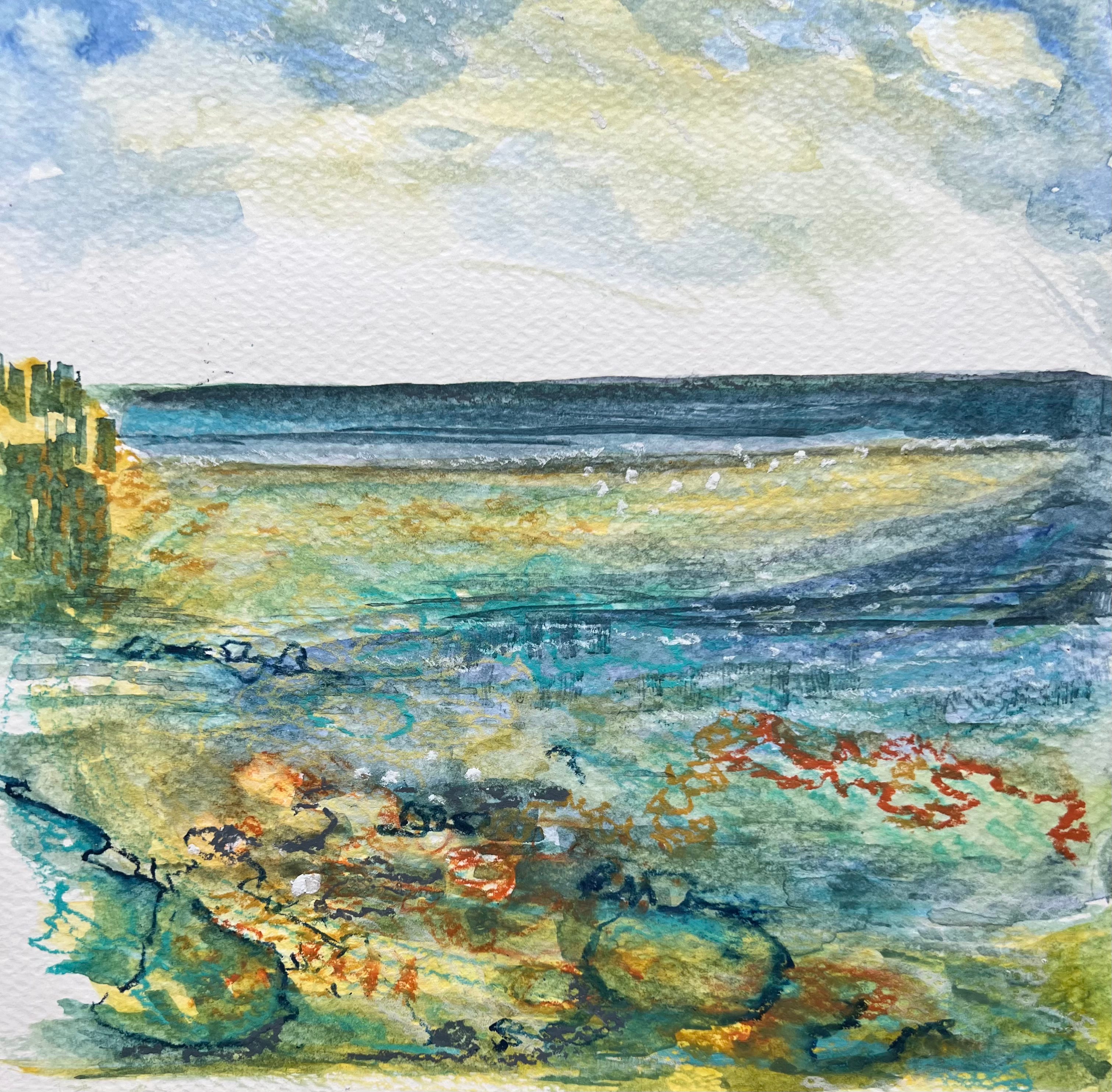
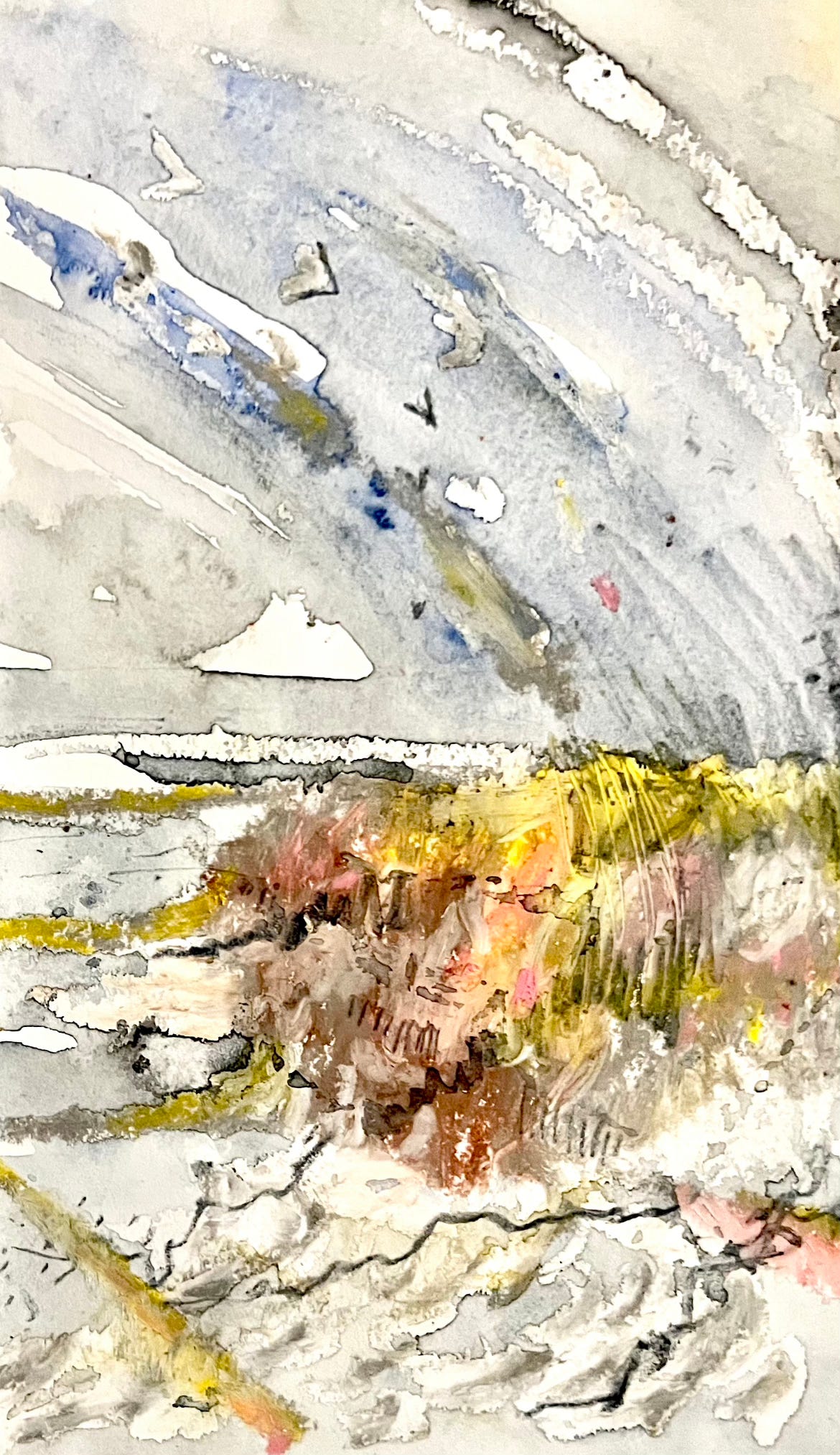
A sketchbook recently filled – vibrant markets and fishing villages in Southern Portugal.. a tiny film.
My big love is being outside in the landscape and drawing and painting. I have just returned from a lovely ‘milestone’ birthday trip to Portugal where I got to do plenty of that and, unusually for me, worked in just one sketchbook and filled it up. Would you like to see? I enjoyed the sights and smells of market days particularly and depicting these bustling, loud and mouthwatering days was my inspiration this time.
This is also my first time filming my sketchbook – so, fingers crossed!!
I spent some of the holiday drawing and painting with my good friend Mary Price and we hoked up for some of our time with another woman, Julie Sajous, a new friend found loitering with sketchbook and pens.
This common ground of drawing (followed by eating and drinking) is such a uniting factor you know! In times which seem to polarise people we need to find our tribes, connect and lift each other up!
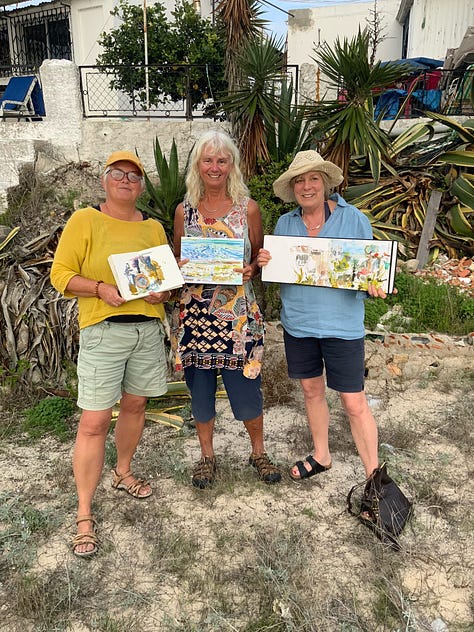
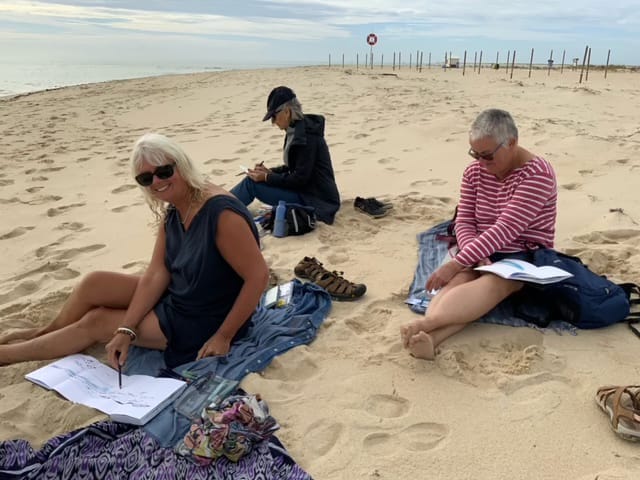
Painting alone and painting with friends – such a great way to connect with place and people. Here are me, Mary Price and Julie Sajous.
That’s me on the left looking like I might fall over backwards into a cactus!
I would love to hear how you record your travels if you do.
Do you draw or photograph and do you think there’s a big difference? Or maybe you keep a written journal? Let me know in the comments ….
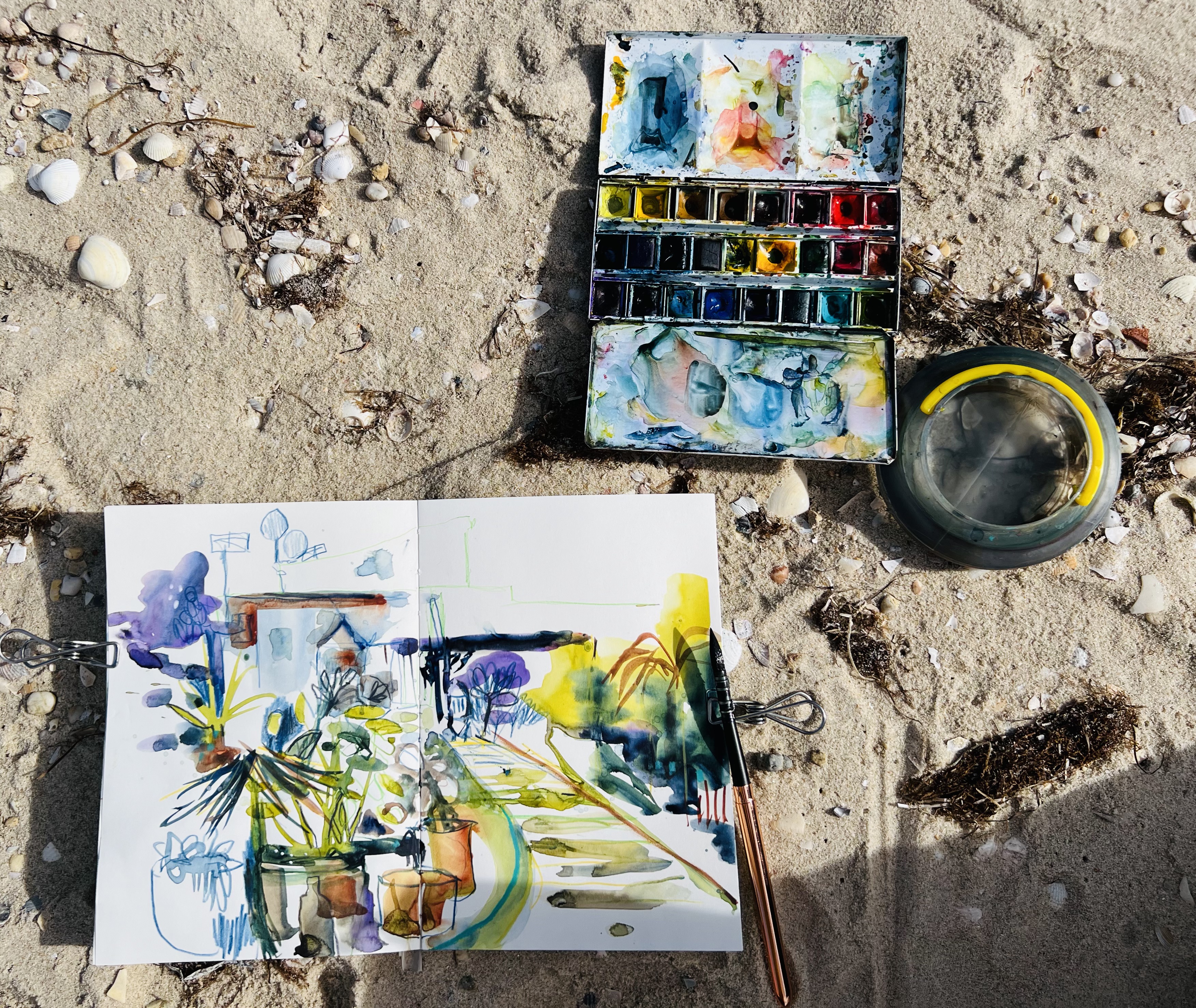
Sketchbook colour trials and a pastel da nata (very lifelike!!)
I don’t know about you but I am finding this world uncomfortable to live in, to say the least. Yesterday this was acute for me – a feeling of compression and deep sadness from thinking about the hold that big corporations have on the political sphere, freedom of speech and debate and enquiry.
The knowledge of the pain that so many people are going through, the role that hyper-capitalism and extractive growth plays in all of that and the deep lack of concern for the lives of innocent people by those motivated by power and greed is almost too much to bear.
Some people won’t even enter into any debate. It’s understandable. Numbing oneself is sometimes necessary to preserve a sense of being able to live in a more privileged world but I do feel we must face the situation, at least sometimes, and sit in the fire of the discomfort to see where we fit in to all of this by indirect complicity and think about what we can do about our (unintentional) contribution.
This interview with Rev. Angel Kyodo Williams helped me to think about my approach. She is a Buddhist priest and activist and the co-author of Radical Dharma: Talking Race, Love, and Liberation, published by North Atlantic Books and has been bridging the worlds of personal transformation and justice since the publication of her critically-acclaimed book, Being Black: Zen and the Art of Living With Fearlessness and Grace.
Then also yesterday I listened to Shaun McNiff talking about how art heals, the thrust of his 30 years of work in transformational potential that art can bring in this interview for Intellect, a publishing house for arts and health, particularly the Journal of Applied Arts and Health which has lots of, available to the commons, articles of interest, the editor in chief of which, Ross Prior, was my first Director of Studies in my PhD.
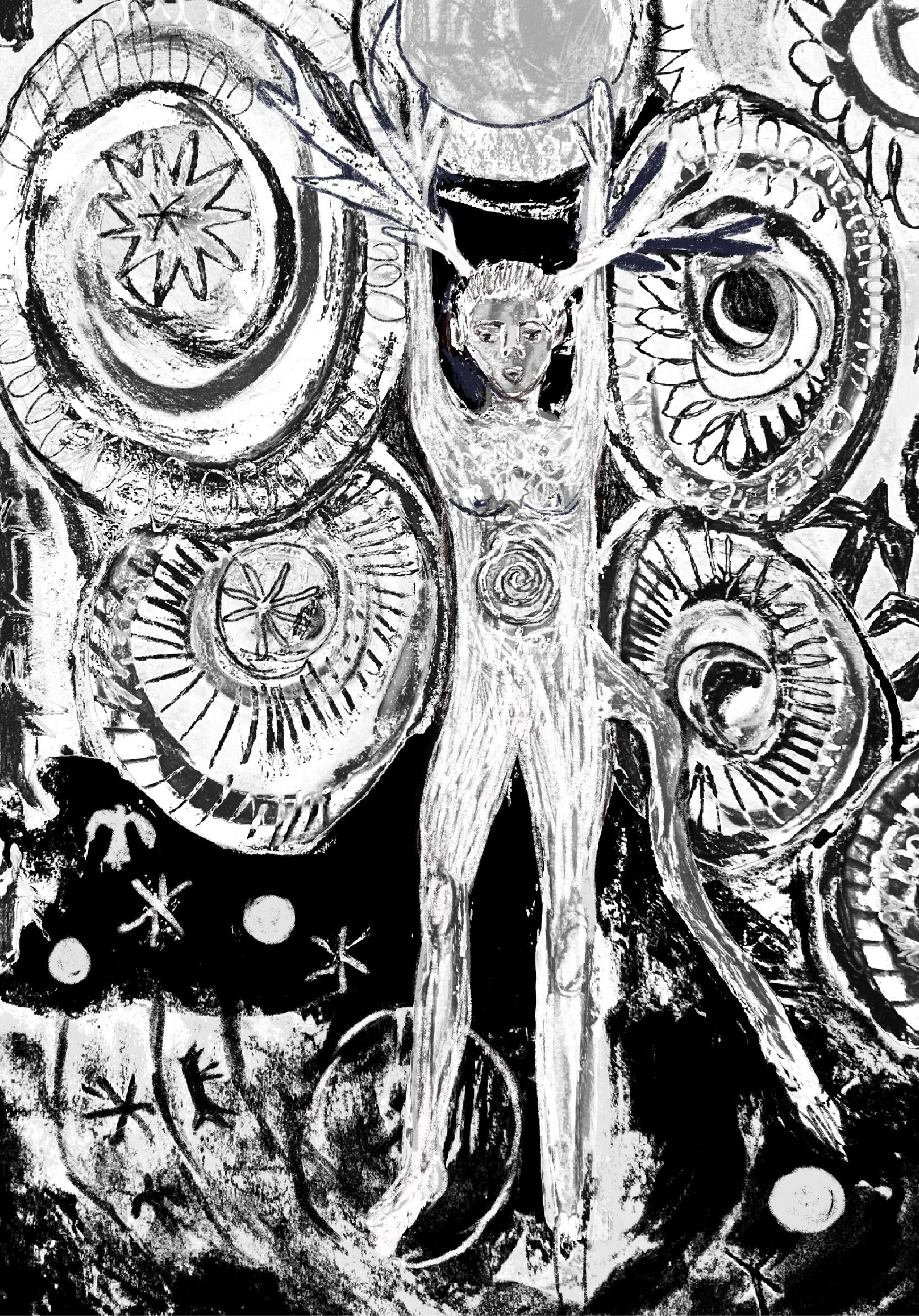
My own work highlights the transformational power of art making through various projects but yesterday was just one of those low, low days of compression which are fortunately fairly rare for me. The wet and cold weather has contributed I’m sure because being out in the garden or walking always shifts things on better days. So anyway I just decided to draw how I felt; sort of pressed in from all these spheres of oppression from Big Tech, growth mindset, cancel culture, suppression of freedom of speech and non-democratic inducing powerlessness.
I wish I had photographed the process but I was engrossed in it for a while, finding a flow as, unintentionally, the drawing took a shift to the positive. I remembered my aphorism that nature shows us best how to operate when making difficult decisions or feeling disempowered and realised it was a full moon as lunar symbols appeared on the page weirdly seemingly without my own direction. I ended up with a positive image of myself, or some sort of being representing me, in play with the spheres which had morphed into representations of positivity and power. How nature and we humans (not that we are separate) must unite to work in harmony to keep this planet in some kind of balance.
Anyway!!! It felt like a positive transmutation and showed the power of making art for personal transformation in a simple, direct and profound way. It lifted the mood and today I have been out planting seeds, weeding and tidying in the garden. The situation of the world has not gone away but I have spent some time facing it and can work out other strategies going forward rather than feeling so disempowered. I can meet discomfort and have ways to work with it, meditation being one of them – listen to Angel Kyodo Williams when you have a moment.
Here is the result of a couple of hours at the sketchbook:
I put it here, though it was for private work, to inspire you to think about drawing how you feel and then to see where it takes you. This made its own transformation – the picture sometimes ‘tells us’ what it needs – and it doesn’t need to transform towards the positive to be effective – the most important thing is that you have EXPRESSED something.
…and don’t think you are not good enough to draw – it’s for you to do and not to share unless you want to…
The issue of talent is the most effective defense against expression… Sit with what you already have and dream with it in a new way. from Trust the Process – Shaun NcNiff
Lack of expression becomes repression/suppression and is the root of many an illness, physical and mental. I see that in my work as a homeopath in deep listening to people.
Whenever illness is associated with loss of soul, the arts emerge spontaneously as remedies, soul medicine. from Art as Medicine – Shaun McNiff
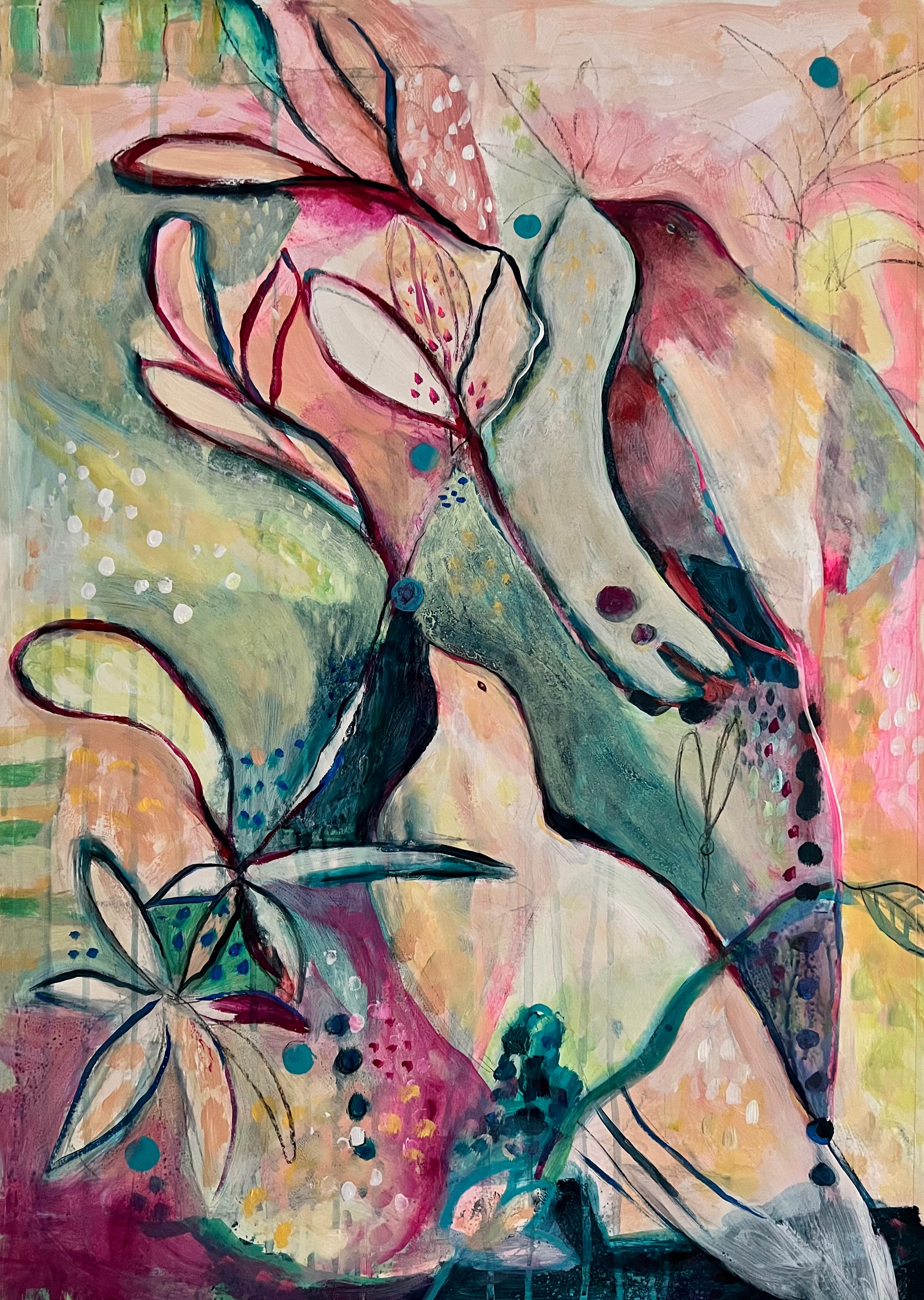
Today I am more upbeat and feeling the interdependence of nature more and this is today’s offering:
I would love a conversation or to hear your thoughts about how you use art making to help yourself or if you would consider trying it.
Creativity is a force of nature, the mainstream of imagination accessible to all. from Imagination in Action – Shaun McNiff
exhibition news
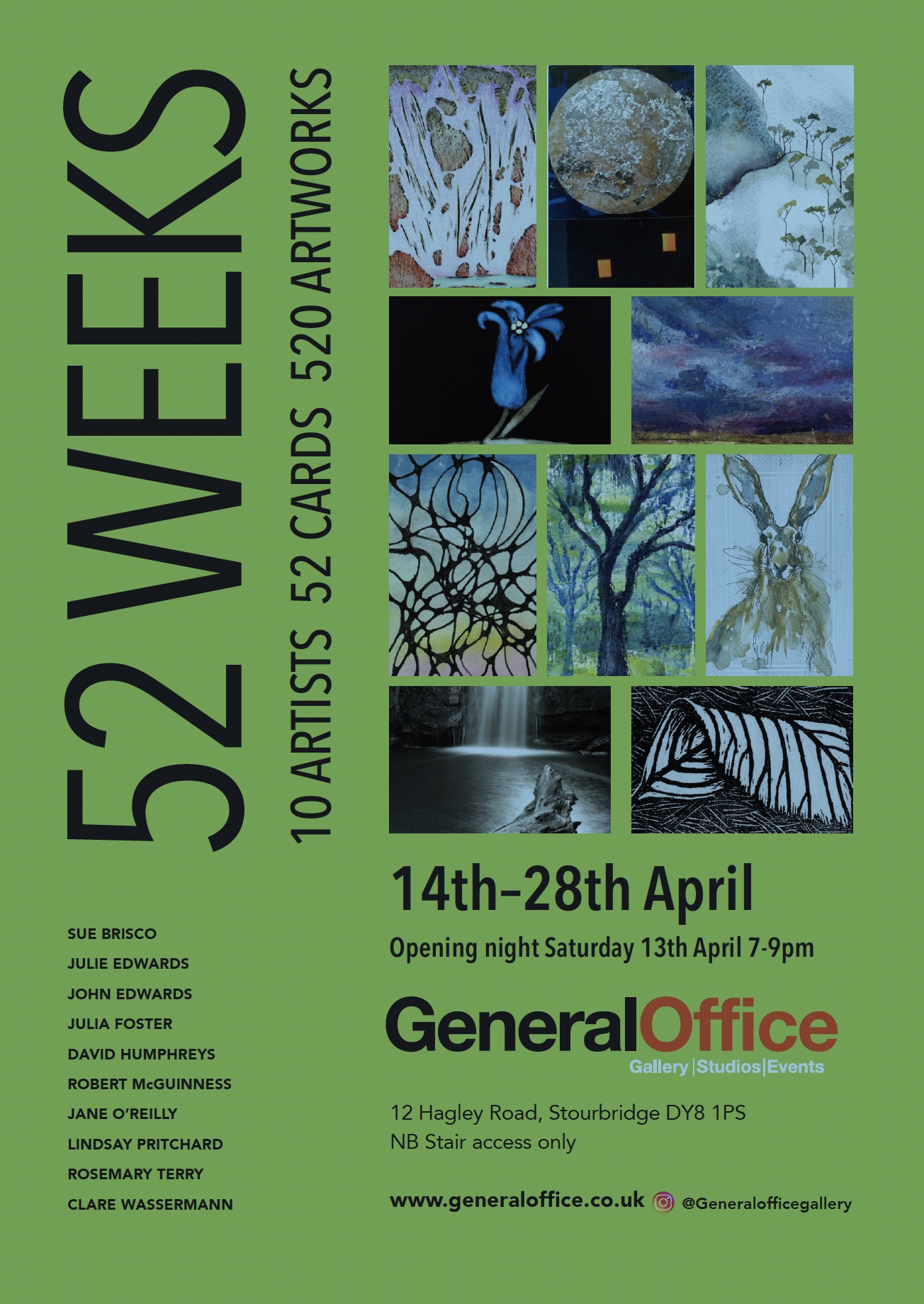
If you are in the Stourbridge area (central England) you are welcome to attend this lovely exhibition at The General Office. It takes place between 14th and 28th April 2024, Tuesday – Sundays 11am-4pm
Here is a flyer – please do bring friends – 10 artists made 52 pieces of work over the course of the year on a playing card and they are all presented here – 520 artworks!!!
Thank you to Julie Edwards who’s concept this was and her husband John who also takes part and did so much of the design work of the posters and backed Julie up wonderfully over the course of her illness.
How I use my sketchbook to find the content of my thoughts
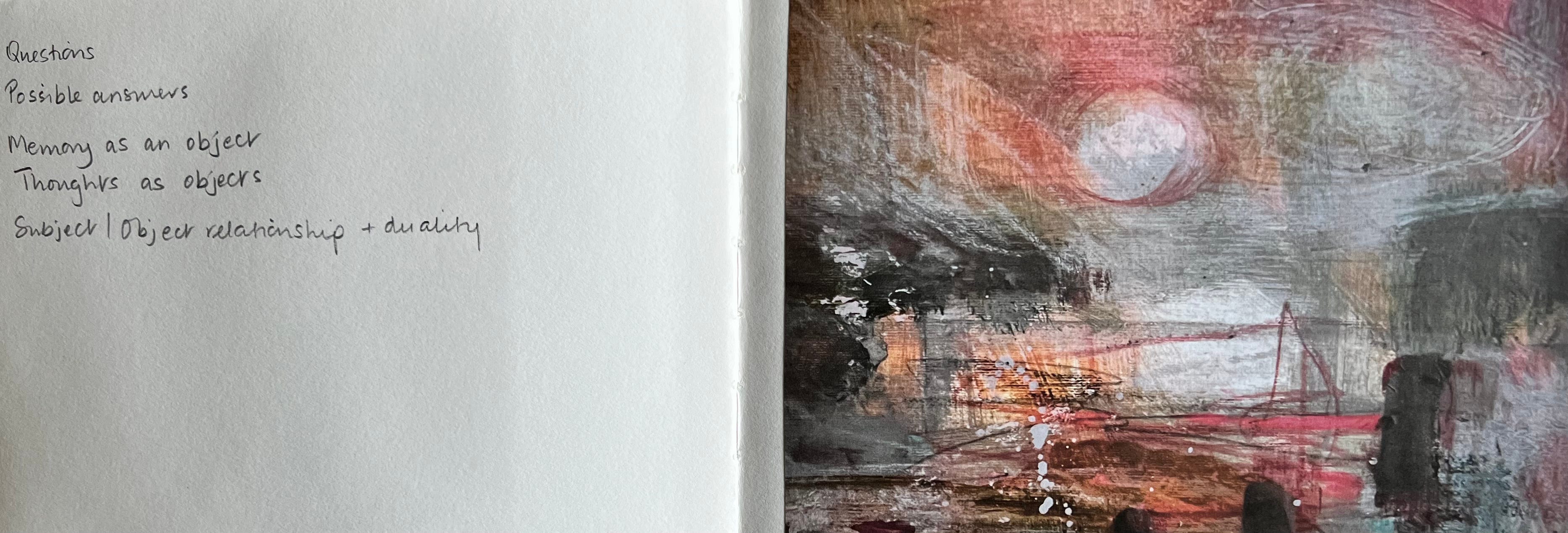
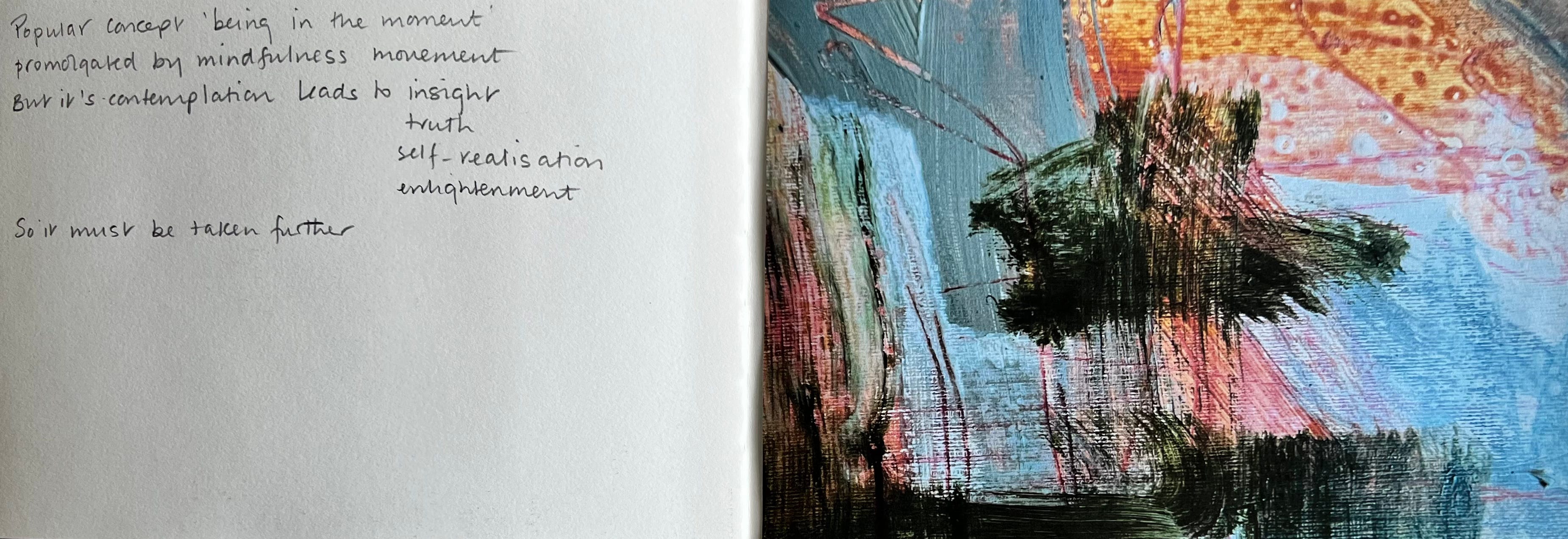
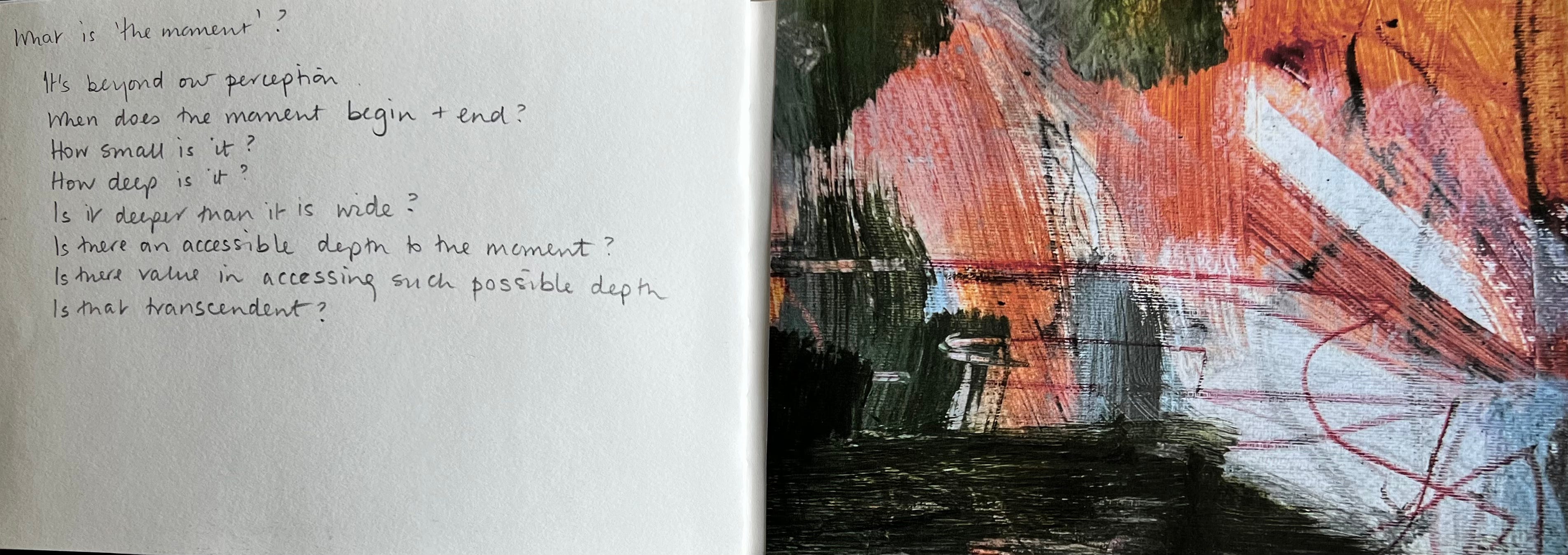
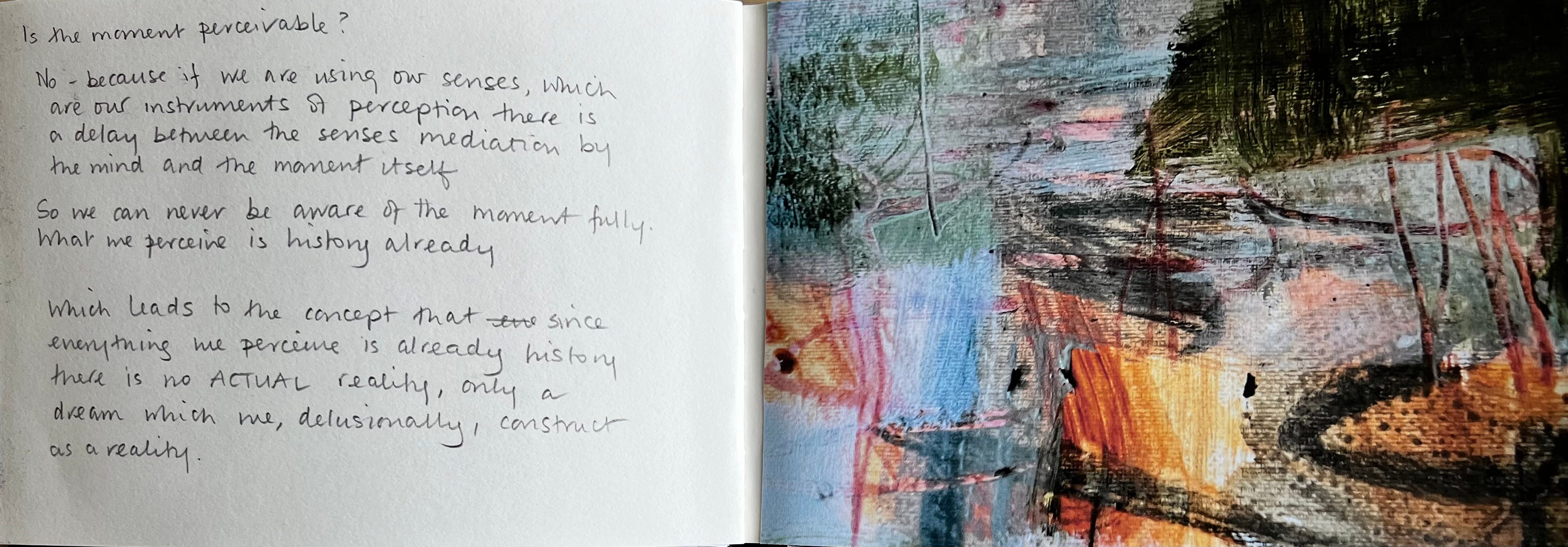
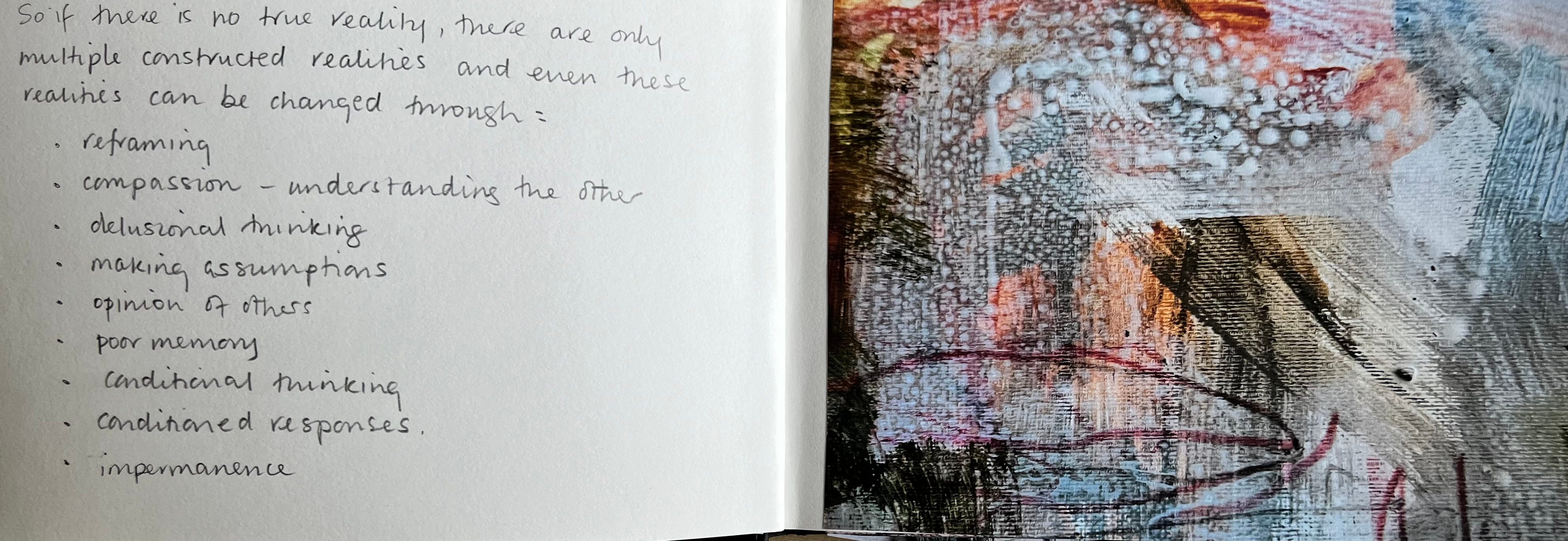
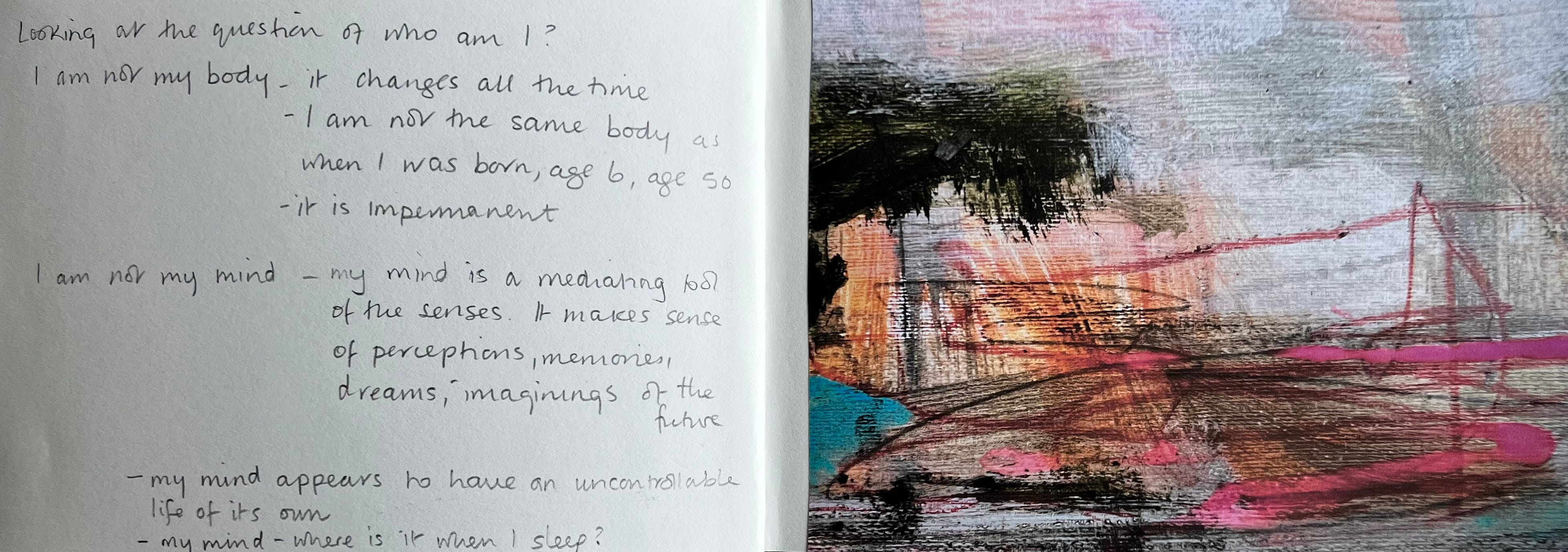
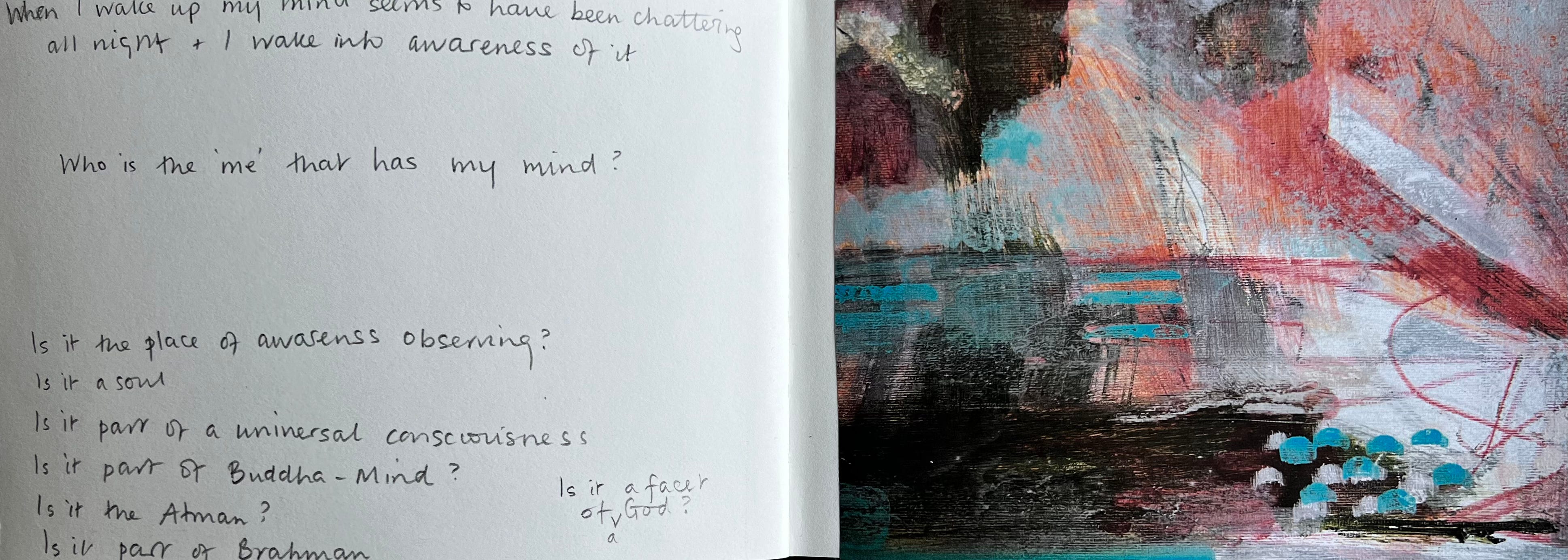
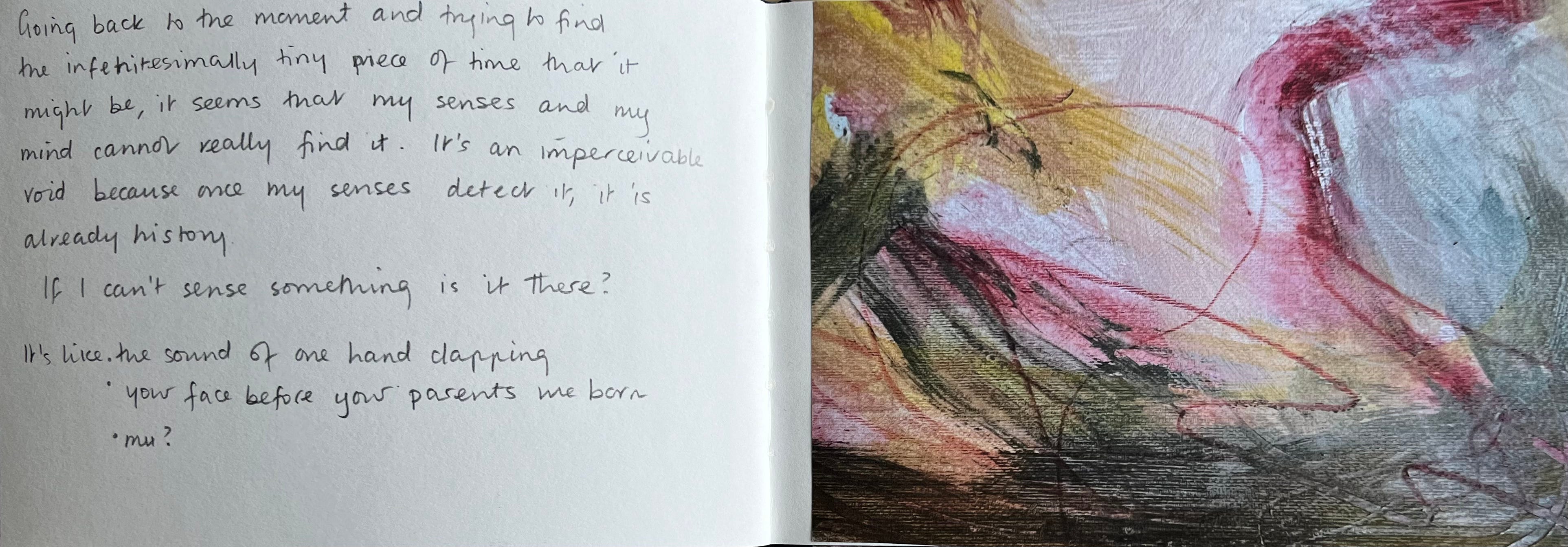
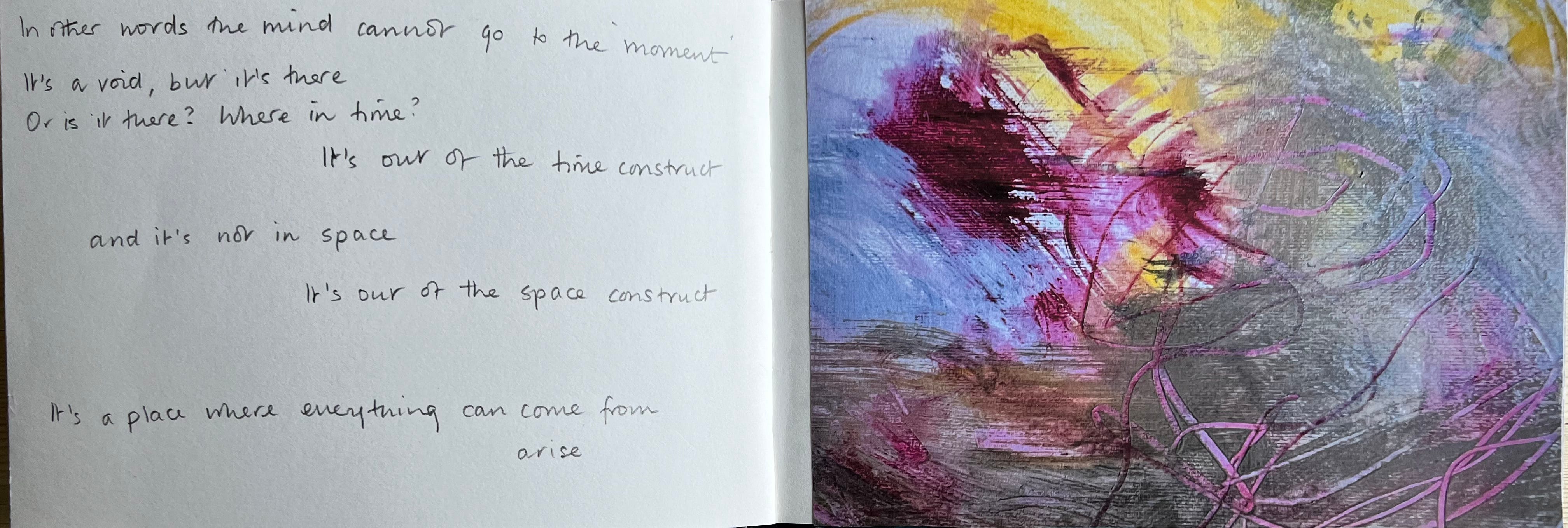
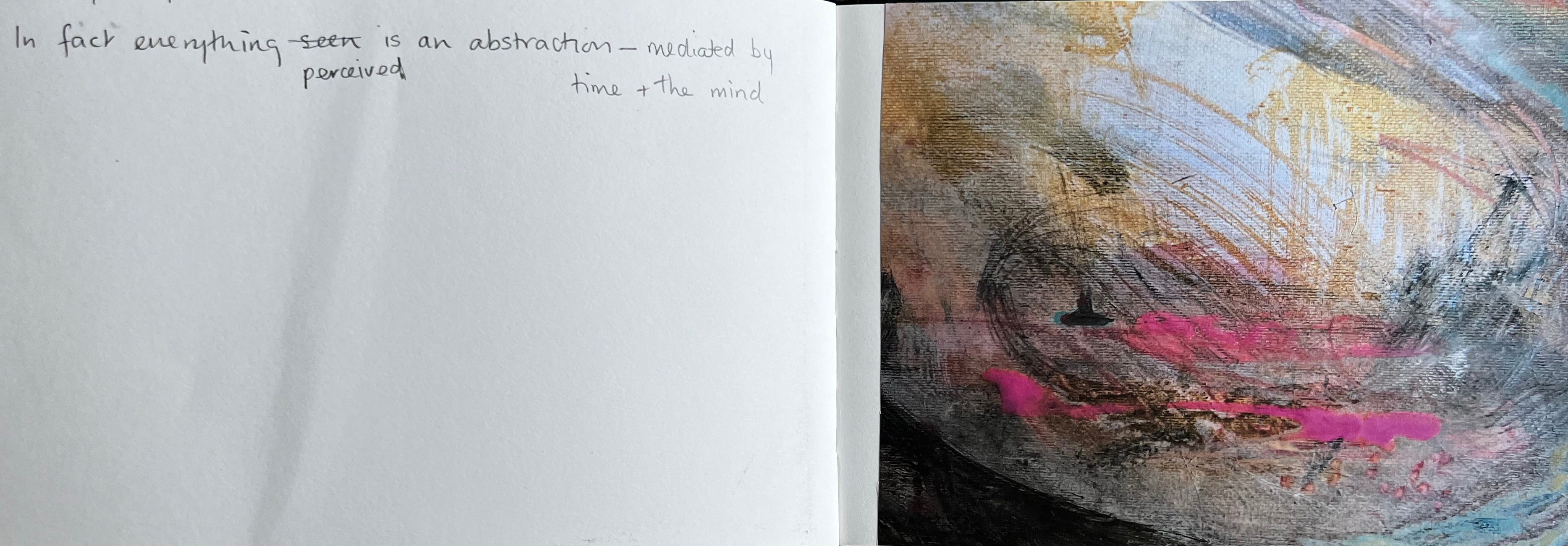
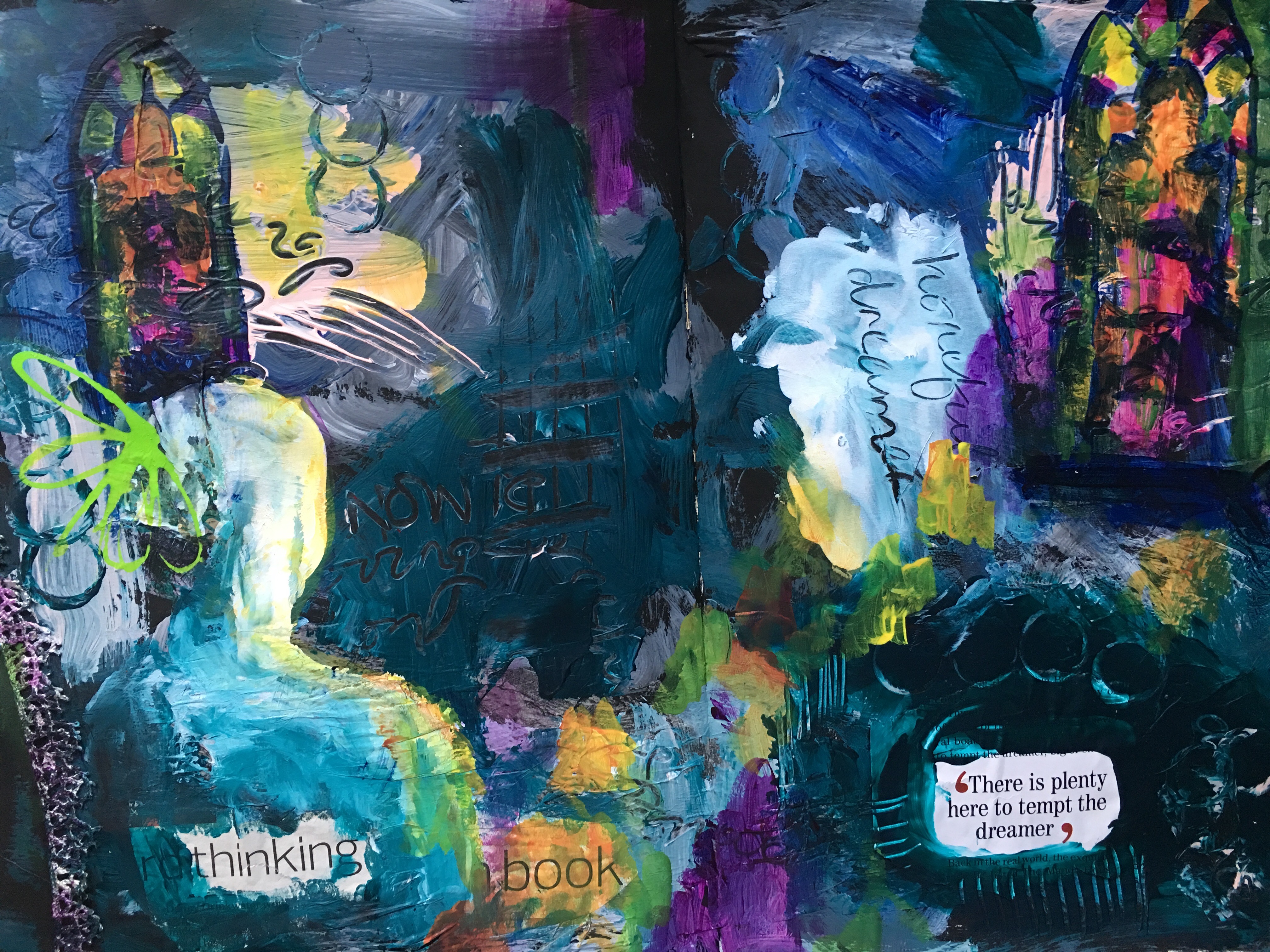
Sketchbook as a portal. This is how my mind gets going sometimes…I’m not sure how much control I have over it, but it’s a way of using a sketchbook to find stuff going on in this head ….
These are the images for this particular stream of consciousness sketchbook. They are copies of a long series of paintings I made on the sea wall in blustery North Wales through which I embody the storm. This is a section in my PhD research which I have really enjoyed documenting. I find that I don’t really have too much control over what I am writing – I leave it to come through me in a way akin to the notion of ‘enchantment’ spoken about by activist and leader Nina Simons. She advocates taking a solitary walk and seeing what comes through you as a form of contemplative practice. Here I paste images made by myself and then open myself up to what writing is there…it’s an experience I enjoy, it’s immersive. It’s part of sadhana a practice in jñāna yoga.
Here are some pages:
This I call the questioning of abstract ideas through the vehicle of images. I am questioning here the nature of reality. Have you ever thought about that?
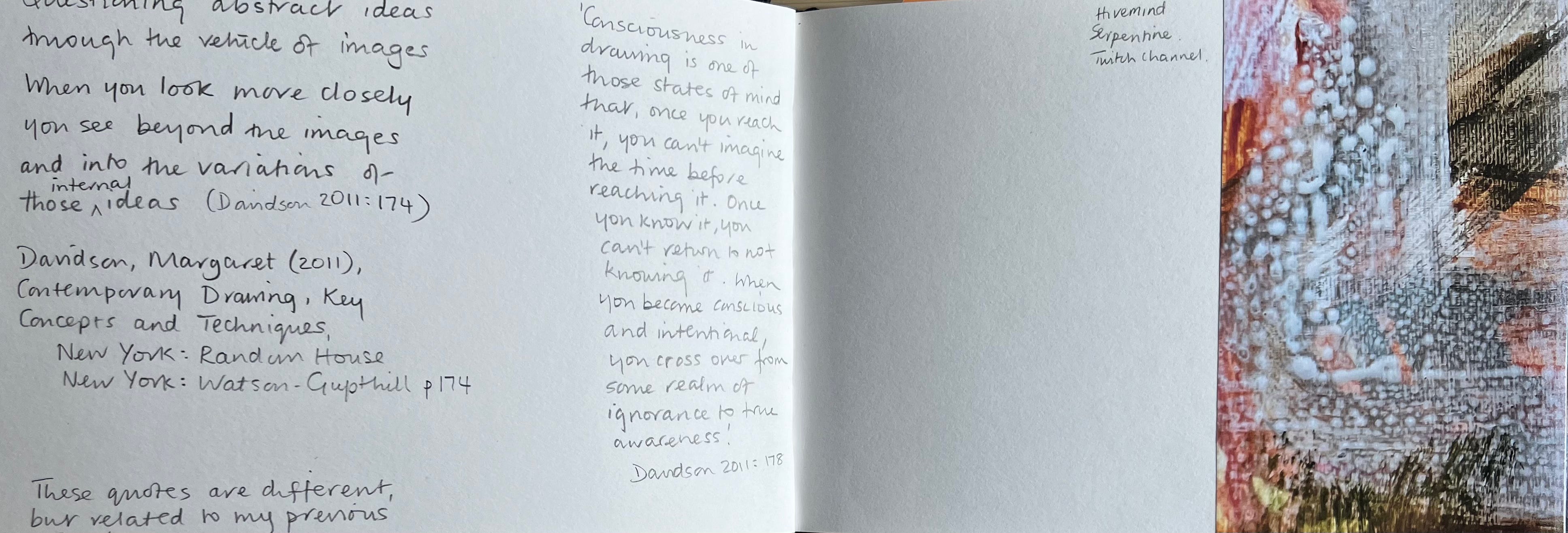
I like these two quotes by Margaret Davidson on contemporary drawing:
When you look more closely you see beyond the images and into the variations of those internal ideas.
Davidson 2011: 174
and
Consciousness in drawing is one of those states of mind that, once you reach it, you can’t imagine the time before reaching it. Once you know it, you can’t return to not knowing it. When you become conscious and intentional, you cross over from some realm of ignorance to true awareness.
Davidson 2011:178
Ref: Davidson, Margaret (2011), Contemporary drawing: key concepts and techniques, New York: Random House.
She’s spot on as far as I’m concerned.
This week in the studio I am working particularly on this painting – by next week’s newsletter it will be done. It’s one of three that have occupied me during January and February – they are towards a solo exhibition in August in Much Wenlock, Shropshire UK. Which reminds me I must get cracking on that work…speed up a bit!
83 x 59cm – work in progress but nearly there!
That’s all for this week!
but …
I’d love to know if :
you write much in your sketchbooks if you have them?
you do free writing or a stream of consciousness
you have worked with Julia Cameron’s morning pages concept
Is it too much to wonder if drawing can be an act of resistance against disconnection or a political act to create unity and peace through presence, mindfulness and interconnectivity?
22 NOV 2023
This last week I was going to write a piece about drawing and the role that it can play in mindfulness and ‘being present’, but on thinking about it that was put to one side slightly and the importance of drawing as an interconnectedness with all things came up.
How amazing it would be if the simple act of drawing could be used as a transformational process to bring people and their ecosystem (that which forms a network of relationship and interdependence i.e. everything) together?
What if drawing creates union?
What got me thinking
I do a lot of my PhD research about mindfulness, meditation and contemplation in relation to an art practice. It’s always a good excuse to go out and draw anyway; justifying the pleasure with some kind of ridiculous validating argument as if I can’t just have the pleasure. But anyway, in the name of research (!) I was on holiday in Portugal last week and set myself a little goal of painting or drawing to record the trip each day as I generally do when travelling, both as a diary and as something more.
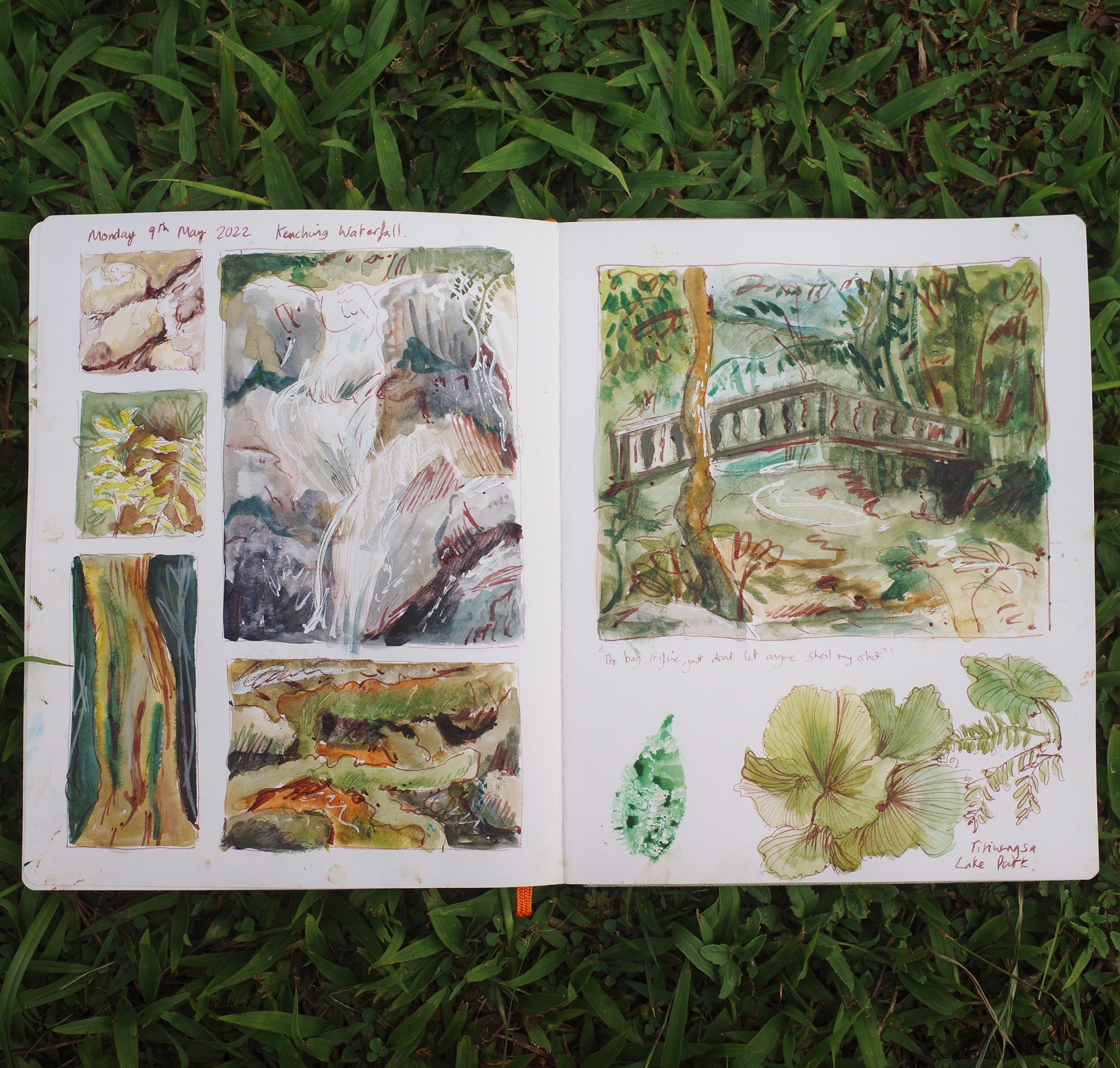
I took a little A5 sized sketchbook and a small pad of watercolour paper and carved niches of time out to use them throughout the trip.
For me, drawing in the landscape is part of a full participation in a location. I take photos, like the rest of us, but the difference between photographing and drawing is enormous.
Michael Taussig, anthrolopologist and field notes maker, in his book “I Swear I Saw This: Drawings in Fieldwork Notebooks, Namely my own”, speaks of drawings:
“folding organically into the writing in the notebook whereas a photograph lives in another sphere altogether, with technology, lying between you and the world”.
He mentions John Berger’s thoughts, with his enigmatic notion that a photograph stops time, while the drawing encompasses it and encompassing is like enclosure. There is an intimacy that Berger finds between the drawer and the drawn, suggesting that drawing is like a conversation with the theme drawn likely to involve prolonged and total immersion. Here the idea is that the person becomes the drawing, you become so close to the object, until you are finally it as it were, the contours you have drawn marking the edge of what you have seen, but also the:
“edge of what you have become, an autobiographical record of one’s discovery of an event, scene, remembered, or imagined.” (Berger 2007:3)
Berger also says that drawing has something that painting, sculpture, installations and videos lack, and that is corporeality. (Berger 2007: 16).
I think mindfulness is a big part of it for me and I like to cultivate and exercise that skill when I can. Here are a couple of definitions of mindfulness:
“Mindfulness […] is generally defined to include focusing one’s attention in a nonjudgmental or accepting way on the experience occurring in the present moment [and] can be contrasted with states of mind in which attention is focused elsewhere, including preoccupation with memories, fantasies, plans, or worries, and behaving automatically without awareness of one’s actions.” (Baer et al. 2004: 191).
“Mindfulness is a process of regulating attention in order to bring a quality of non-elaborative awareness to current experience and a quality of relating to one’s experience within an orientation of curiosity, experiential openness, and acceptance.” (Bishop et al. 2004: 234).
There are two understandings of mindfulness: Western and Buddhist derived. A more Eastern-based idea of mindfulness (sati) is:
“Eastern mindfulness means having the ability to hang to current objects, to remember them, and not to lose sight of them through distraction, wandering attention, associative thinking, explaining away, or rejection.” (Weick & Sutcliffe (2006: 518)
You can see why this is a useful practice to cultivate! It is beneficial to be able to bring this skill to play in all sorts of life situations!
Benefits of mindfulness
The practice of mindfulness, through methods such as body scanning, meditation, and yoga, aims to achieve a state of “being-mode”, characterized by acceptance of change and non-attachment. (This is a confusing idea for Westerners – we can assume too easily that it has connotations of detachment which is not the same – let’s call non-attachment “caring non-attachment” instead because that is more useful). The goal is to master the mind, understand that human suffering is an illusion based on attachment to the nonexistent, and develop compassion and empathy for all beings.
Mindfulness improves mental skills and present-moment awareness by encouraging withdrawal from external factors that cause rumination, complex thinking, and emotional reactions. However, the idea of achieving a purely passive state of mind is paradoxical, as the mind is always interacting with the external environment. Despite this, mindfulness practitioners assert that the practice enhances the ability to remain internally focused and undisturbed by external phenomena.
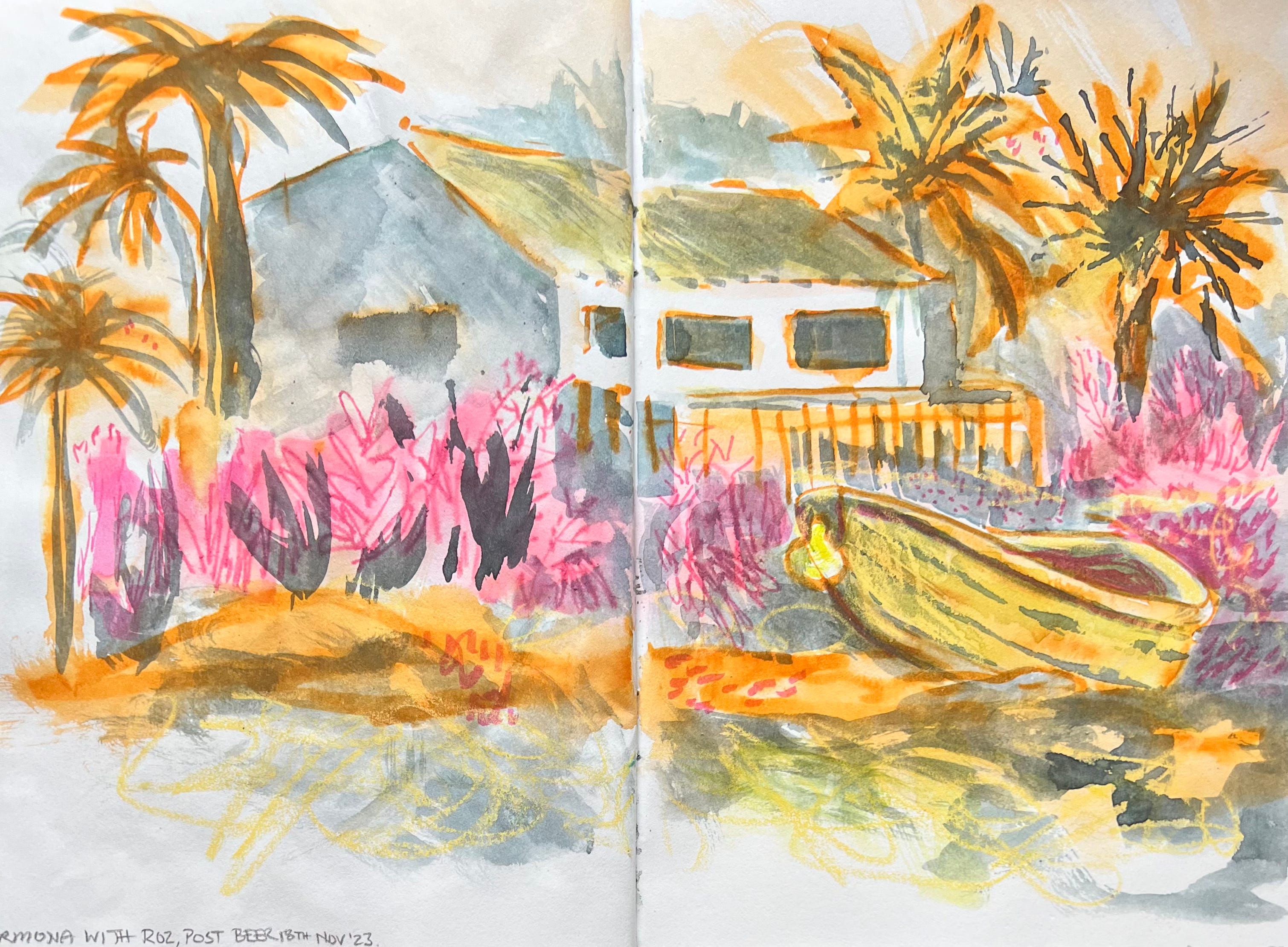
You can see why sitting on a beautiful beach painting this on the island of Armona in Portugal can be argued for!
Mindfulness and Presence
Why are we drawn to being present? Could it be because the awareness of the body knows innately that being present is good for it?
We know scientifically that people who regularly encounter awe and acknowledge it have certain advantages.
But I got to thinking about what the present moment actually is? There is some literature about what a moment is. How small is it? One idea is that a moment is under six seconds, after which memory and prediction come into the picture.
How deep is it? Does mindfulness give depth to a moment.
What is time anyway? (time is a human construction a space time modality, actually, it doesn’t exist but that is another book – see Deepak Chopra’s outpourings amongst others!).
And what actually is presence?
An experienced moment happens now, for a short extended moment but mental presence encloses a sequence of such moments for the representation of a unified experience of presence. Whereas the experienced moment forms an elementary unit, a temporally unified percept, mental presence involves the experience of a perceiving and feeling agent (“my self”) within a window of extended presence, a phenomenon that is based on working memory function.
“Working memory provides a temporal bridge between events – both those that are internally generated and environmentally presented – thereby conferring a sense of unity and continuity to conscious experience” (Goldman-Rakic, 1997).
My favourite two authors (not academic because so much more relatable!) on presence are Eckhart Tolle and Michael Singer. I read and reread these books (see links) and try to live the ideas there.
Maybe I can think of it this way: Archiving an event
This was a little sketch from Faro – I spent an hour sitting on a bench, fully enjoying the sun, smells, taste and sounds of the market on the marina whilst making this.
If a moment is nebulous in terms of definition then are we talking about an event? Am I archiving an event rather than being present? What is an event made up of? An event has a preparation, and moment, and a memory but can also be made up of smaller moments of consciousness or awareness, which add up to a sense of being present.
How is drawing like yoga?
Honestly I don’t draw or paint in a headstand or the tree pose – that’s not what I mean!
So, recording a feeling of interconnectedness through a medium of art materials is like experiencing the interconnection between my body and mind to something which is greater than me when practising yoga or meditation. In a physical sense, I place my awareness in my body when practising yoga and sense the interconnectedness of, for example, the breath and the position of the body, of which part of me is relaxed and which part of me is tense. When drawing outside I have pockets of attention like this, both of the inside of me (interoception) and outside of me in my (perceived) external environment.
Sometimes this interconnected quality of being feels very profound. I am connected to everything, everything is my ecology. The word ‘yoga’ comes from ‘yuj’ which means ‘union’. The mindful presence of being still and receptive in drawing is like the true meaning of yoga. A connection to my ecology which of course is THE ecology.
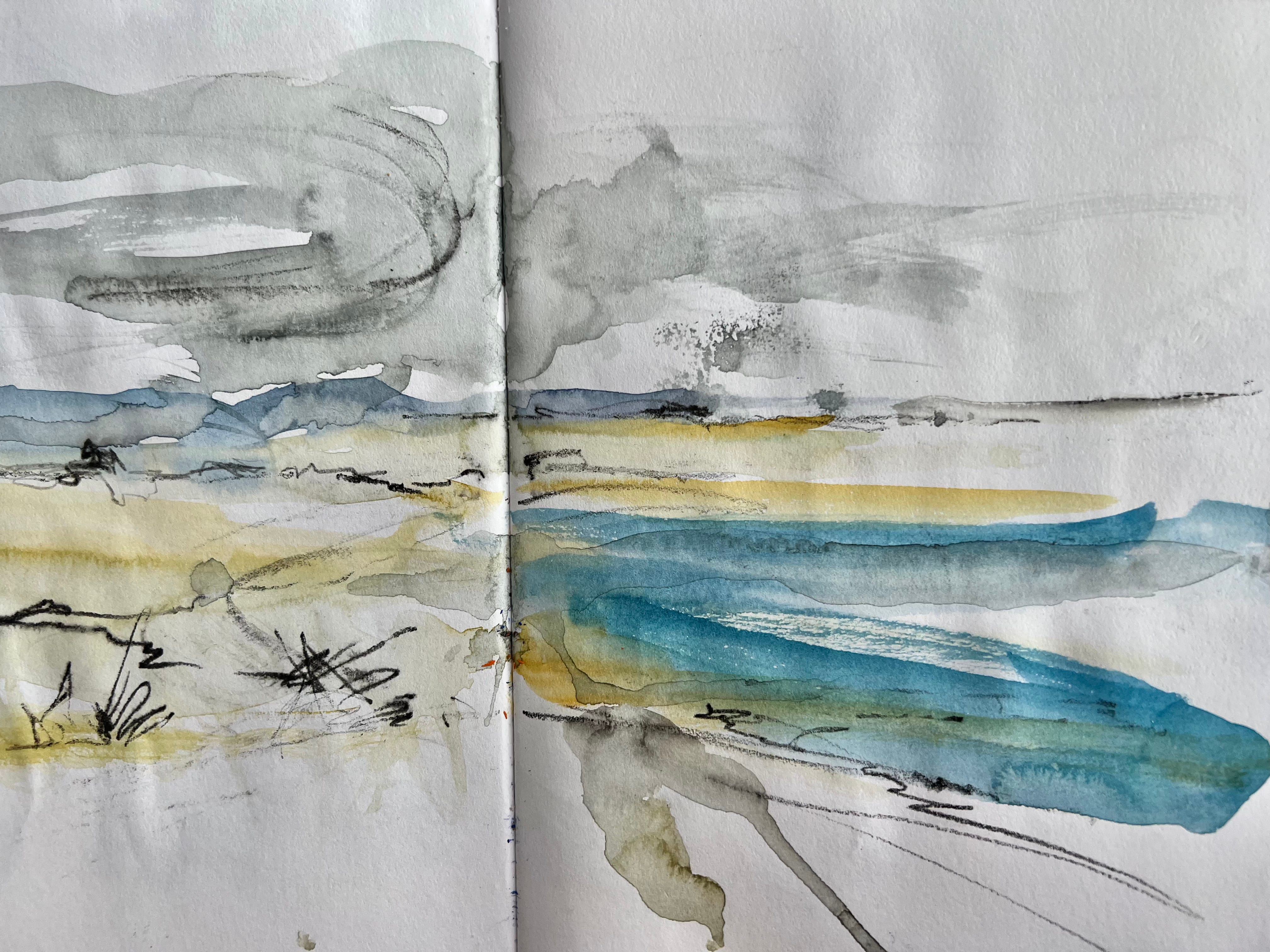
Drawing the beach – sensing the perceptions of my outer environment, sensing the perceptions of experimenting with materials and sensing my internal state. It’s what meditation is, it’s what yoga is.
Why do I sometimes feel the need to capture a past event from a photo?
Is it because I wanted to re-capture, relive, recover that sense of awe? I can mention here two examples. The first is a drawing made in Portugal of the experience of walking on the salt flats at Olhão which was about experiencing the sense of the light rather than that of form. The sense of the light was having an awe-inspiring affect on my body.
I used a photo to remind me of the awesome experience of light in the salt flats but the painting is not at all purely representational.
The other example is the drawing made about the feeling of interconnectedness when swimming in the river at Dolanog. This went on to become a resolved painting. I will talk about that in another post. It was profound for me.
Drawing and flow state
How can drawing become an entry point into flow? Because drawing can be a form of voluntary play and play is an intentional portal into flow – more on this in another Substack too!
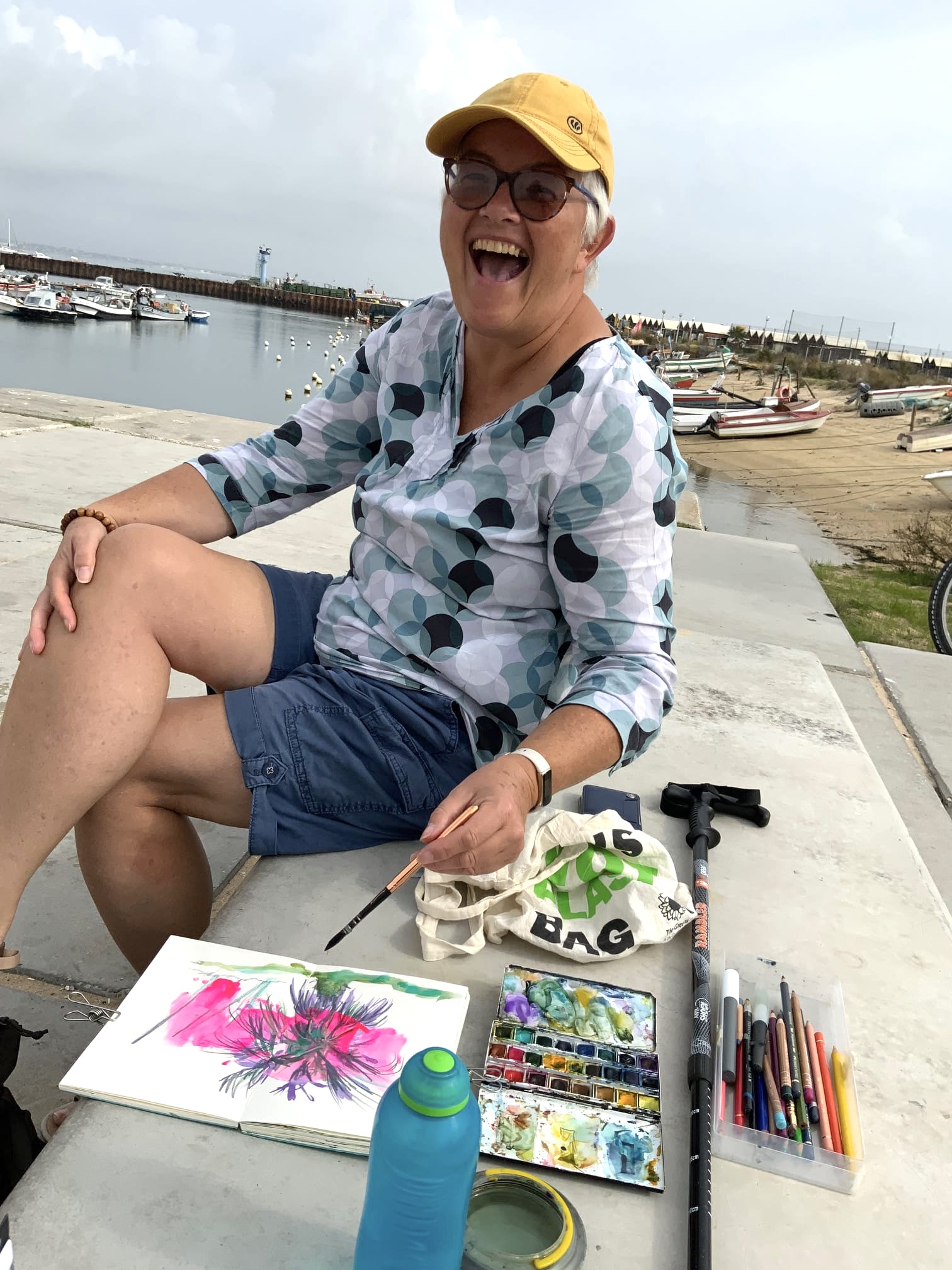
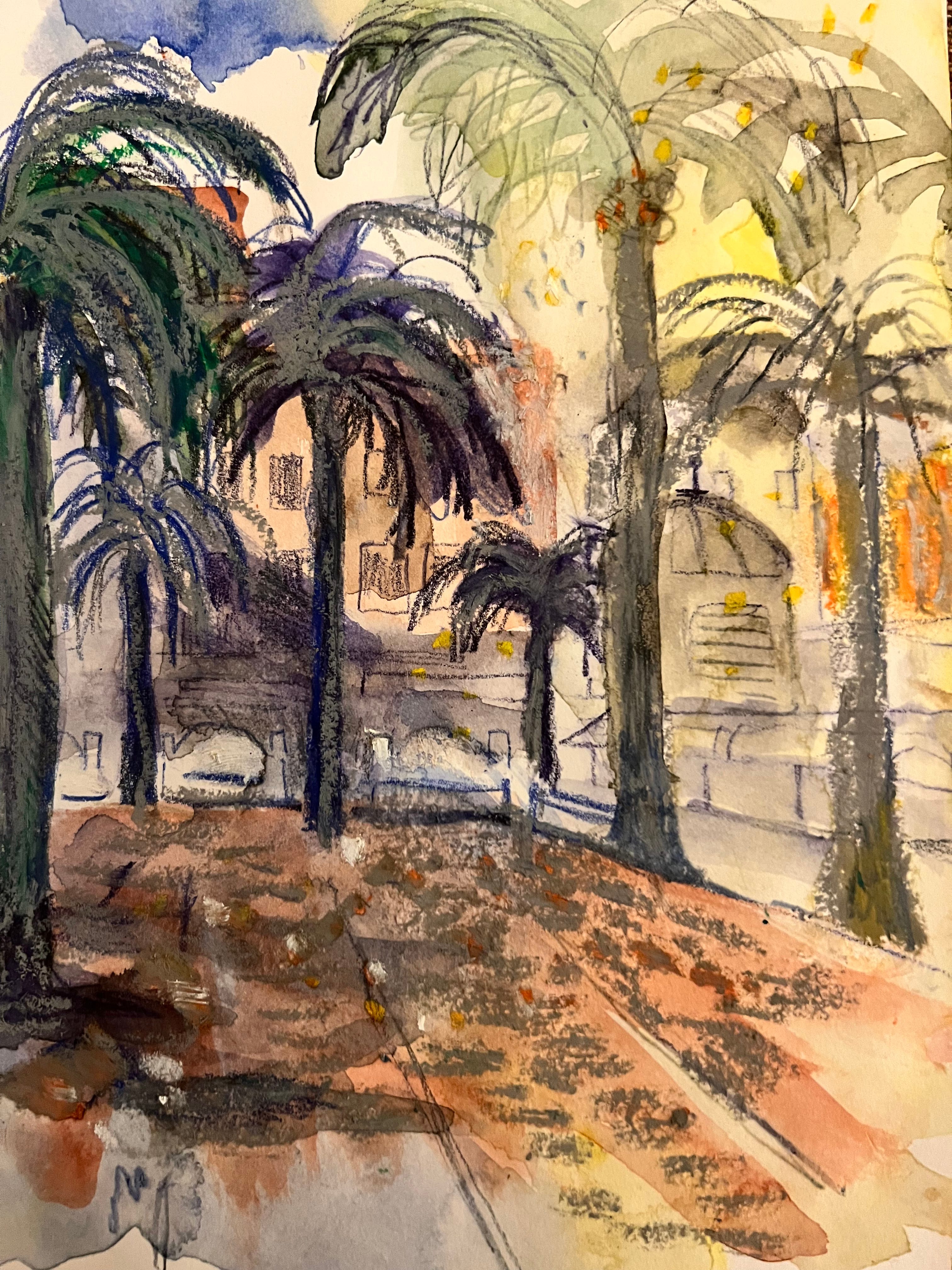
Sketching on an autumnal, orange ripening day in Ayamonte over the border in Spain.
If all of this has become too cerebral, how about this, as a more person to person connection arising from drawing outside last week:
Drawing and people connections
In around 2016 I met Mary Price (of Artist in the Shed on Instagram) on an art workshop in Brighton, tutored by the Australian artist Tracey Verdugo when she was on a world tour. Mary was sitting next to me during the weekend and over a Saturday night curry we made ourselves into friends, but only had an online friendship subsequently over the years, until just last year when we found ourselves in Olhǎo, Portugal at the same time. We spent a couple of happy days then out sketching together and drinking vinho verde of course!
This year she was to be in Olhǎo again at the same time as us. We organised more time to be spent out with sketchbooks and the day before we met up she had by chance encountered, in a cafe, another artist, Roz Beaver, who was travelling light around Portugal with her art materials. Over the next week or two we all bonded through drawing together, talking about art making, connections, and sharing life stories. We united through being in our true happy places, each of us connecting with our environment through drawing and painting in a deep and present way. We will remain friends wherever we are in the world through this true commonality and unity.
Roz, me and Mary – connected
So…
Is it too much to wonder if drawing can be an act of resistance against disconnection and a political act to create unity and peace through presence, mindfulness and interconnectivity?
follow me on Substack : long form writing, no ads, no attention seeking reels! Link: CLARE WASSERMANN
Some refs:
Taussig, Michael (2011), I Swear I Saw This: Drawings in Fieldwork Notebooks, Namely my own, Chicago: University of Chicago Press
Berger, John (2007), John Berger: Life Drawing, Ed. J. Savage, London: Occasional Press.
Let me know if you want the other citations – I need to go and have a custard cream now.
Firstly here are some artists I have found particularly inspirational with regard to sketchbooks. Following this are some suggestions for you to ponder as you use your sketchbook.
Inspirational Artists and their Sketchbooks
Kurt Jackson is a British artist who has been using sketchbooks for decades. He uses them to capture the natural beauty of the British Isles, and his work often features nature-inspired elements. He believes that sketchbooks can be used to create works of art that are both beautiful and meaningful. Jackson has said that sketchbooks are a great way for him to document his travels and explore his creative ideas. Jackson’s sketchbooks are vital to the development and completion of his paintings. The pages of his sketchbooks reveal how the hastily executed images can help him to work out what he wants to achieve on canvas, or simply capture a spontaneous image when there is not enough time to paint or draw properly. Insights into his domestic and professional life − not necessarily revealed in his exhibited works − abound from his continual routine of making drawings, marks, notes, poems and scribbles.
Grayson Perry is an artist who has garnered worldwide renown for his unique artwork and his use of sketchbooks to create it. Perry’s sketchbooks are filled with creative drawings, sketches, and ideas that have become the basis for many of his works. Perry uses his sketchbooks to capture his creative process and provide an insight into his thought process. He has said that he finds the practice of sketching and sketchbooking to be incredibly helpful in developing his ideas. Perry’s sketchbooks are full of vibrant images and playful doodles that reflect his unique style and creative vision. Bringing together his favourites for the first time and showing some of the finished works that result from these initial drawings, one result is a rich, beautiful book ‘Sketchbooks’, in print, perfect for those who want to know more about the artist’s creative process.
Grayson Perry
Anthony Gormley is a British sculptor and installation artist who has gained worldwide recognition for his unique and thought-provoking works. Gormley often uses his sketchbooks to explore new techniques and new materials, and to develop his ideas for future sculptures. His tiny passport sized Muji sketchbooks are filled with drawings of his sculptures in progress, as well as detailed notes and diagrams. He also uses his sketchbooks to document his travels and his interactions with other artists. Through his sketchbooks, Gormley is able to capture his creative process and the evolution of his works. His sketchbooks provide an insight into his creative journey and his artistic vision. The long glass cabinets filled with these books on view at his exhibition at the Royal Academy in London in 2019 certainly inspired me. Some examples can be found here and here.
Maya Lin is an American artist and designer who is best known for her iconic Vietnam War Memorial in Washington DC. Lin is also an avid sketchbook artist, using her sketchbooks as a form of creative expression and to document her ideas. She often uses her sketchbooks to explore her own creative process and to work out the details of her artwork. Lin uses her sketchbooks to capture her creative journey and to explore her own creative potential. Her sketchbooks are filled with drawings, sketches, and notes that capture her creative process, as well as her travels and experiences. By using her sketchbooks to document her creative journey, Lin has created some of the most iconic works of our time. Some of her work is in her book ‘Boundaries’.
Frida Kahlo is a renowned Mexican artist known for her vibrant self-portraits and her unique style of painting. Kahlo’s art was deeply personal and often explored her own identity and her Mexican heritage. In addition to her painting, Kahlo was also a prolific user of sketchbooks, some of which are in print in The Diary of Frida Kahlo
Frida’s journal
Baljinder Kaur is an artist and illustrator based in Wolverhampton, UK. Her sketchbooks provide a unique insight into her creative process and her thoughts on art, life, and the everyday. Her sketchbooks are filled with drawings, sketches, and notes that capture her creative journey, travels and her interactions with the world around her notably through explorations of Sikhism. Kaur often uses her sketchbooks to explore new techniques and materials, and to develop her ideas for future book illustrations – take a look here, and here is her wonderful Instagram account – do look at her children’s books.
How we can all benefit from a Sketchbook Practice
Sketchbooks are an essential tool for any artist, offering a convenient and portable workspace for creating, experimenting, and planning. Whether you’re a professional artist or a hobbyist, sketchbooks provide a great outlet for your creativity and help you explore a variety of techniques. Here are 10 different ways that artists use sketchbooks to their advantage:
Drawing: Sketchbooks are an ideal platform for making quick sketches and getting your ideas down on paper. Many artists use sketchbooks to draw out their concepts, designs, and ideas before starting work on a larger piece.
Painting: Just like drawing, sketchbooks allow artists to experiment with colour, composition, and other elements of painting. Most artists use sketchbooks to practice their painting techniques, or to make small paintings before tackling a larger project.
Inspiration: Many artists use their sketchbooks as a source of inspiration, filling the pages with images, quotes, and other things that spark their creativity.
Research: Researching new techniques and sources of inspiration is important for any artist. Sketchbooks provide a great way to collect images, ideas, and other research material in one place.
Illustration: Artist often use sketchbooks to illustrate stories, create comic strips, or even design entire books.
Collage: Sketchbooks can also be used as a canvas for creating interesting collages with a variety of materials.
Journaling: Journaling is a great way to document your creative journey and track your progress. Sketchbooks make it easy to keep a record of your thoughts and ideas.
Planning: Sketchbooks are a great place to plan out future projects. Artists can use sketchbooks to sketch out their ideas and plan out the steps they need to take to complete their projects.
Brainstorming: Sketchbooks provide a great platform for brainstorming and coming up with new ideas.
Reflection: Artists often use their sketchbooks as a place to reflect on past projects and take note of what worked and what didn’t. This helps them to grow as artists and become better at what they do.
From traditional drawing and painting to more experimental techniques, sketchbooks offer a great way for artists to explore their creativity. For any artist, having a sketchbook handy is essential. Using sketchbooks as a creative outlet is a great way for artists to express themselves and improve their artistic skills. They provide an easy and convenient way for artists to experiment with different techniques and materials, and to document their creative journey. With a sketchbook, artists can create unique works of art, record their ideas and explore their creative potential.
My own sketchbooks are part of a daily art practice
They are a repository for collected ephemera, a diary, a planning space and a portable studio for experiments, drawing practice, colour trials and lots of collage. I keep quite a lot of visual records now digitally, but nothing can beat the tactile experience of a nice fat and messy sketchbook! My sketchbook is my discipline and sometimes my obsession. I spend from 10 minutes to several hours a day most days in it.
Here’s a page from my cycling experience along the Llangollen canal in North Wales last week. I have been using the images to begin some larger paintings this week.
Viaducts and Aqueducts pageA large painting as a work in progress February 2023 in the studio – one of a series
I’m giving a talk about Sketchbook use, mine and others, on 7th September 2023 in Swindon near Wombourne, Staffordshire UK, in the afternoon, for Wolverhampton Creative Embroiderers. If you are interested do contact me. This will be followed by a workshop the following week.
Inspiration for you
This Library Has 46,681 SKETCHBOOKS!
This project, housed in Brooklyn, New York and founded in 2006, has now ended but I have seen this and also participated in it. You can find about it here. It’s also reproduced in its entirety digitally. What a resource!
And finally a workshop for you for free?
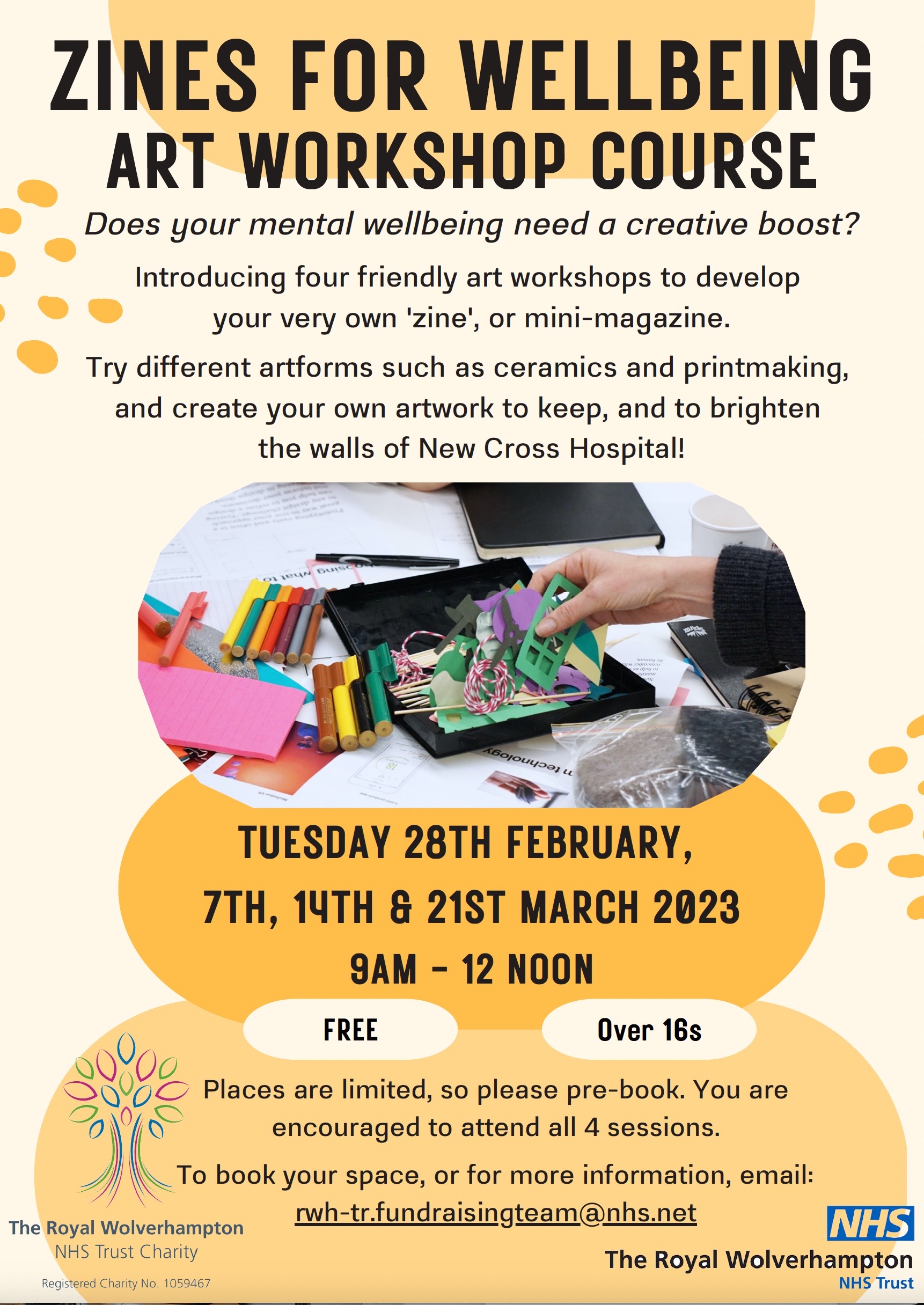
My date is March 14th 2023 from 9-12am, where we will combine fun self portraits, positivity, relaxation and letting go of what no longer serves us well. The venue is Wolverhampton Art Gallery. Please email rah-tr.fundraisingteam@nhs.net to book – not me!
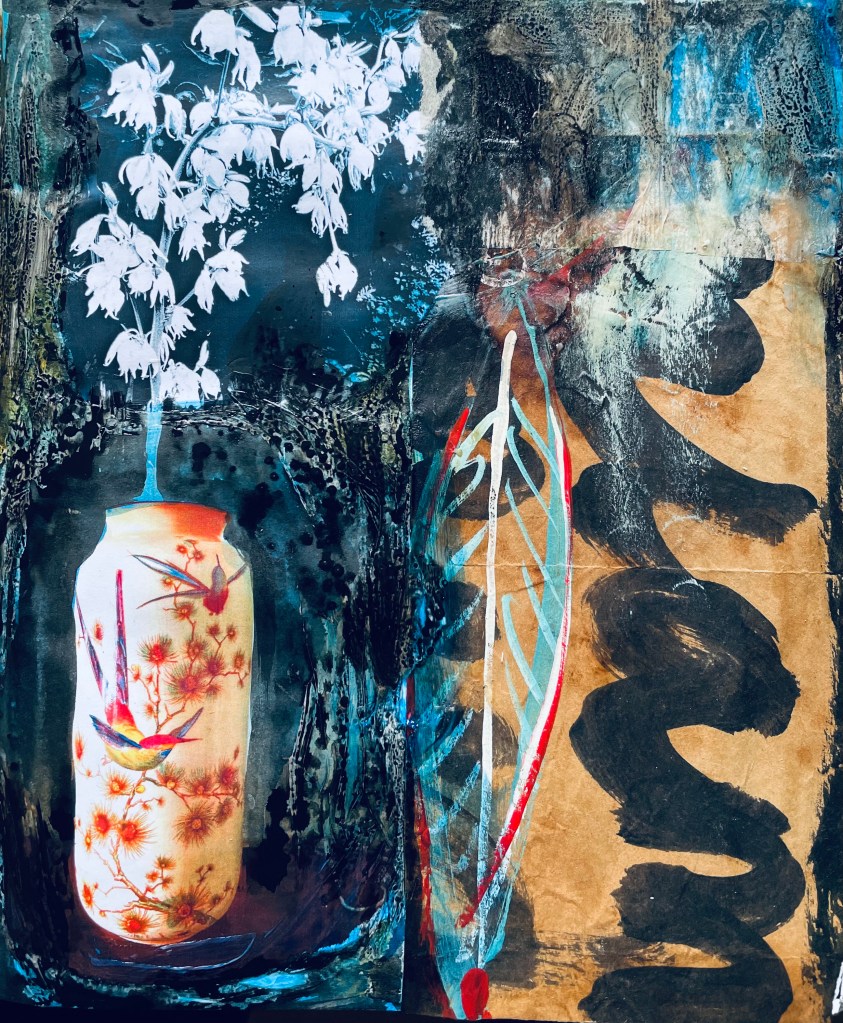
I’ve been pondering recently about imaginal thinking and how it can shape change. It involves, for me, more often than not, taking two or more seemingly unrelated images, putting them together and creating meaning from them. An act of ‘wondering and wandering’.
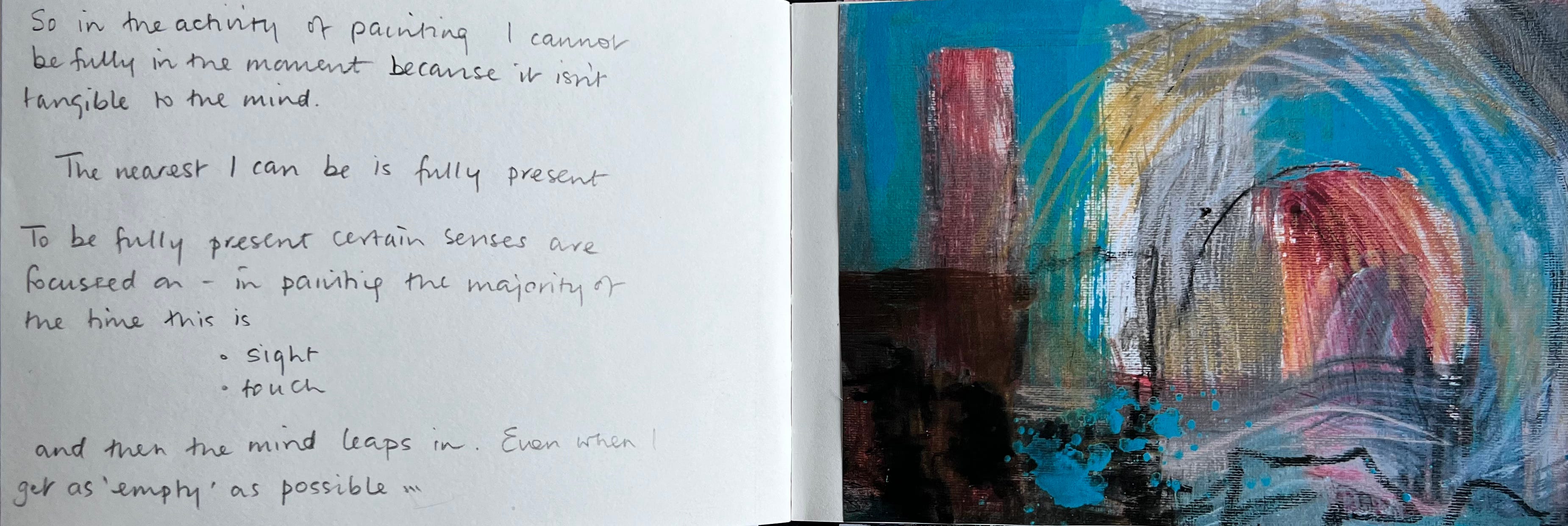
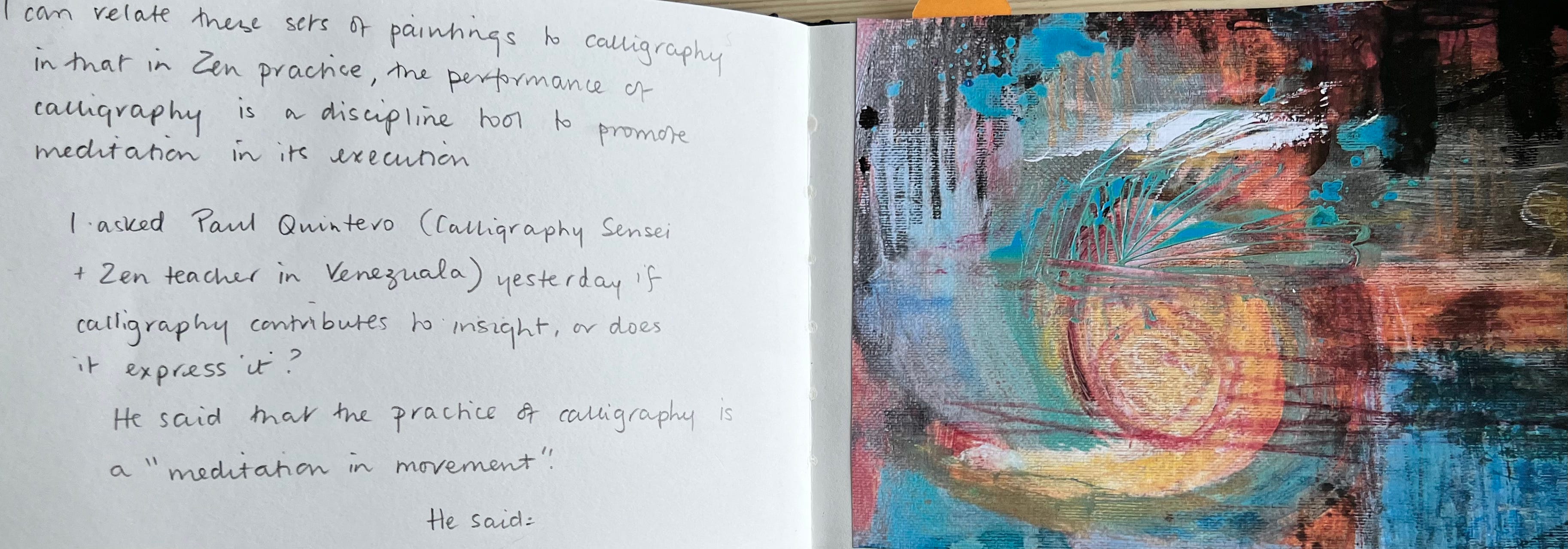
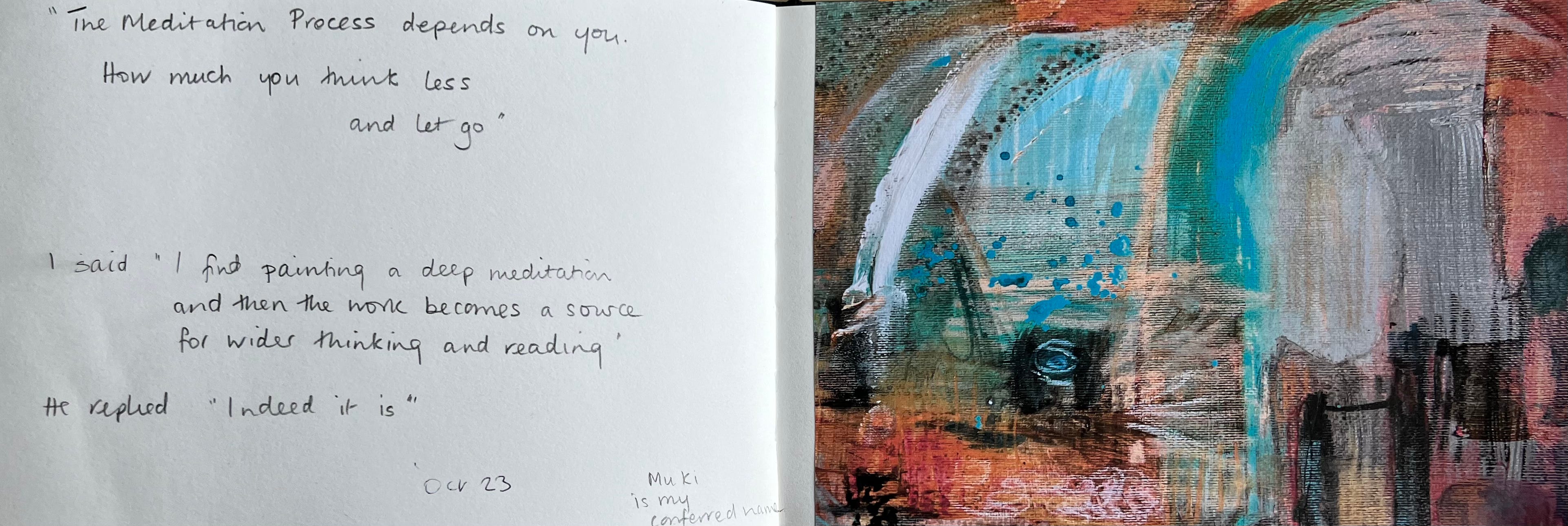
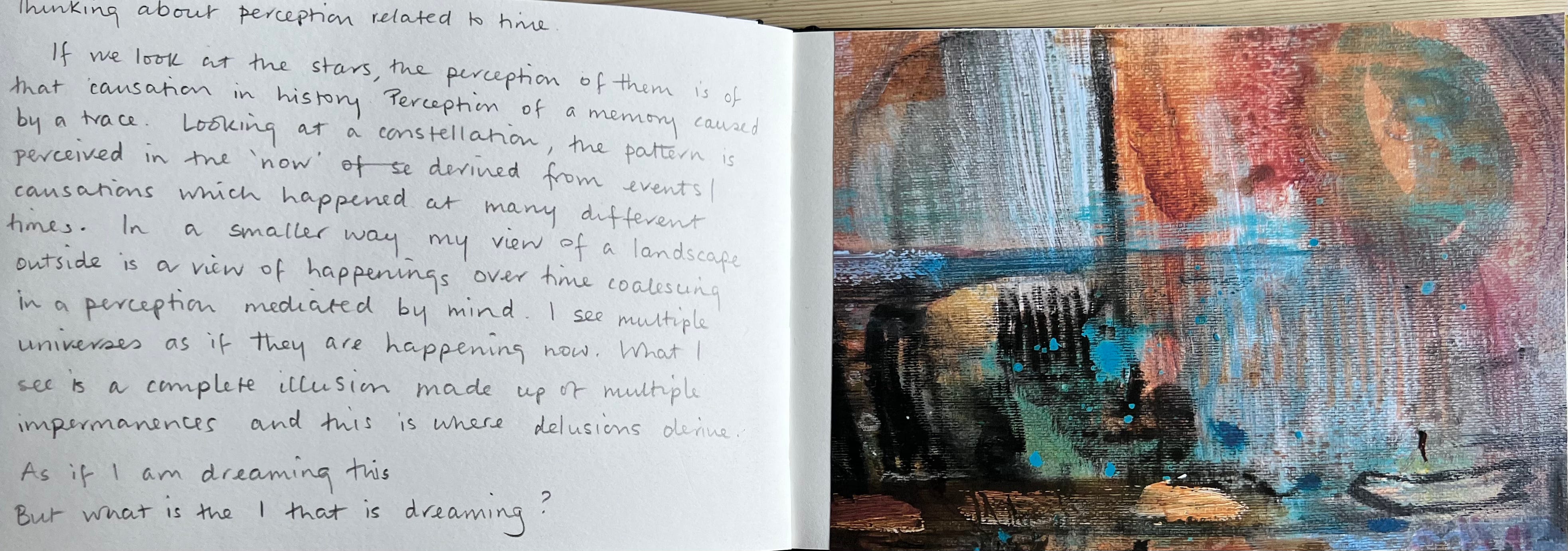
I work a lot this way in my notebooks / sketchbooks. From the semi-intuitively produced image comes larger thinking and access to parts of my consciousness that may be dormant – the subconscious or unconscious and makes it iterative and conscious.
Practice with materials leads to and becomes part of the exploration. Wider aesthetic thinking occurs (something we in the West have largely lost) which leads to thought and words. Afterwards I might write or just ponder as I garden or cook or do the daily tasks. Sometimes there is a notion of an imprinting in the body (embodiment), the book is closed and other life is resumed. Closure….for now.
Here are a few examples from the past week:
and here is a way of going:
Deconstruct / re-construct. Something we need to think about. Transformative thinking comes in here. When there is space after the deconstruction.
You can read a little more about the story of the images on my Instagram here.
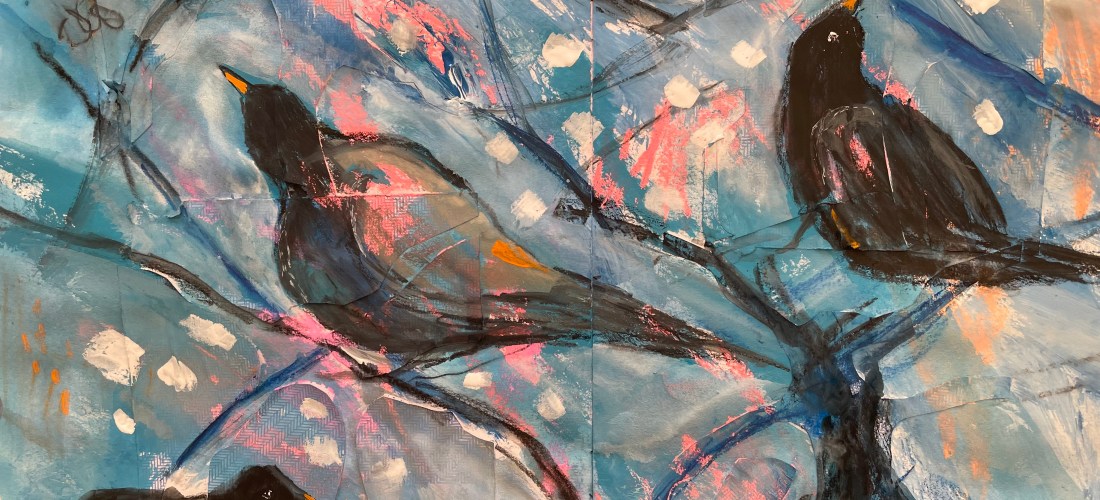
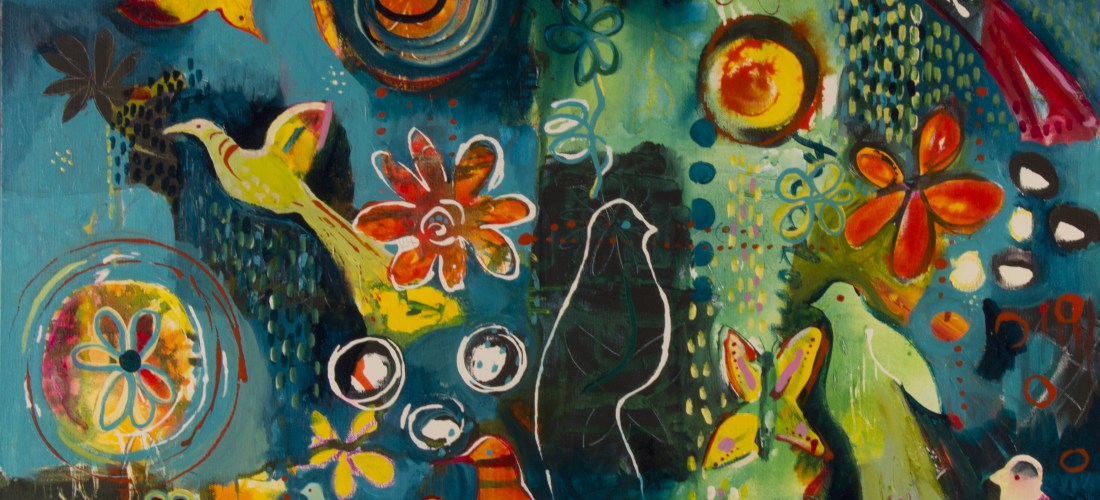
Anyone who knows me will not be surprised when I say how much I like birds. They appear in many of my paintings.
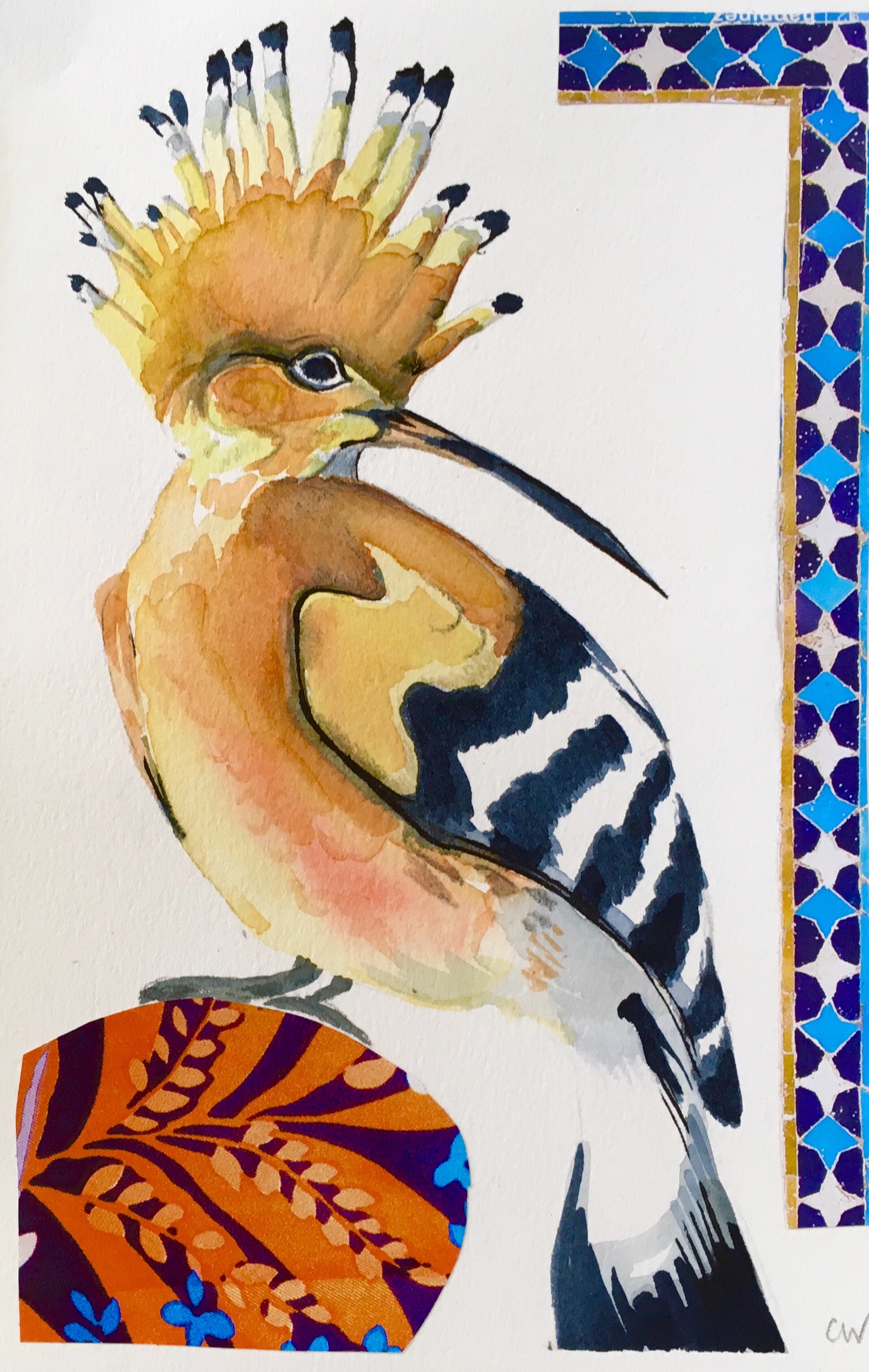
One of my favourite, apart from the dove, is the hoopoe. He is sometimes to be seen in southern areas of the UK but they proliferate here in Saudi Arabia. Very shy, they run between the trees scuttling from view if they sense you.
However if you have patience and sit still they come quite close.
Today’s collage is mostly water colour with just a little decorative collage because I had plenty of time. Is he sitting on a giant patterned egg? I wonder what bird of paradise would hatch from this?
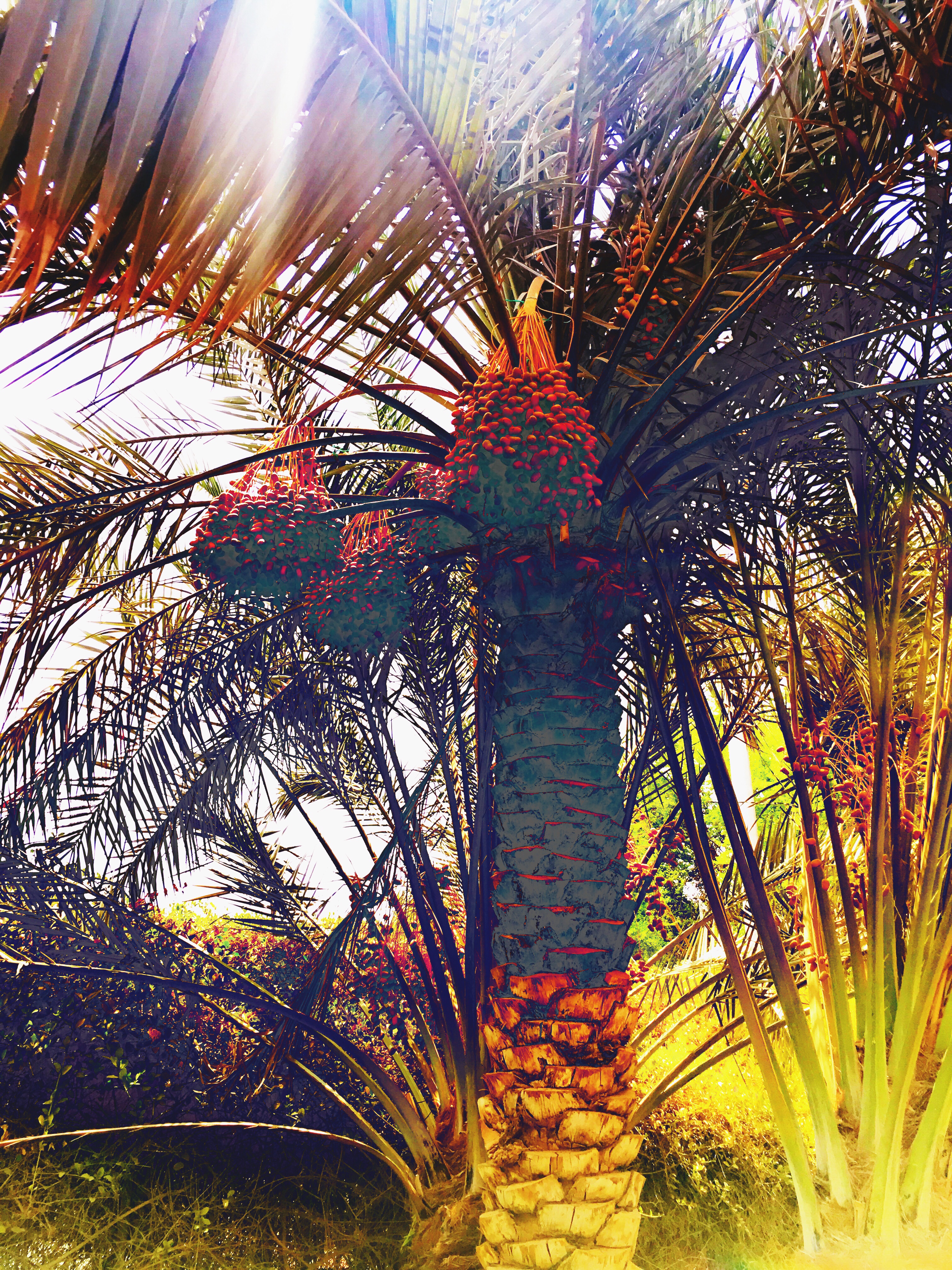
Meanwhile I’m enjoying the shade of palm trees and the air con in the 43 degree heat.
If you would like to join in please tag #collageaday2018 on Instagram or Facebook. I can’t comment (on Insta from here) but I can see your posts. I can comment on Facebook. Restrictions!
If you don’t know me already this is a little about me and the year that has nearly finished. It’s been a whirlwind, very busy but very happy-making!!
Clare Wassermann lives and works in Wolverhampton. Originally gaining an honours degree in Music with Education, then teaching and playing saxophone and clarinet in London and Nottingham, she re-qualified as a Registered Homeopath and returned to Wolverhampton in 2001. For fourteen years she happily combined teaching and homeopathy but then her artwork suddenly began to take off.
“I have always enjoyed painting, drawing and stitching since childhood, encouraged by my father who was a long-standing member of Wolverhampton Society of Artists, but suddenly my work really began to sell in 2014”
She had started to paint larger paintings which were very vibrant and uplifting and buyers were inspired by their optimistic and health giving properties. “I love the idea of layer upon layer in paint, memories and experience. Some paintings have ten or even twenty layers built up and most are in response to my meditation and yoga practice. All are a pure celebration of my external and internal landscape. Juxtaposition of edges and colour combinations excite me.
I use recurring symbols, meaningful to me and sometimes words in my layers, building up and letting go of images as I work.
Sometimes I work in fabric and stitch for even more texture.
I use my intuition, as far as possible, to take me on the journey towards a final balance point. This art practice becomes a metaphor for life”.
In January 2016, after a successful exhibition, she took the plunge and rented a studio at Newhampton Arts Centre, Wolverhampton and since then things have moved apace.
An American Author, Kathy Walsh, admired her work on Instagram and asked her if she would illustrate her next children’s book. “I looked at her previous books on Amazon and saw that she was writing with an aim to promote peace and mindfulness for children”, Clare commented, “so I decided to accept this opportunity and embrace a new genre for me”.
The first two books, “Today An Elephant I Will Be” and “My Mindfulness ABC” are now available and I’m working on the third which will be out in the early part of next year. Kathy and she are planning some events in the U.S.A. next year.
Another unexpected development has been teaching art workshops in the studio space. I work with small groups to open up creative ideas and build confidence in expression in paint and mixed media. Artists who are experiencing block and adults who feel that they would like to paint creatively but lack confidence have all enjoyed these unusual and enjoyable days.
I certainly am enjoying the longer days of Summer despite the enormous amount of rain that we have experienced here in the UK. But the upside of that is that everything is very lush and green around where I live. The garden is romping away and the weeds are growing, as usual twice as fast as everything else!
It’s been a busy two months. My ‘creativity in paint workshops’ have taken off – all the sketchbook, 12″ canvas and 30″ canvas ones have filled up here in Wolverhampton, so I am shortly going to release some more dates on the Workshops page of this website. However I am taking to the road in October and doing some teaching in Cornwall (October 26th in Mylor Bridge, near Truro and October 27th at Threemilestone, also near Truro).
It’s all about expressing yourself in paint in sketchbooks and on paper – beginners and more experienced are very welcome.
Connect and Unite – Sketchbook 2016
Exhibitions
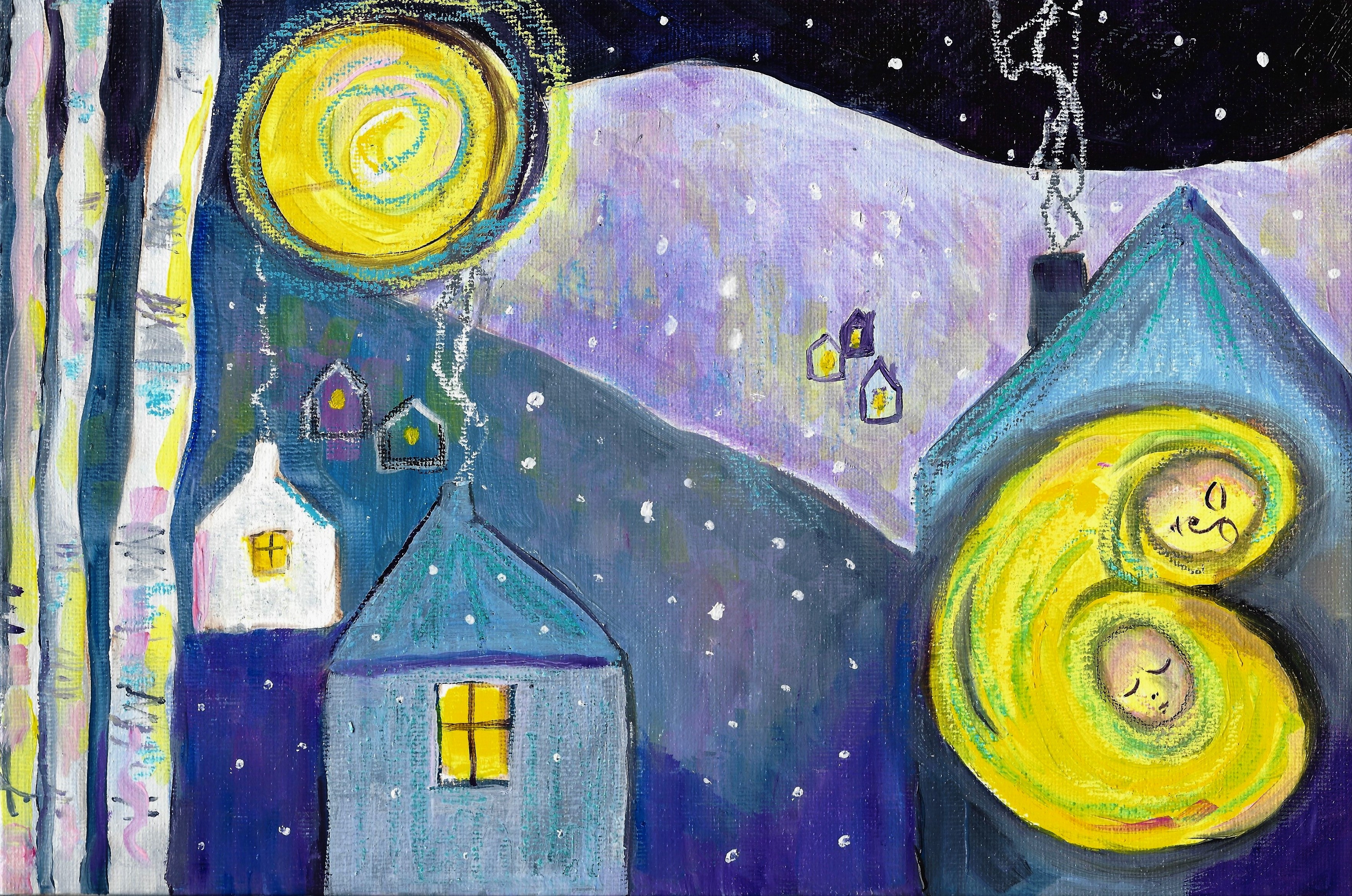
Crazy mad summer time – the season for art to come out of the closet it seems. I am lucky to be selected for exhibition currently in Derby Museum and Art Gallery, Wolverhampton Art Gallery, Asylum Gallery Wolverhampton and I’ve just been astounded to find myself in the Macynlleth Open at MOMA Wales from July 9th – September 1st with a small oil painting entitled ” At My Side My Cradled Infant Slumbers Peacefully” taken from a line from a poem by Samuel Taylor Coleridge. A great honour to be part of this.
“At My Side My Cradled Infant Slumbers Peacefully” Oil on Canvas 8″x 12″
“Gentle Rain” Acrylic on box canvas 30″ x 30″
Pintar Rapido
We had our own Pintar Rapido here in Wolverhampton last weekend which was a great community event. We called it Paint The Day – 70 members of the public got their paper and canvases stamped and rushed into the very changeable weather to paint scenes in the local area of Whitmore Reans in Inner City Wolverhampton. We returned our work by 5pm and overnight some elves hung the exhibition.
It’s still up until next Saturday (July 9th) at Newhampton Arts Centre for the public to see at midday for two hours during the week and all day Saturday until the closing in the evening. All work is for sale and there is an auction on Saturday of remaining pieces. Proceeds go to keep this lovely Arts Centre open as the funding has all been removed by the Council due to continuing austerity measures. Do go and support everyone if you can – there’s some lovely children’s work.
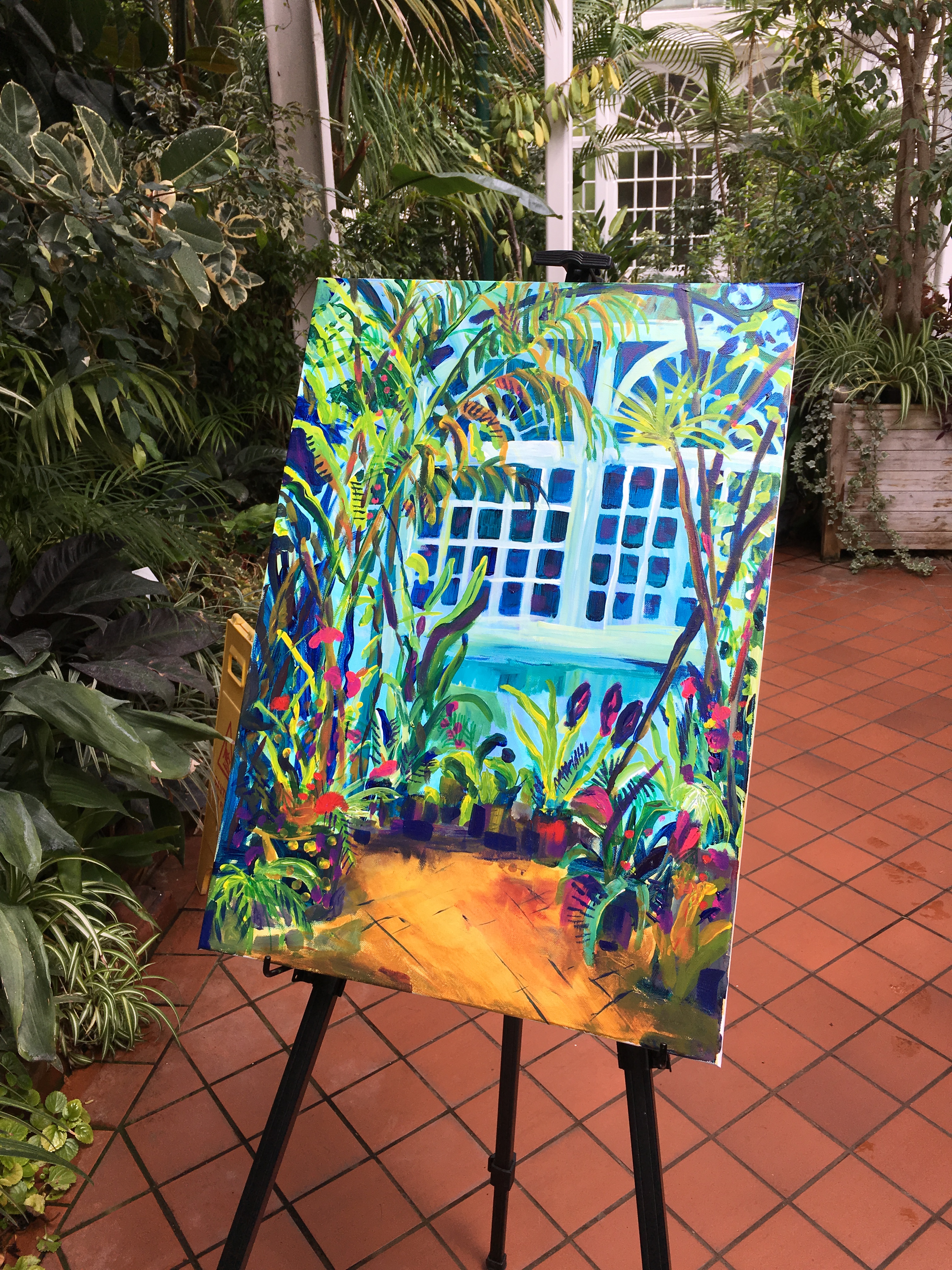
partially worked painting in West Park Conservatory
Finally to mention I am part of a lovely exhibition at Tettenhall Wood Institute which is of a wonderfully diverse and contemporary spread of work by Wolverhampton Embroiderers’ Guild. Open 10-4 July 9th and 10th
One of the beauties of keeping a sketchbook for painting in, I find, is not necessarily making notes and thumbnails for future work, but simply to feel an emotion into. This is what I try to teach on some of my workshops.
The sketchbook is a freeing and liberating place sometimes, without the importance of a full sized painting.
This week I attended a funeral for a colleague who’s life was cut short before she was even 40 years old. There are no words for this. It was useful for me to express the inexpressible. Both art and music do this for me.
A Pleasure Trip
Yesterday I went to Saltaire, Yorkshire to visit the open houses there which have displays and sales of art in them from artists of the area. The houses in themselves are treat to visit, built as they were originally as dwellings for workers in the mill belonging to Titus Salt. There was some excellent art to be seen – it’s all open again today if you can manage the trip.
Salt’s Mill itself is now an amazing building with galleries, shops and a huge amount of work by David Hockney. It was fabulous to stand so close to paintings such as this which are all in a shop which is filled with art books and materials – heaven!
This is Salt’s Mill – huge! What’s more it has the most glorious kitchenware shop!
Workshops
See the workshops page above – I have opened a couple of new dates for Creative Sketchbooks workshops – click here for information as to what’s available – they are proving very popular.
Exhibitions
Two coming up soon
Wolverhampton Open Studios – my studio at Newhampton Arts Centre, Dunkley St., Wolverhampton WV1 4AN is open on June 25-26th 2016 from 10am – 3pm.
Lots of other houses and studios are open that weekend.
Bantock House and Park, Wolverhampton July 23rd – Sept 4th 2016 with a theme of “Birds”. Children’s activities and exhibition in the gallery. Street Art also by Steve Edwards.




















 Clare Wassermann Art