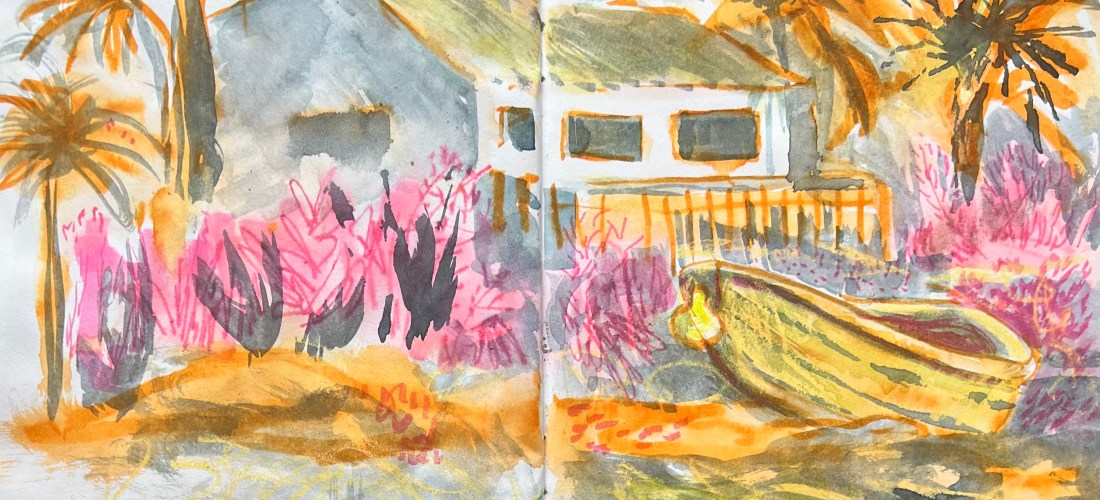
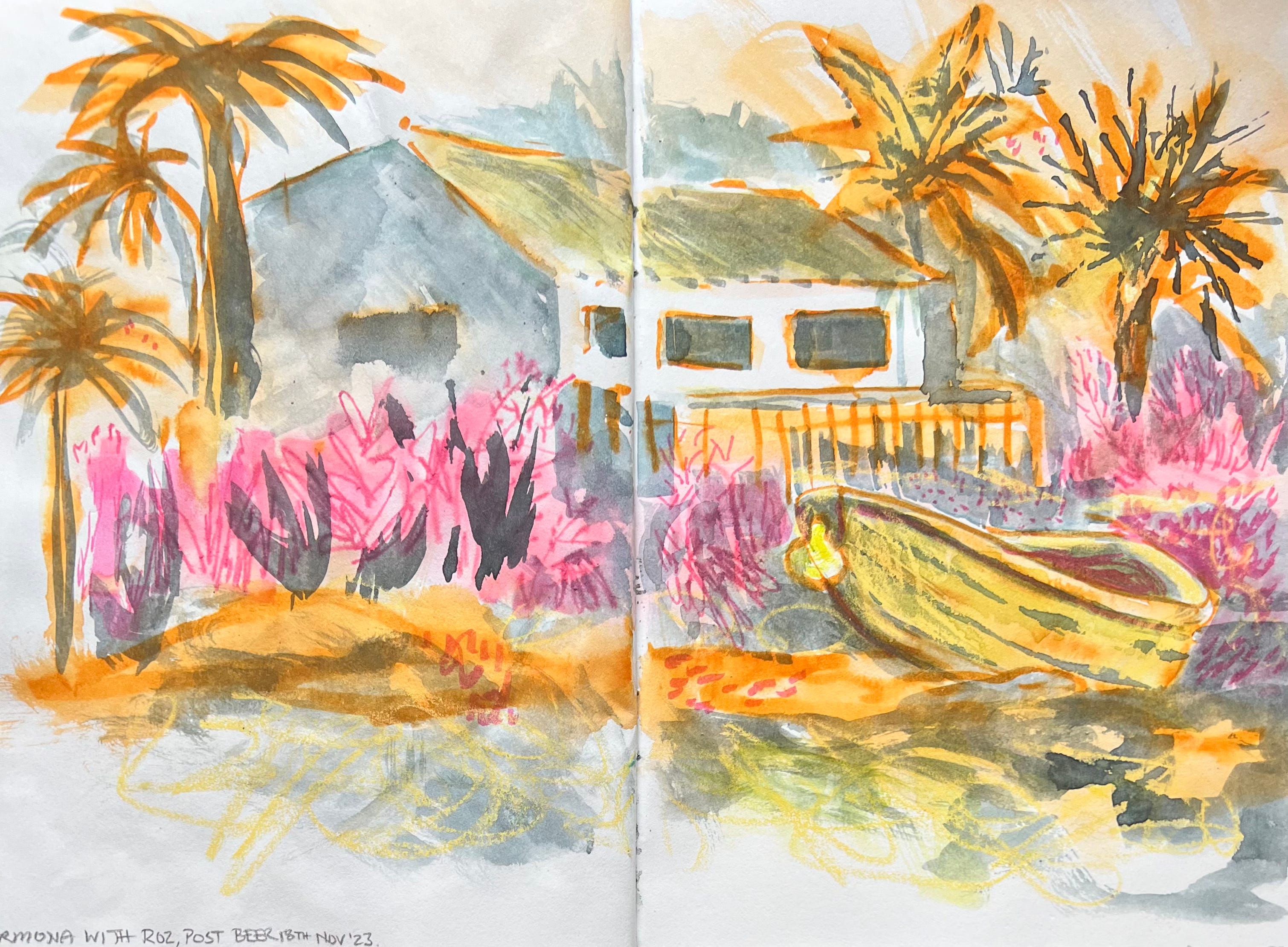
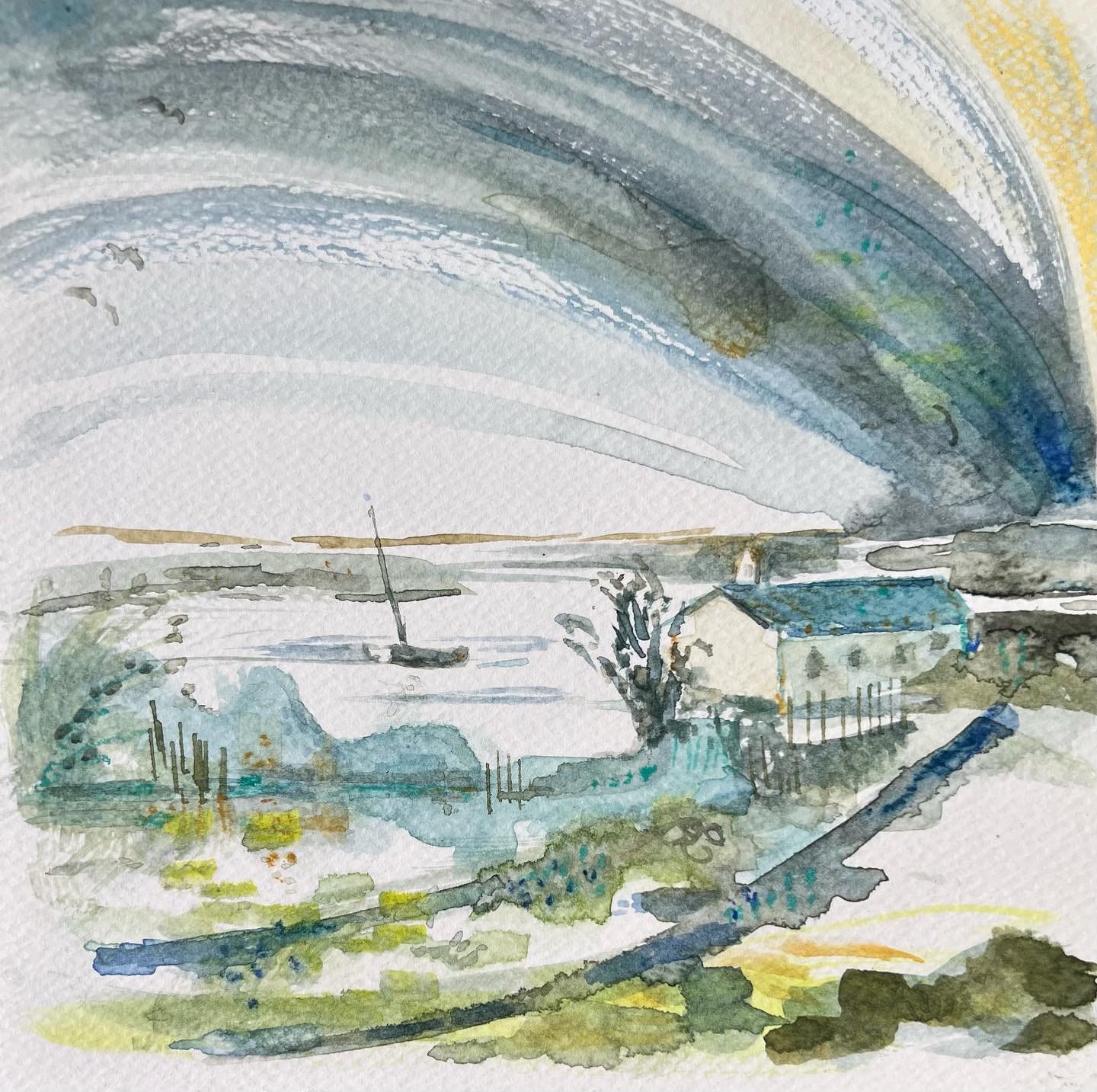
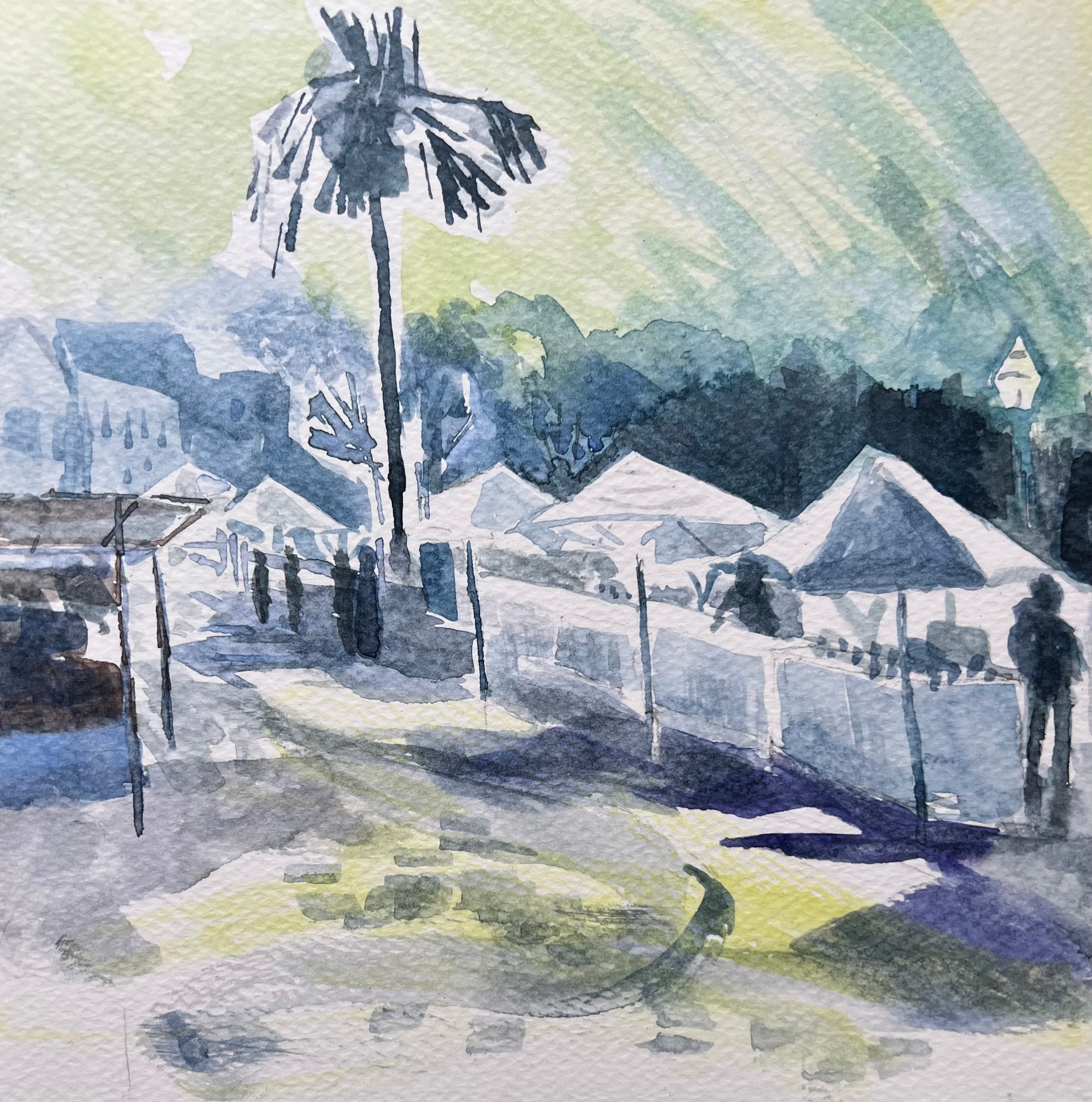
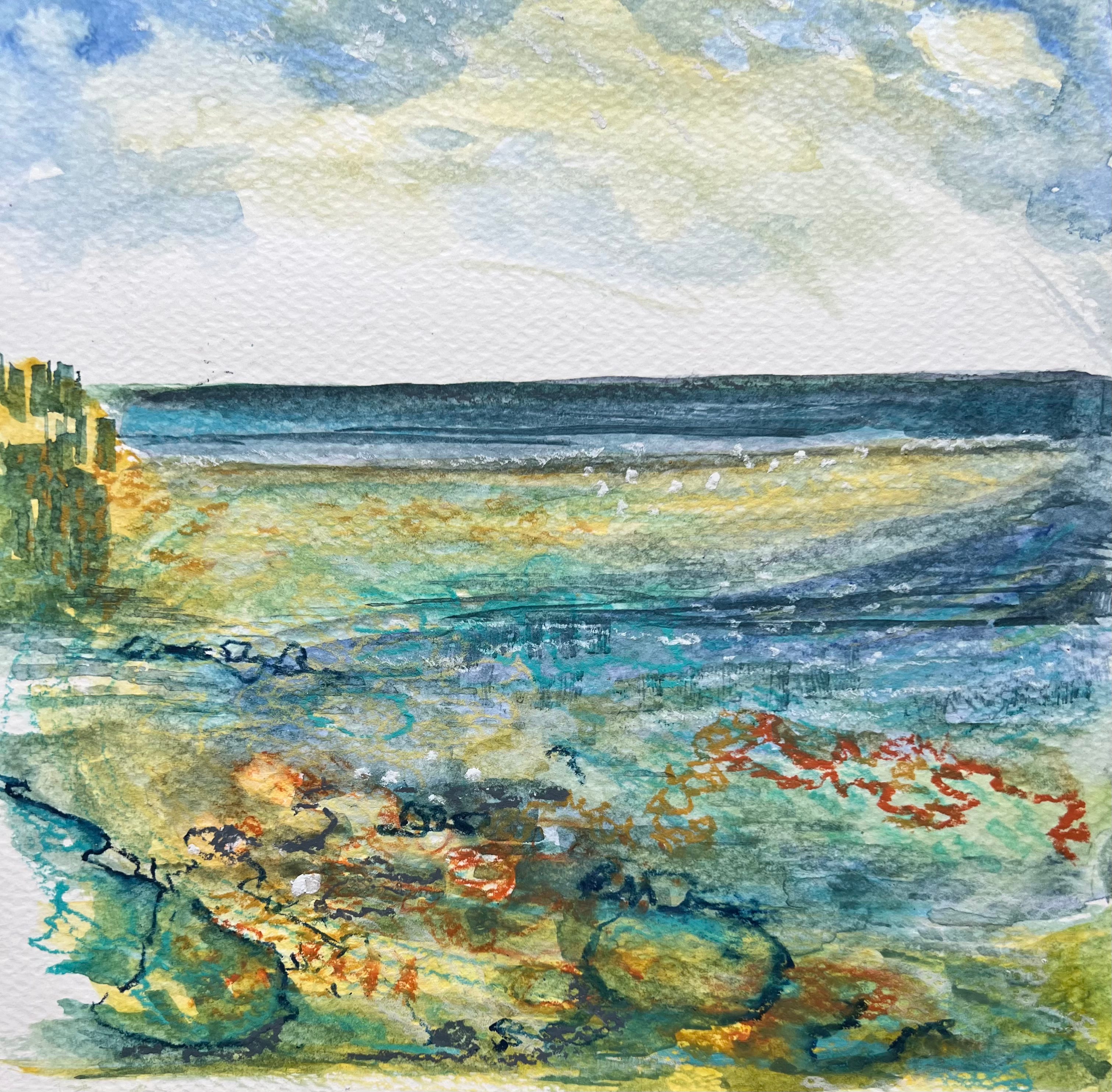
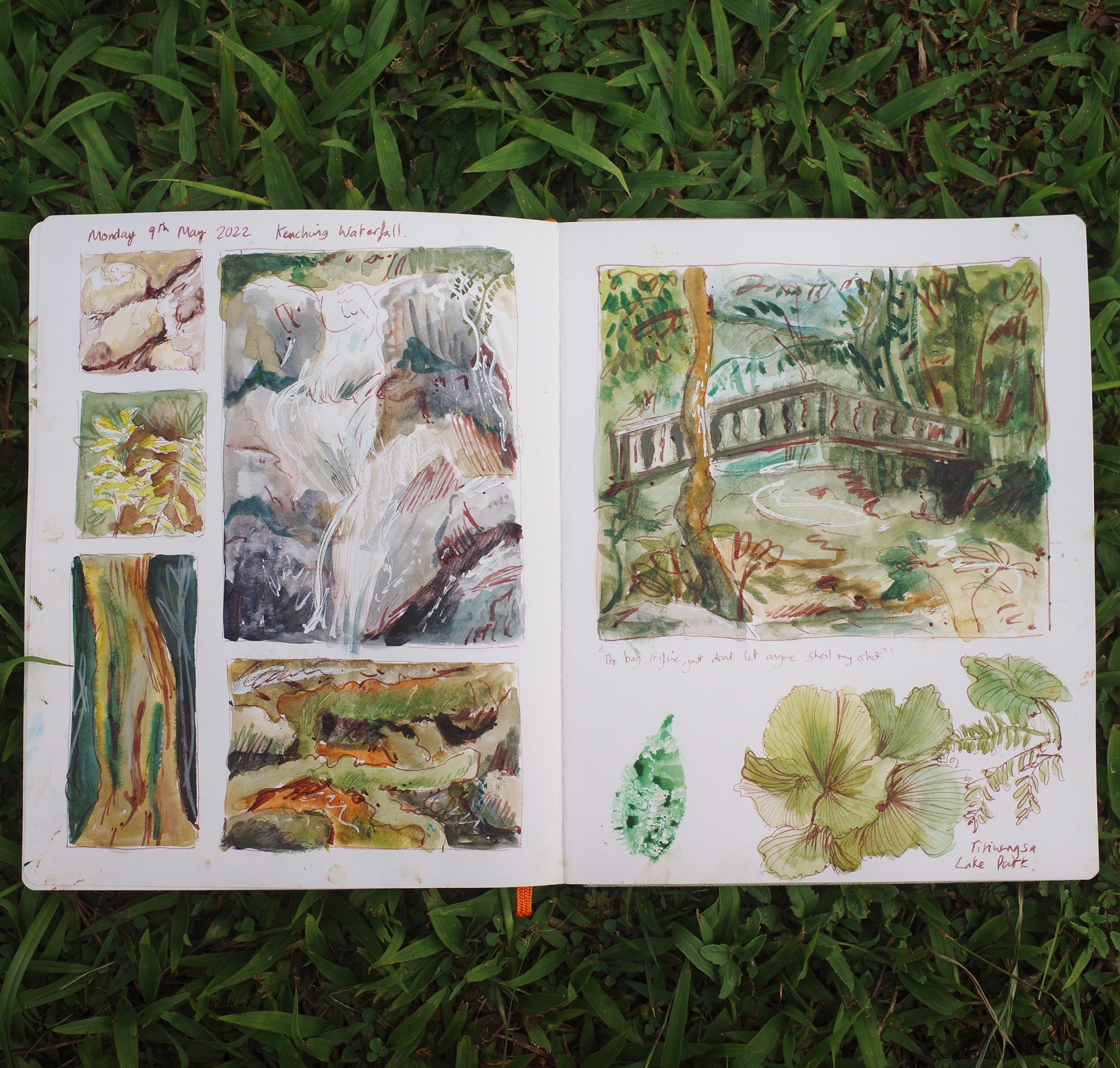
A sketchbook recently filled – vibrant markets and fishing villages in Southern Portugal.. a tiny film.
My big love is being outside in the landscape and drawing and painting. I have just returned from a lovely ‘milestone’ birthday trip to Portugal where I got to do plenty of that and, unusually for me, worked in just one sketchbook and filled it up. Would you like to see? I enjoyed the sights and smells of market days particularly and depicting these bustling, loud and mouthwatering days was my inspiration this time.
This is also my first time filming my sketchbook – so, fingers crossed!!
I spent some of the holiday drawing and painting with my good friend Mary Price and we hoked up for some of our time with another woman, Julie Sajous, a new friend found loitering with sketchbook and pens.
This common ground of drawing (followed by eating and drinking) is such a uniting factor you know! In times which seem to polarise people we need to find our tribes, connect and lift each other up!
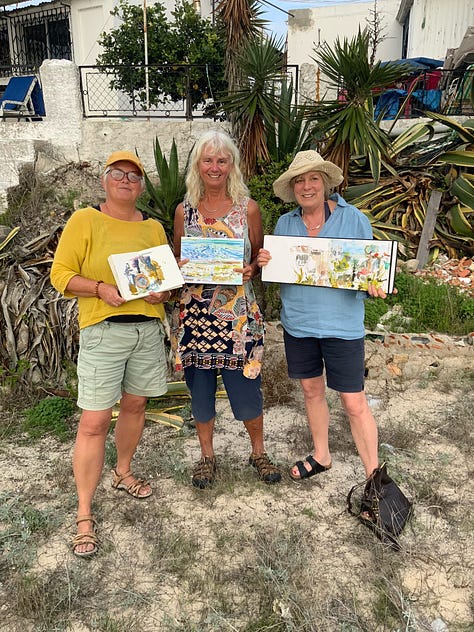
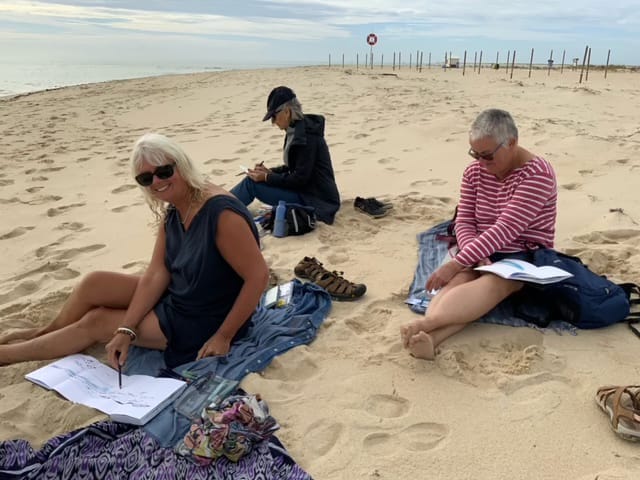
Painting alone and painting with friends – such a great way to connect with place and people. Here are me, Mary Price and Julie Sajous.
That’s me on the left looking like I might fall over backwards into a cactus!
I would love to hear how you record your travels if you do.
Do you draw or photograph and do you think there’s a big difference? Or maybe you keep a written journal? Let me know in the comments ….
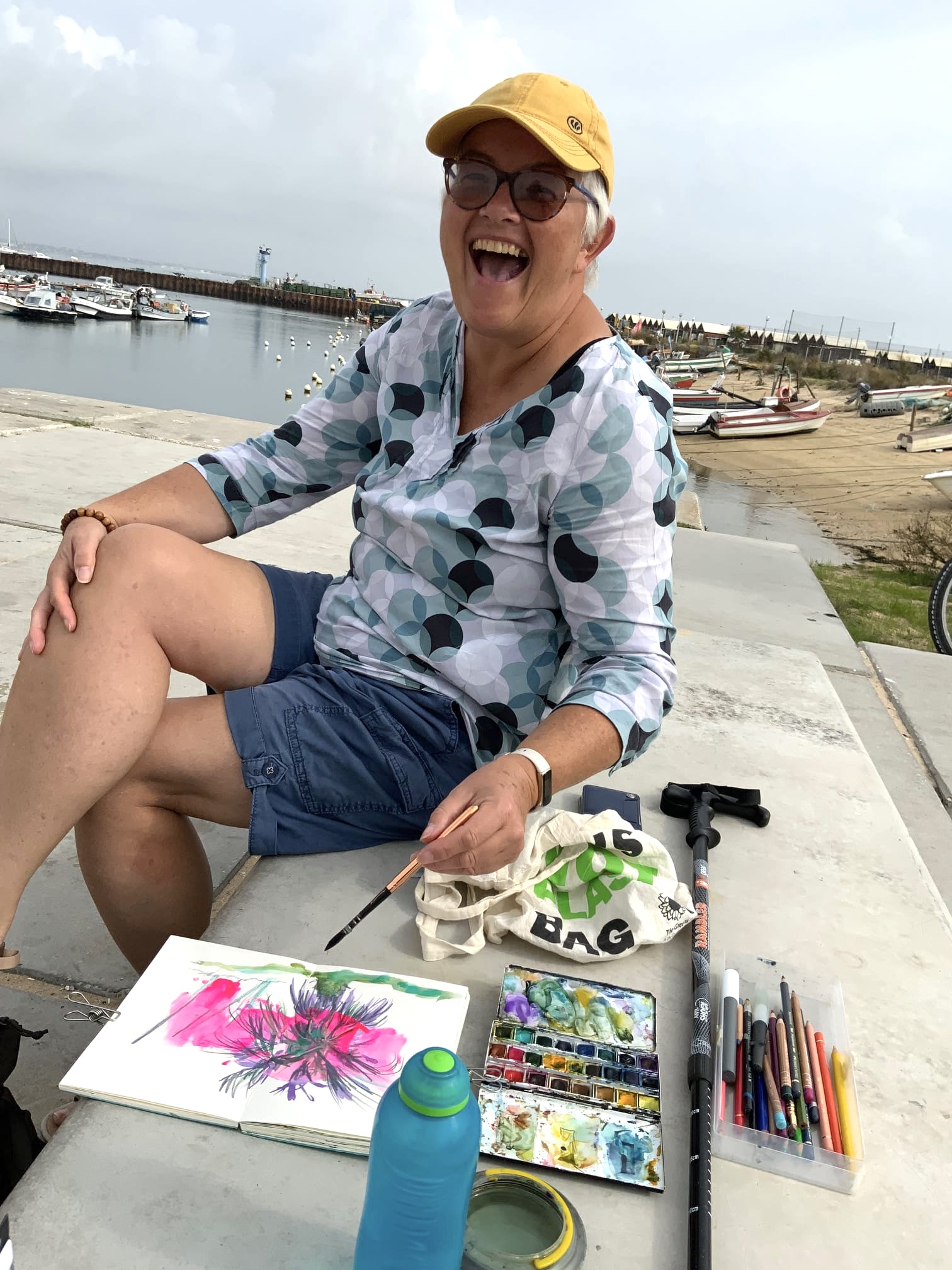
Sketchbook colour trials and a pastel da nata (very lifelike!!)
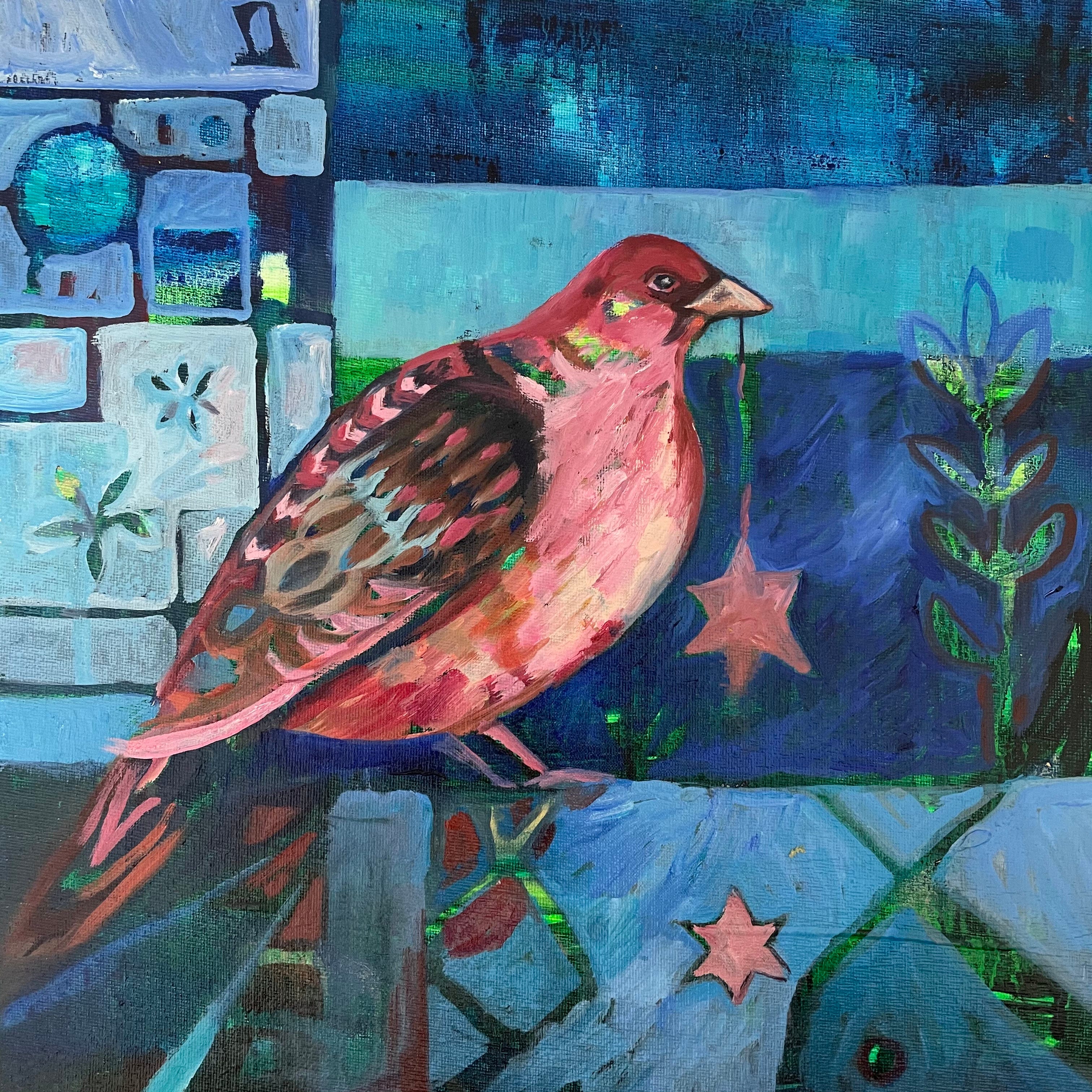
If I look at most of my paintings over the last few years they almost all feature birds. Do you remember in lockdown in 2020 how we, if we were fortunate to be able to, spent such a lot of time noticing birds in our gardens and parks, the drop in traffic noise, the stillness rarified by fear amplifying their song?
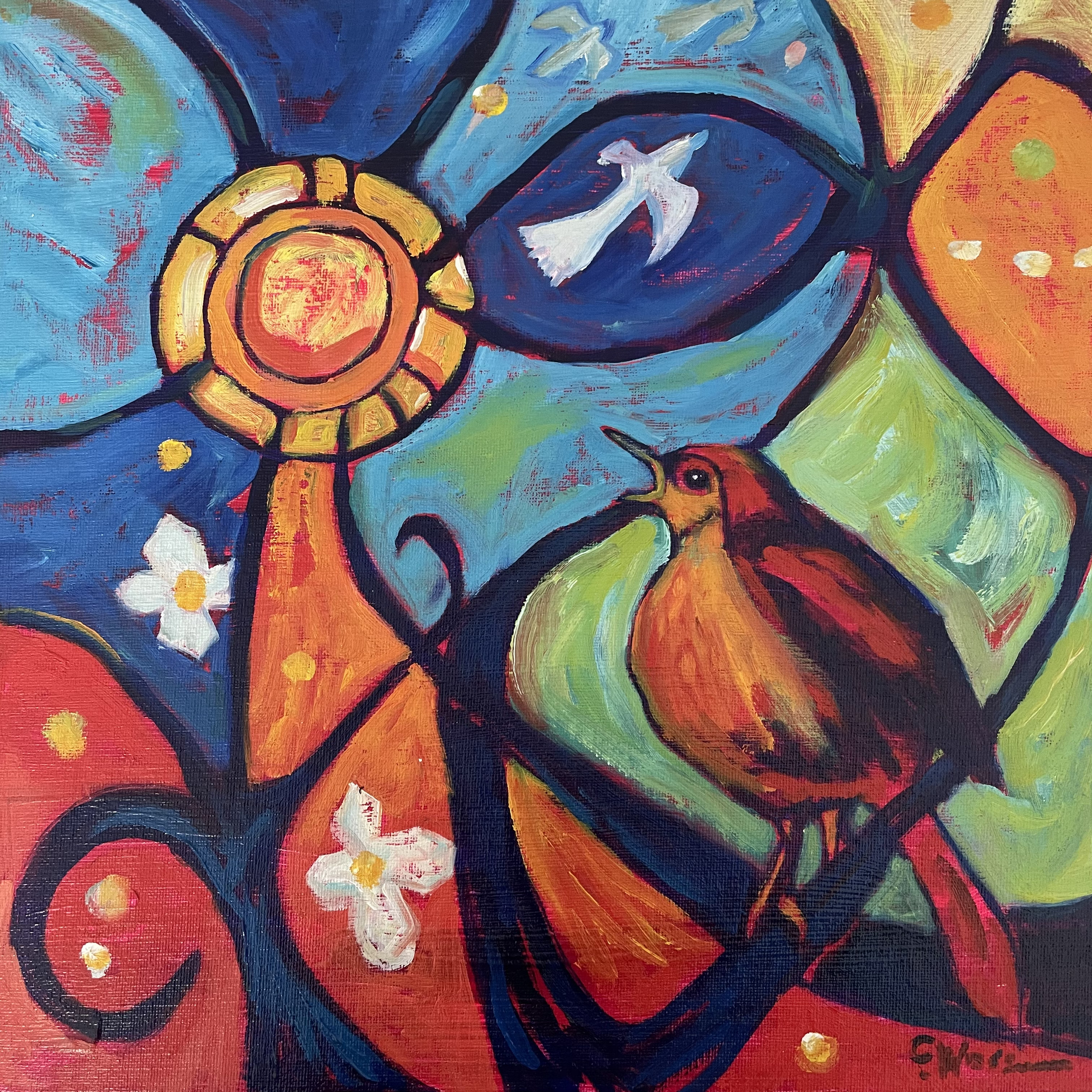
During that time I was struck by the activity in the garden of the birds and I began to paint them, almost sanctifying their presence by placing them against imaginary stained glass windows. They started to become symbolic of freedom and adaptability to me. There seemed nothing freer than a bird, able to go wherever it desired, able to adapt to the buffeting of winds and forces of nature.
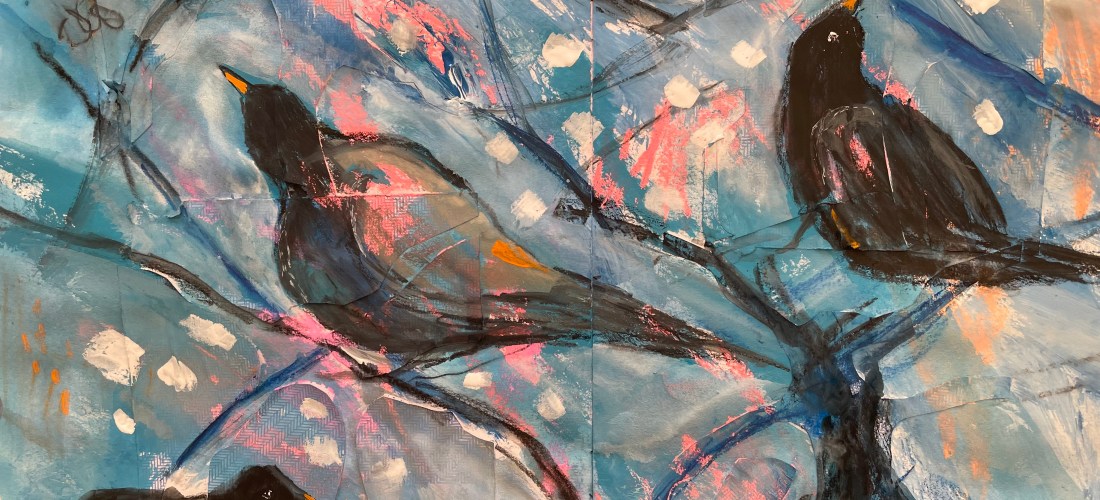
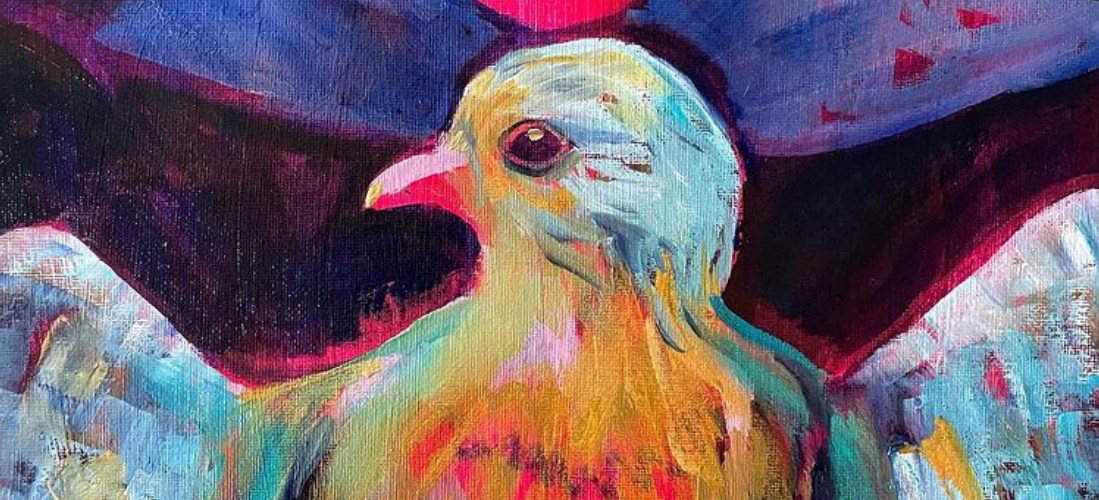
Two oil paintings made by myself during lockdown 30 x 30cm
What was the freedom I craved?
at first it was definitely a ‘freedom from…’ away from the city, the griminess of urban decay, away from domestic duty, peace from interruptions of children, family, spouse, responsibility, obligation,time constraints and room for spacious thinking time and epic landscapes.
then I seemed to move on and the symbol came to stand for ‘freedom to…’ a feeling of wanting to run for the hills, to the wild open spaces of Wales, to the mountain tops and valleys, to quiet contemplative woodlands with ancient trees where I could feel rooted and amongst the ancients.
eventually, as I worked through these challenges I realised that the freedom lay in my head all along, I didn’t need to do a geographical relocation, because I learned to manage a work life balance and prioritise those activities (and non-activities) that kept me sane. I can go into those another time but as I realised who I really was, the shift came and the symbol stood instead for ‘transcendent thinking.’ The understanding of who I am, what I am and what I am here for became my work and fulfilled many of the needs I thought I had. The hills, wide open spaces, mountains and valleys, places of contemplation and rootedness were all within.
Jung and Symbolism
Along the way I started to become interested in the work of C.G. Jung, the father of psychoanalysis (after Freud with whom I would have a difficult relationship!). Jung was particularly interested in dreams and symbols developing a process he termed active imagination.
Jung’s ideas fed into psychotherapy, art therapy, dance and music therapy all part of the panoply of psychological release available today. All the time the idea, for him, was to allow us to get in touch with our true self and find the senses of purpose that we all need.
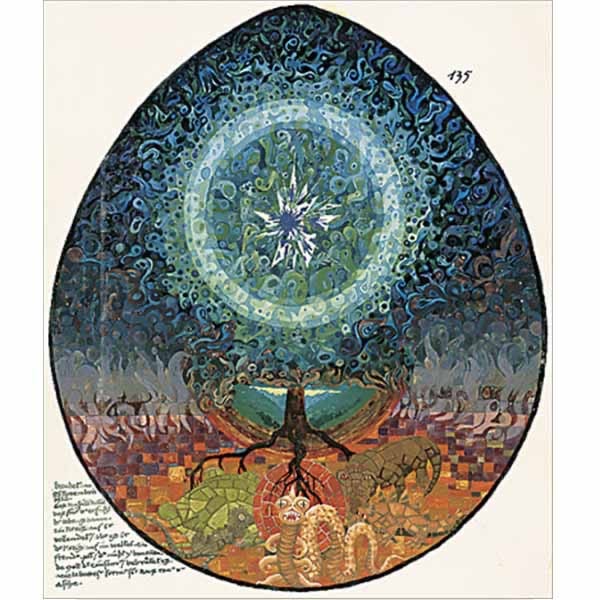
Jung himself was a mystic. He filled sketchbook after sketchbook with notes and drawings which he called the Black Books, which were eventually consolodated into the most beautiful work The Red Book, or Liber Novus which he stipulated should not be published until after his death. It is filled with astonishingly beautiful symbolic watercolours. Jung was a mystic but he kept it hidden from the scientific world for fear of being discredited in his field of psychoanalysis.
A page from Jung’s Black Books which represent his visionary imagination through writing and painting reflecting on his own life as well as the evolution of a theory of analytic psychologyThe Cosmic Egg from “The Red Book” by Jung
Jung also became fascinated by alchemy as a symbolic representation of individuation, the process of synthesis of the Self which consists mainly of the union of the unconscious and the consciousness. He said:
“Only after I had familiarised myself with alchemy did I realise that the unconscious is a process, and that the psyche is transformed or developed by the relationship of the ego to the contents of the unconscious”.
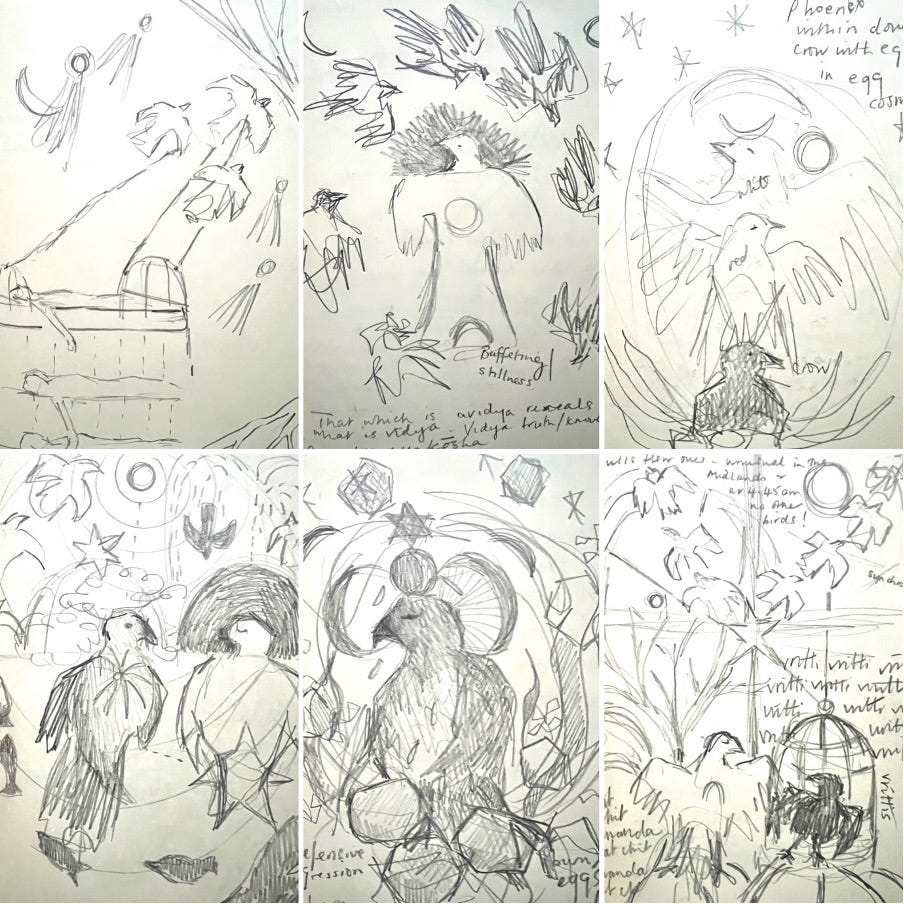
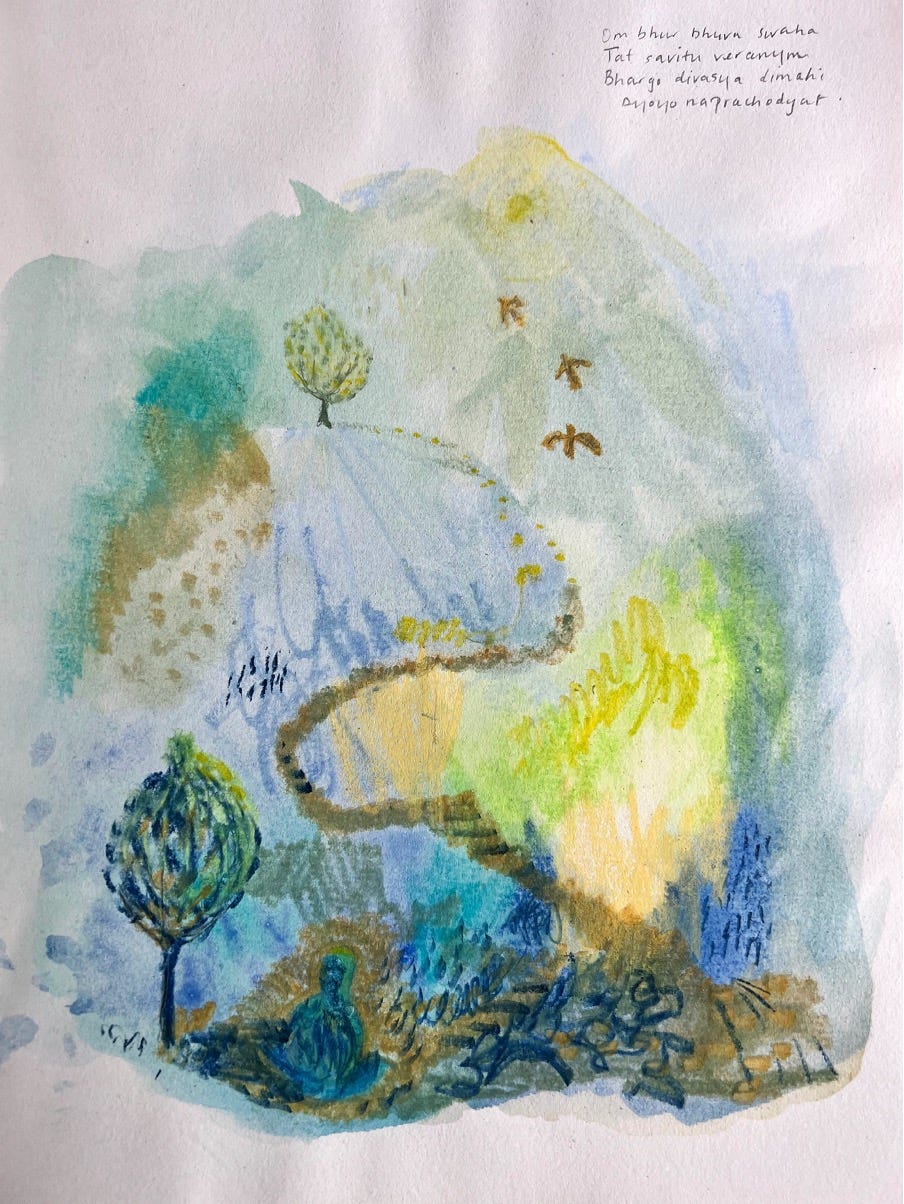
Jung developed a method of assimilation of unconscious contents through their experimentation as fantasies in the wakeful state which he termed ‘active imagination’. This can be used in or out of the therapeutic environment as a journey of possible self discovery on the path to individuation or self-realisation. I have played with this approach myself through recording my dreams, which are often of birds, and making more resolved work from the dream-sketches:
Examples of my dream-sketches, ‘Dreamworks’, quick sketch later worked into, graphite and acrylic on paper, 20.5 x 15cm, 2023Dreamworks 4’, watercolour and Neocolour II sticks on paper, 21.5 x 28cm, 2023, writing in corner shows the ‘Gayatri Mantra’ which was in my mind on waking. This a mantra used in Hindu based meditation practices concerning invoking light.
Meta Thinking / Transcendent Thinking
This work has lead to further thought, for me, about the idea of being metahuman. To be metahuman means to move past the limitations constructed by the mind and enter a new state of awareness where we have deliberate and concrete access to peak experiences that can transform our lives from the inside out. I would count drawing, meditation and walking in nature as being peak experiences. Athletes and musicians often experience this state when performing particularly well. You might call it ‘being in the zone.’
Waking up, we learn, isn’t just about mindfulness or meditation. Waking up, to become metahuman, is to expand our consciousness in all that we think, say, and do. By going beyond, we liberate ourselves from old conditioning and all the mental constructs that underlie anxiety, tension, and ego-driven demands. Useful insight on this is Deepak Chopra’s ‘Metahuman: Unleashing Your Infinite Potential’ much of which draws from ideas from the Upanishads and Vedanta teachings of ancient India.
This I would say could be called transcendent thinking where transcendent doesn’t mean going above, but more working alongside from a different perspective.
The combination of meta thinking, ideas of alchemy and symbolism have resulted in some interesting and helpful personal development. Combining this with study of Sanskrit texts such as The Upanishads, The Yoga Sutras and the Bhagavad Gita has made for an enlightening journey. Long may it continue!!!
… and the birds continue… more paintings
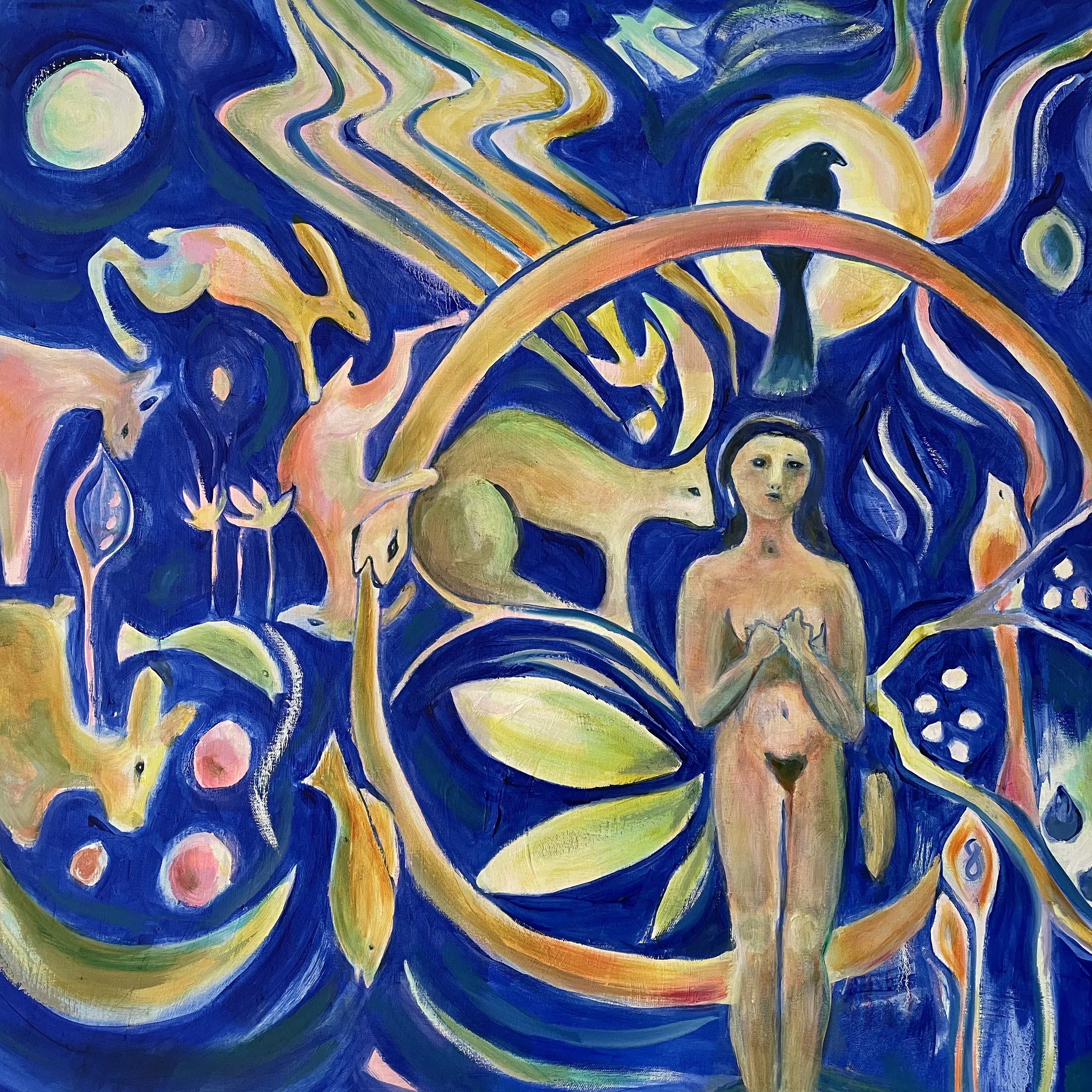
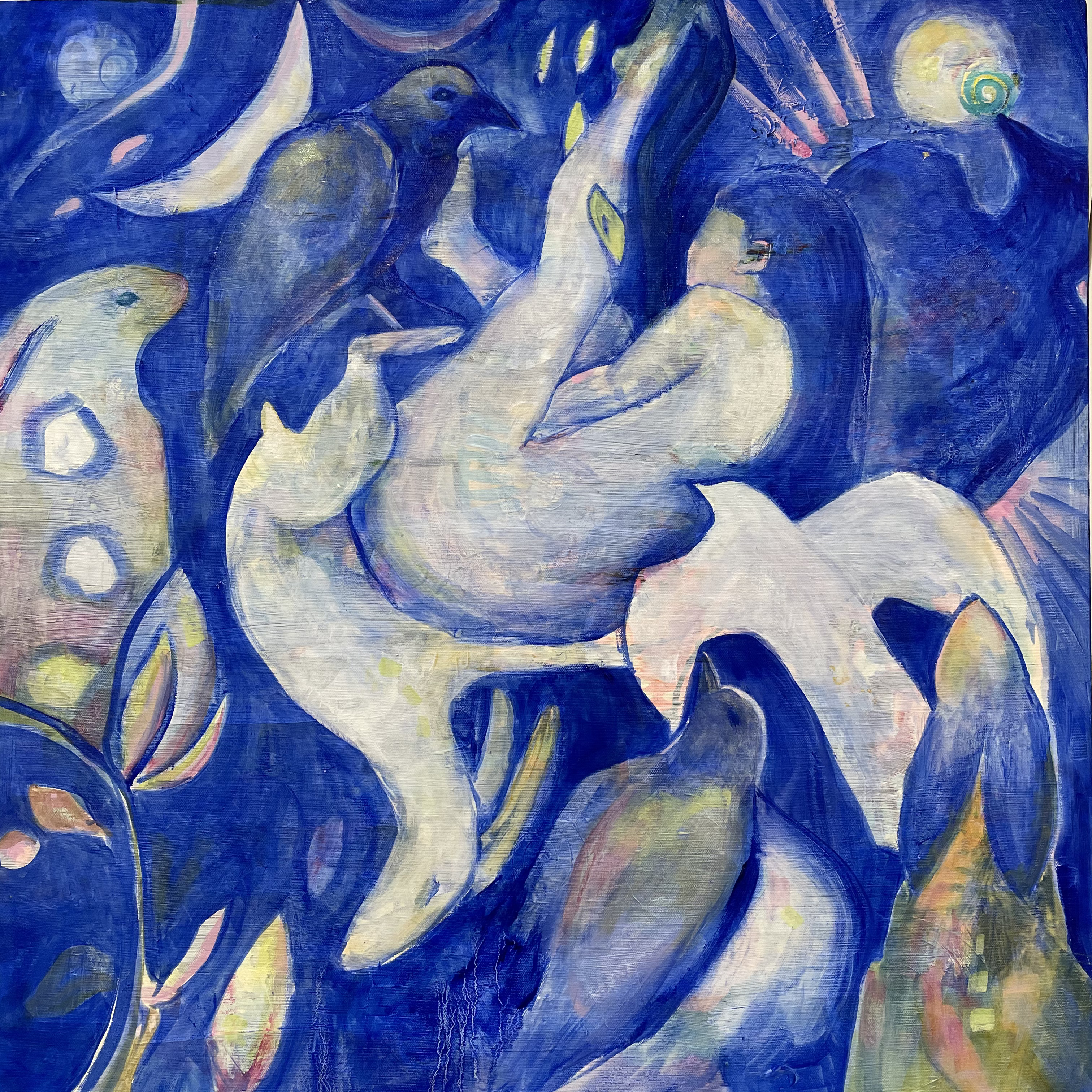
At a recent three person exhibition, ‘Sprezzatura’ with Julia Burns and Rachel Magdeburg, I was able to show some of the paintings resulting from these dreams and imaginations. They are all available to see here (they are at a very good price for a VERY limited time – let me know if you would like to purchase) but here are a few:
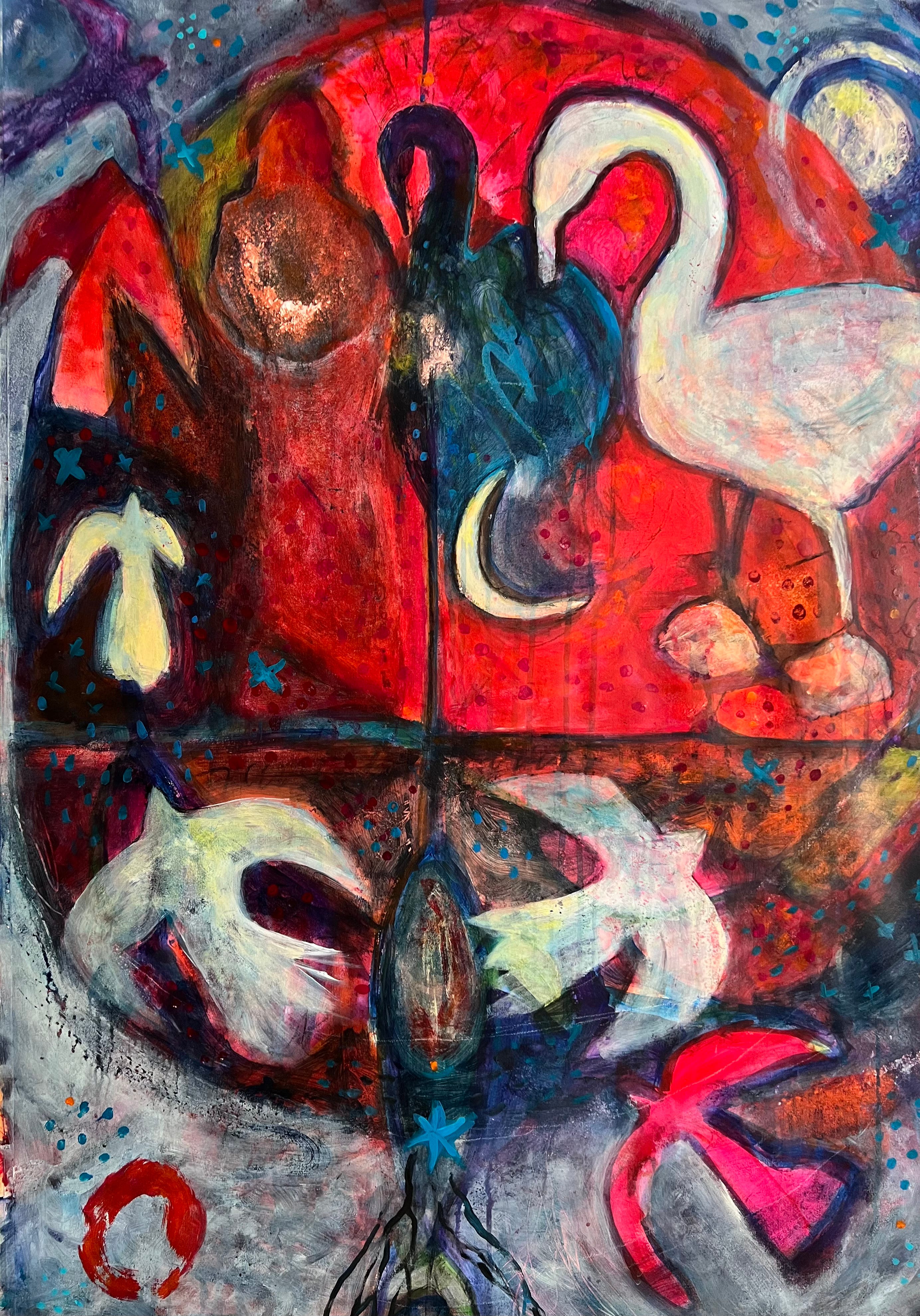
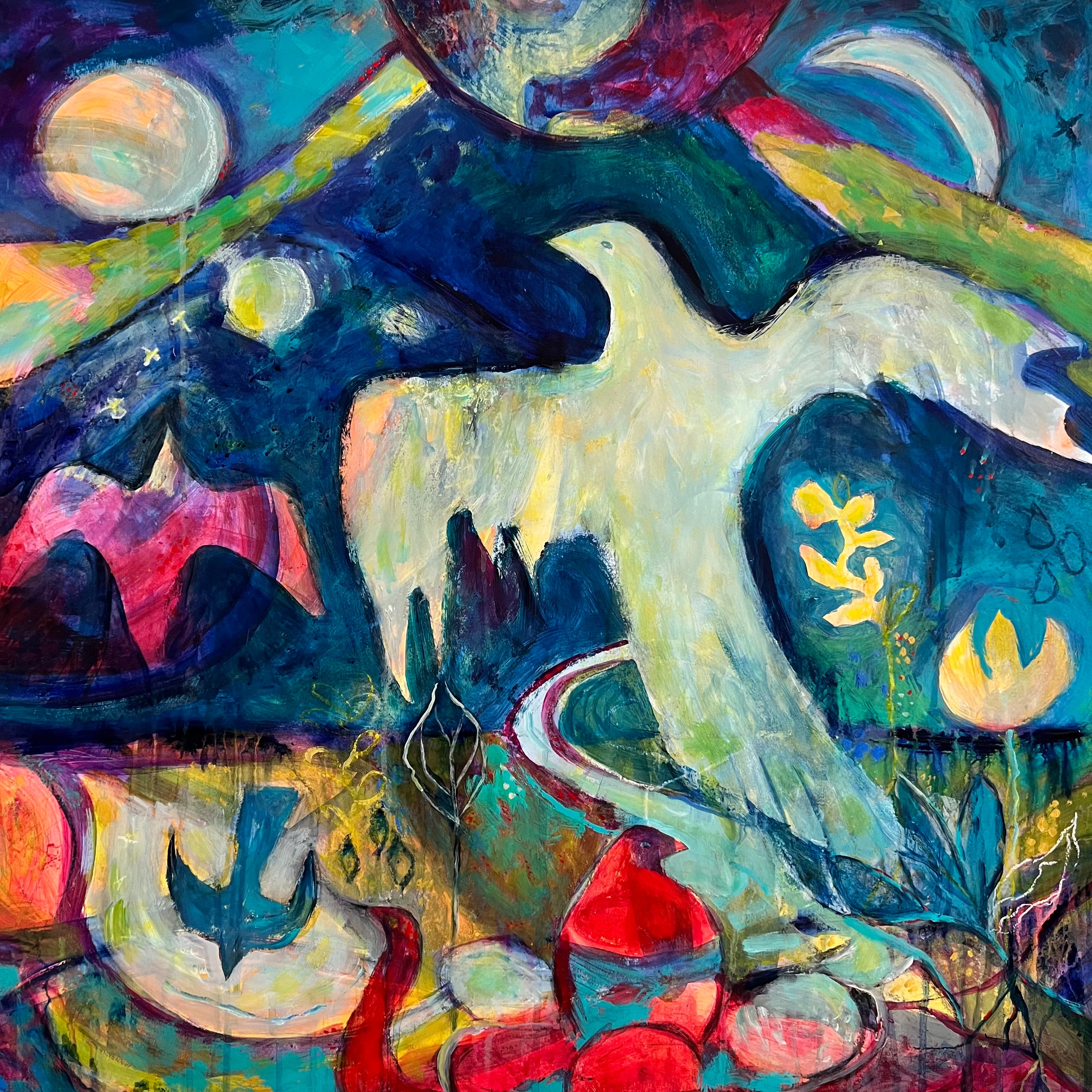
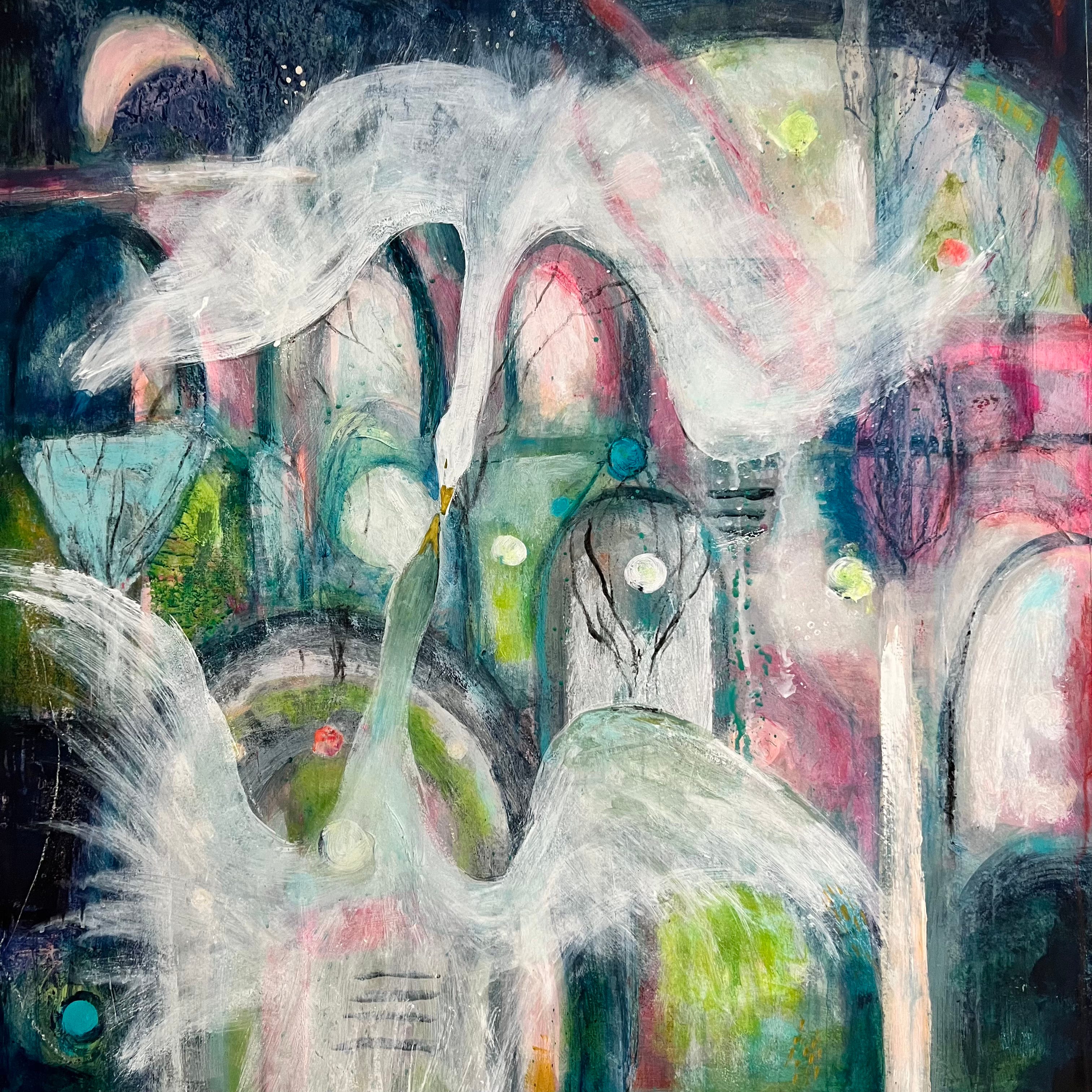
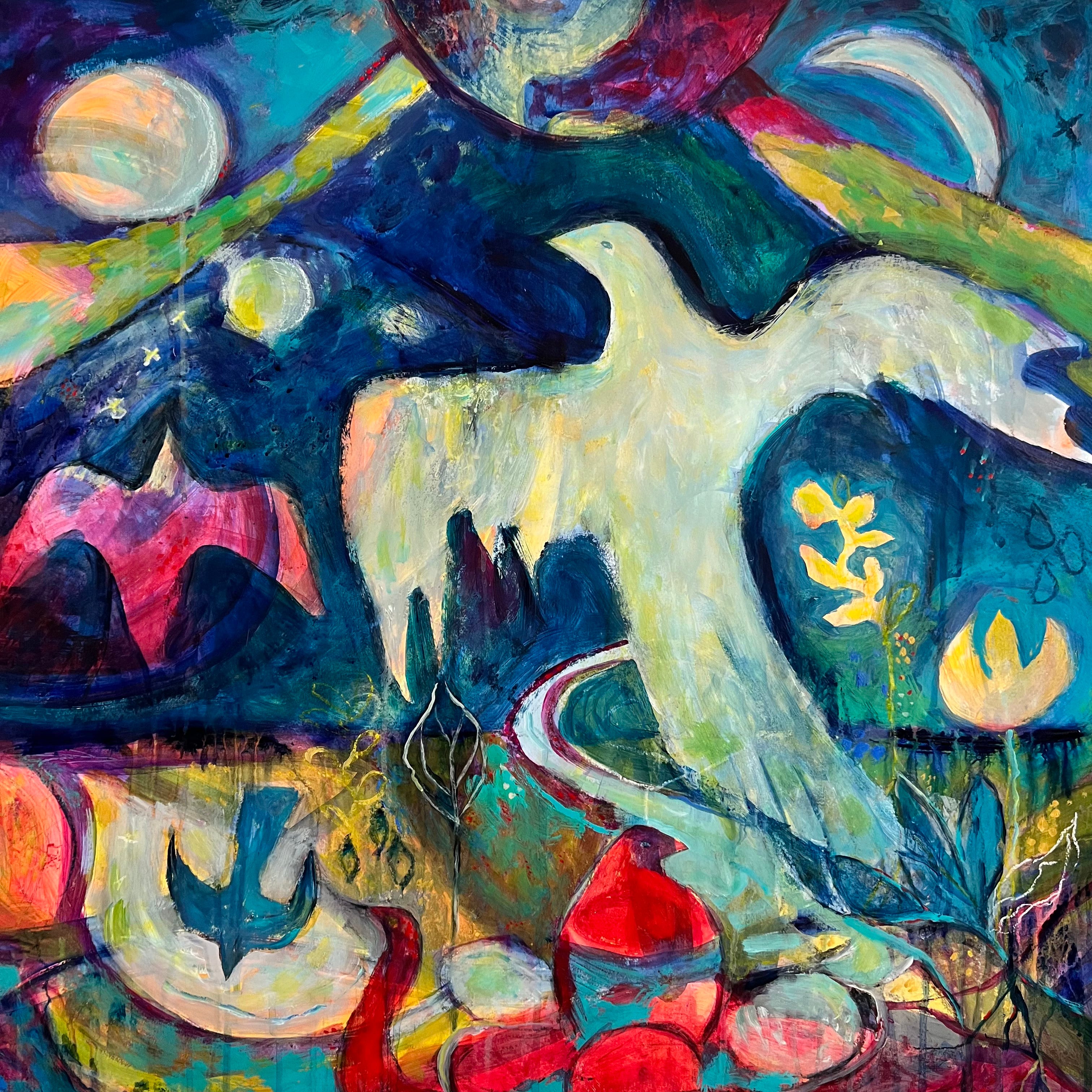
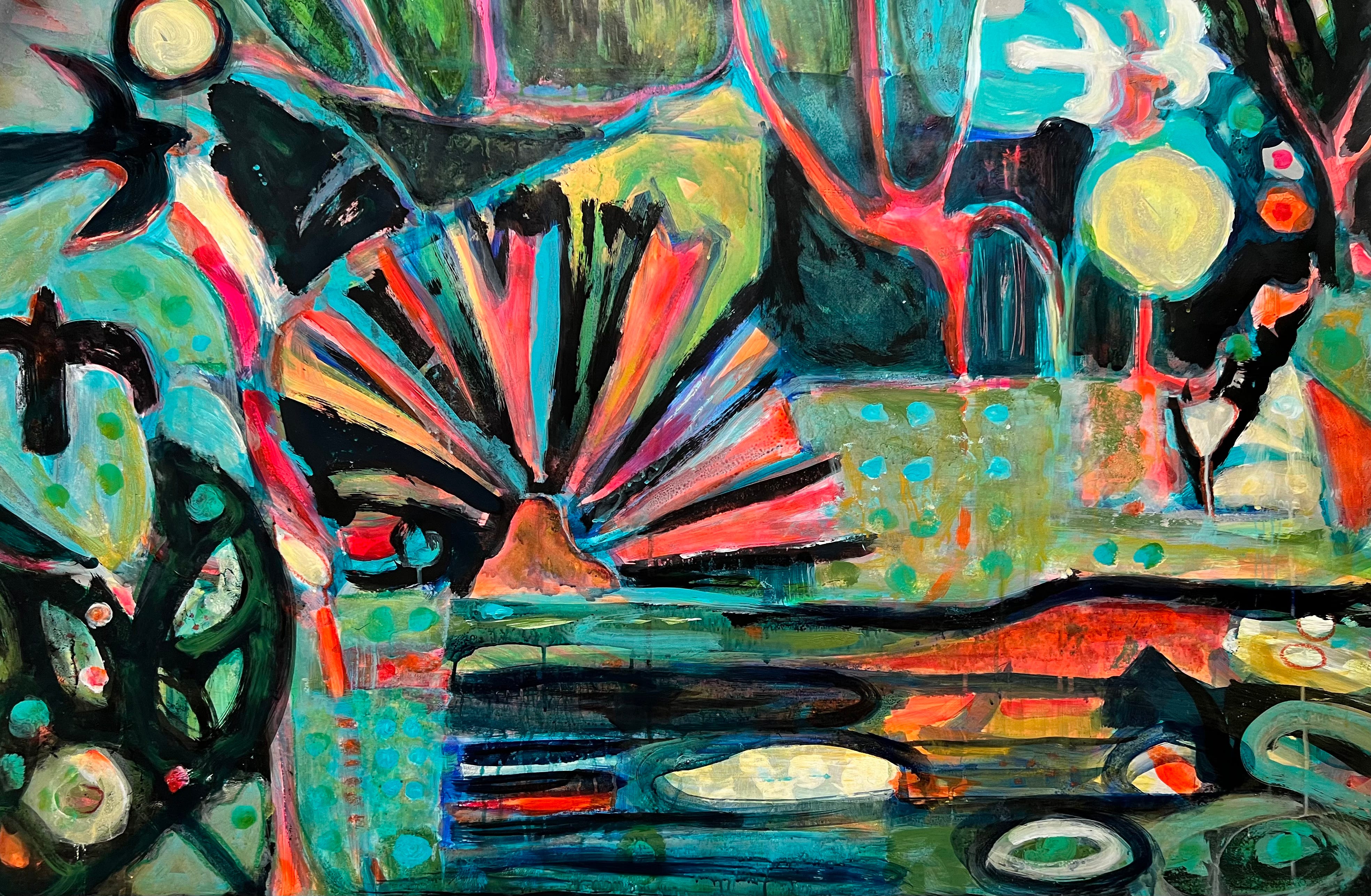
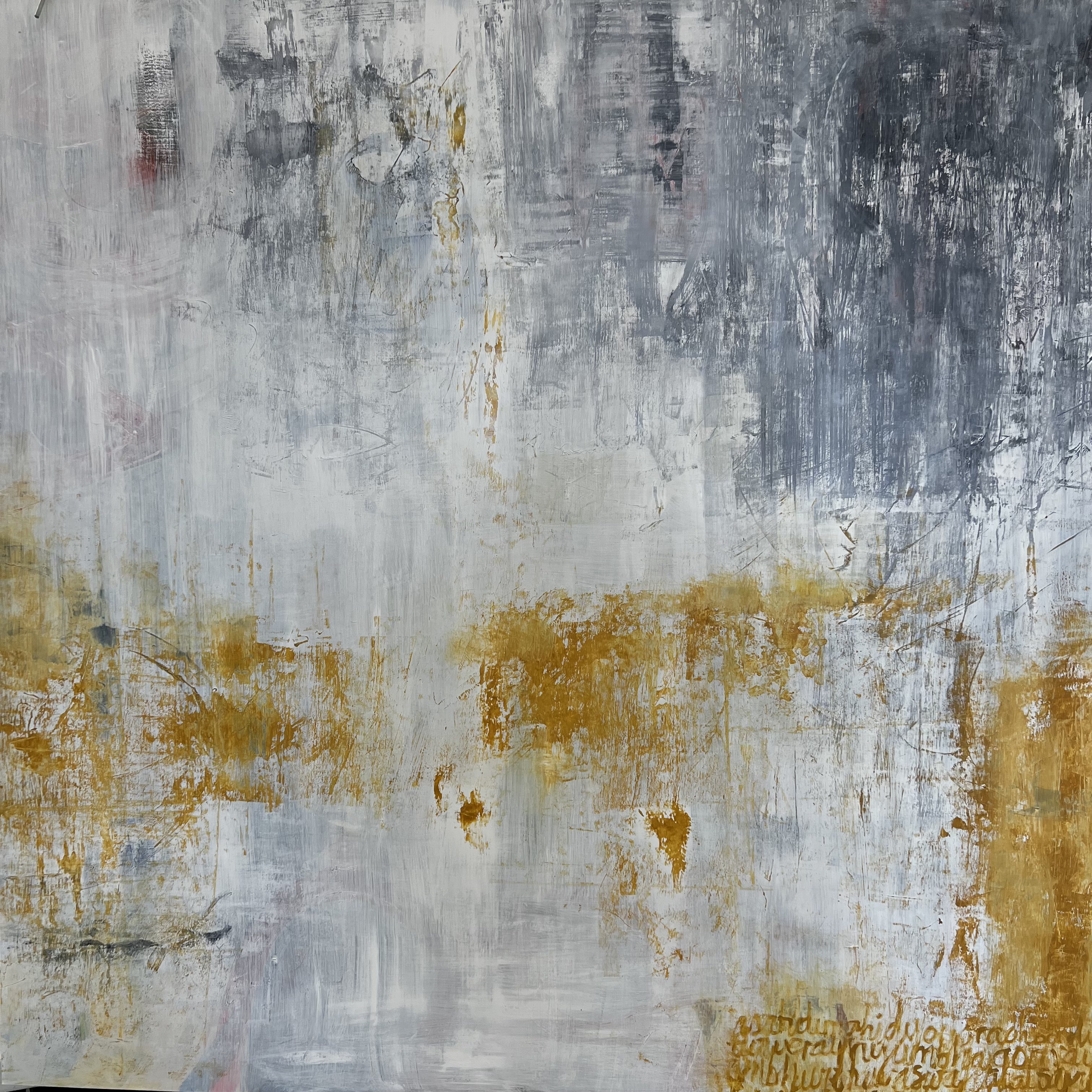
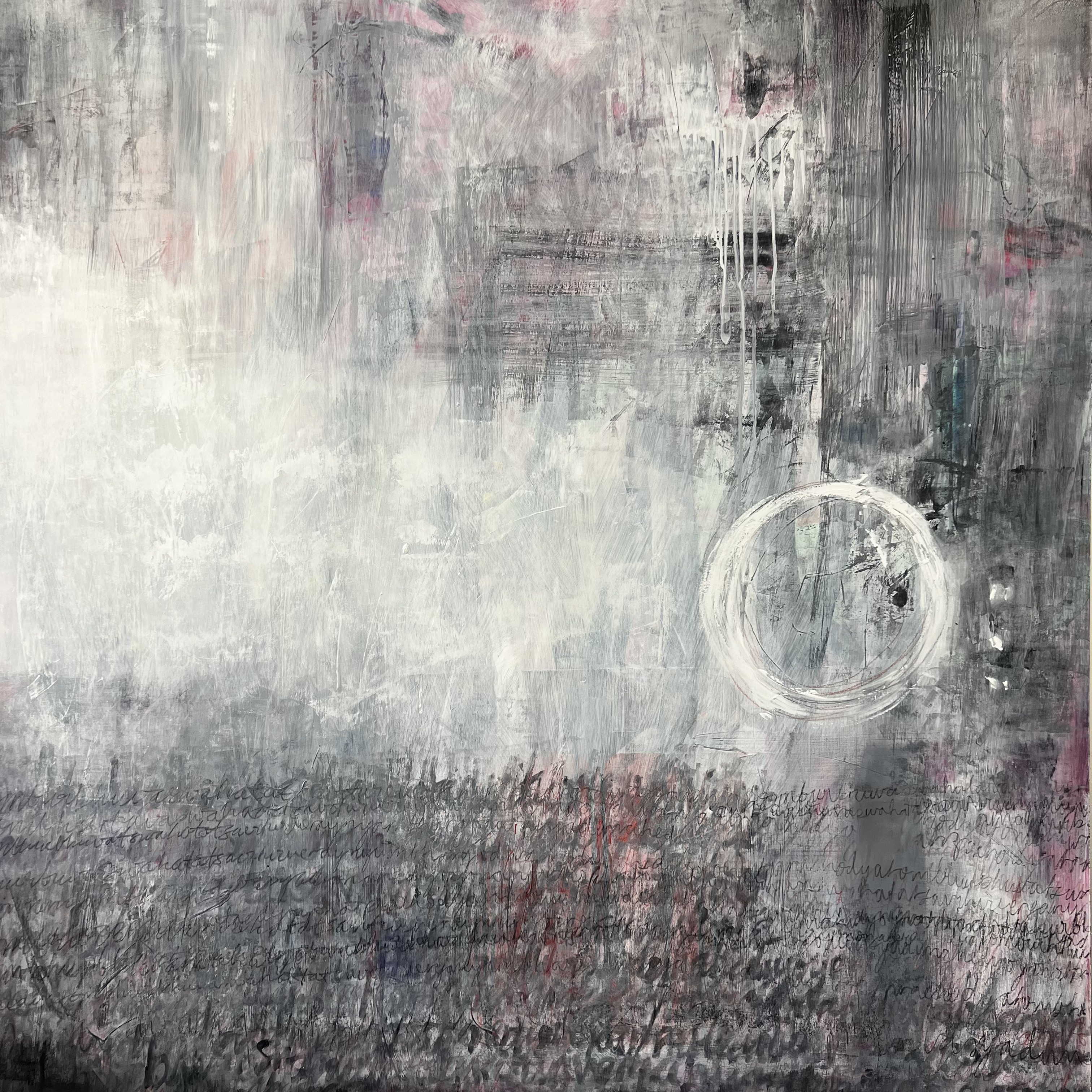
‘Axis Mundi’- Acrylic paint on paper – 71 x 120cm -£300‘Om Kara’ – Acrylic paint on paper – 73 x 73 cm – £300‘Thinly Veiled’ – Acrylic paint on paper – 72 x 74cm – £300
I have put the prices of these paintings here and there are more on the link page too – I unashamedly am selling these for funds for next year’s PhD fees and my travel related to drawing and painting in my beloved Campervan – a place for spacious thinking. Let me know if you would like to purchase. Postage is extra, at cost, and the work will be sent in a strong tube for you to choose a frame. Get a bargain whilst it lasts because through a gallery …. well, you know …..
Is it too much to wonder if drawing can be an act of resistance against disconnection or a political act to create unity and peace through presence, mindfulness and interconnectivity?
22 NOV 2023
This last week I was going to write a piece about drawing and the role that it can play in mindfulness and ‘being present’, but on thinking about it that was put to one side slightly and the importance of drawing as an interconnectedness with all things came up.
How amazing it would be if the simple act of drawing could be used as a transformational process to bring people and their ecosystem (that which forms a network of relationship and interdependence i.e. everything) together?
What if drawing creates union?
What got me thinking
I do a lot of my PhD research about mindfulness, meditation and contemplation in relation to an art practice. It’s always a good excuse to go out and draw anyway; justifying the pleasure with some kind of ridiculous validating argument as if I can’t just have the pleasure. But anyway, in the name of research (!) I was on holiday in Portugal last week and set myself a little goal of painting or drawing to record the trip each day as I generally do when travelling, both as a diary and as something more.
I took a little A5 sized sketchbook and a small pad of watercolour paper and carved niches of time out to use them throughout the trip.
For me, drawing in the landscape is part of a full participation in a location. I take photos, like the rest of us, but the difference between photographing and drawing is enormous.
Michael Taussig, anthrolopologist and field notes maker, in his book “I Swear I Saw This: Drawings in Fieldwork Notebooks, Namely my own”, speaks of drawings:
“folding organically into the writing in the notebook whereas a photograph lives in another sphere altogether, with technology, lying between you and the world”.
He mentions John Berger’s thoughts, with his enigmatic notion that a photograph stops time, while the drawing encompasses it and encompassing is like enclosure. There is an intimacy that Berger finds between the drawer and the drawn, suggesting that drawing is like a conversation with the theme drawn likely to involve prolonged and total immersion. Here the idea is that the person becomes the drawing, you become so close to the object, until you are finally it as it were, the contours you have drawn marking the edge of what you have seen, but also the:
“edge of what you have become, an autobiographical record of one’s discovery of an event, scene, remembered, or imagined.” (Berger 2007:3)
Berger also says that drawing has something that painting, sculpture, installations and videos lack, and that is corporeality. (Berger 2007: 16).
I think mindfulness is a big part of it for me and I like to cultivate and exercise that skill when I can. Here are a couple of definitions of mindfulness:
“Mindfulness […] is generally defined to include focusing one’s attention in a nonjudgmental or accepting way on the experience occurring in the present moment [and] can be contrasted with states of mind in which attention is focused elsewhere, including preoccupation with memories, fantasies, plans, or worries, and behaving automatically without awareness of one’s actions.” (Baer et al. 2004: 191).
“Mindfulness is a process of regulating attention in order to bring a quality of non-elaborative awareness to current experience and a quality of relating to one’s experience within an orientation of curiosity, experiential openness, and acceptance.” (Bishop et al. 2004: 234).
There are two understandings of mindfulness: Western and Buddhist derived. A more Eastern-based idea of mindfulness (sati) is:
“Eastern mindfulness means having the ability to hang to current objects, to remember them, and not to lose sight of them through distraction, wandering attention, associative thinking, explaining away, or rejection.” (Weick & Sutcliffe (2006: 518)
You can see why this is a useful practice to cultivate! It is beneficial to be able to bring this skill to play in all sorts of life situations!
Benefits of mindfulness
The practice of mindfulness, through methods such as body scanning, meditation, and yoga, aims to achieve a state of “being-mode”, characterized by acceptance of change and non-attachment. (This is a confusing idea for Westerners – we can assume too easily that it has connotations of detachment which is not the same – let’s call non-attachment “caring non-attachment” instead because that is more useful). The goal is to master the mind, understand that human suffering is an illusion based on attachment to the nonexistent, and develop compassion and empathy for all beings.
Mindfulness improves mental skills and present-moment awareness by encouraging withdrawal from external factors that cause rumination, complex thinking, and emotional reactions. However, the idea of achieving a purely passive state of mind is paradoxical, as the mind is always interacting with the external environment. Despite this, mindfulness practitioners assert that the practice enhances the ability to remain internally focused and undisturbed by external phenomena.
You can see why sitting on a beautiful beach painting this on the island of Armona in Portugal can be argued for!
Mindfulness and Presence
Why are we drawn to being present? Could it be because the awareness of the body knows innately that being present is good for it?
We know scientifically that people who regularly encounter awe and acknowledge it have certain advantages.
But I got to thinking about what the present moment actually is? There is some literature about what a moment is. How small is it? One idea is that a moment is under six seconds, after which memory and prediction come into the picture.
How deep is it? Does mindfulness give depth to a moment.
What is time anyway? (time is a human construction a space time modality, actually, it doesn’t exist but that is another book – see Deepak Chopra’s outpourings amongst others!).
And what actually is presence?
An experienced moment happens now, for a short extended moment but mental presence encloses a sequence of such moments for the representation of a unified experience of presence. Whereas the experienced moment forms an elementary unit, a temporally unified percept, mental presence involves the experience of a perceiving and feeling agent (“my self”) within a window of extended presence, a phenomenon that is based on working memory function.
“Working memory provides a temporal bridge between events – both those that are internally generated and environmentally presented – thereby conferring a sense of unity and continuity to conscious experience” (Goldman-Rakic, 1997).
My favourite two authors (not academic because so much more relatable!) on presence are Eckhart Tolle and Michael Singer. I read and reread these books (see links) and try to live the ideas there.
Maybe I can think of it this way: Archiving an event
This was a little sketch from Faro – I spent an hour sitting on a bench, fully enjoying the sun, smells, taste and sounds of the market on the marina whilst making this.
If a moment is nebulous in terms of definition then are we talking about an event? Am I archiving an event rather than being present? What is an event made up of? An event has a preparation, and moment, and a memory but can also be made up of smaller moments of consciousness or awareness, which add up to a sense of being present.
How is drawing like yoga?
Honestly I don’t draw or paint in a headstand or the tree pose – that’s not what I mean!
So, recording a feeling of interconnectedness through a medium of art materials is like experiencing the interconnection between my body and mind to something which is greater than me when practising yoga or meditation. In a physical sense, I place my awareness in my body when practising yoga and sense the interconnectedness of, for example, the breath and the position of the body, of which part of me is relaxed and which part of me is tense. When drawing outside I have pockets of attention like this, both of the inside of me (interoception) and outside of me in my (perceived) external environment.
Sometimes this interconnected quality of being feels very profound. I am connected to everything, everything is my ecology. The word ‘yoga’ comes from ‘yuj’ which means ‘union’. The mindful presence of being still and receptive in drawing is like the true meaning of yoga. A connection to my ecology which of course is THE ecology.
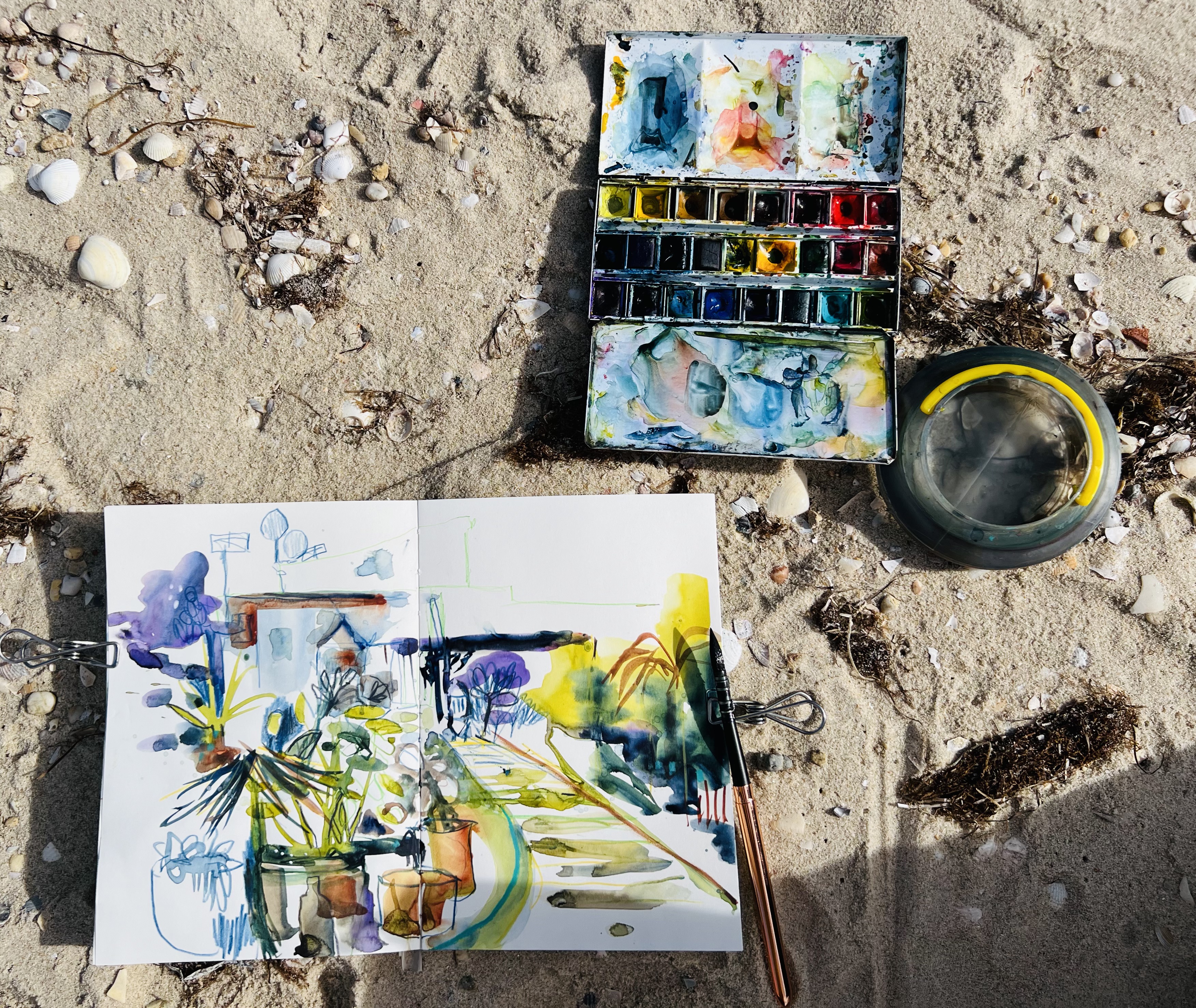
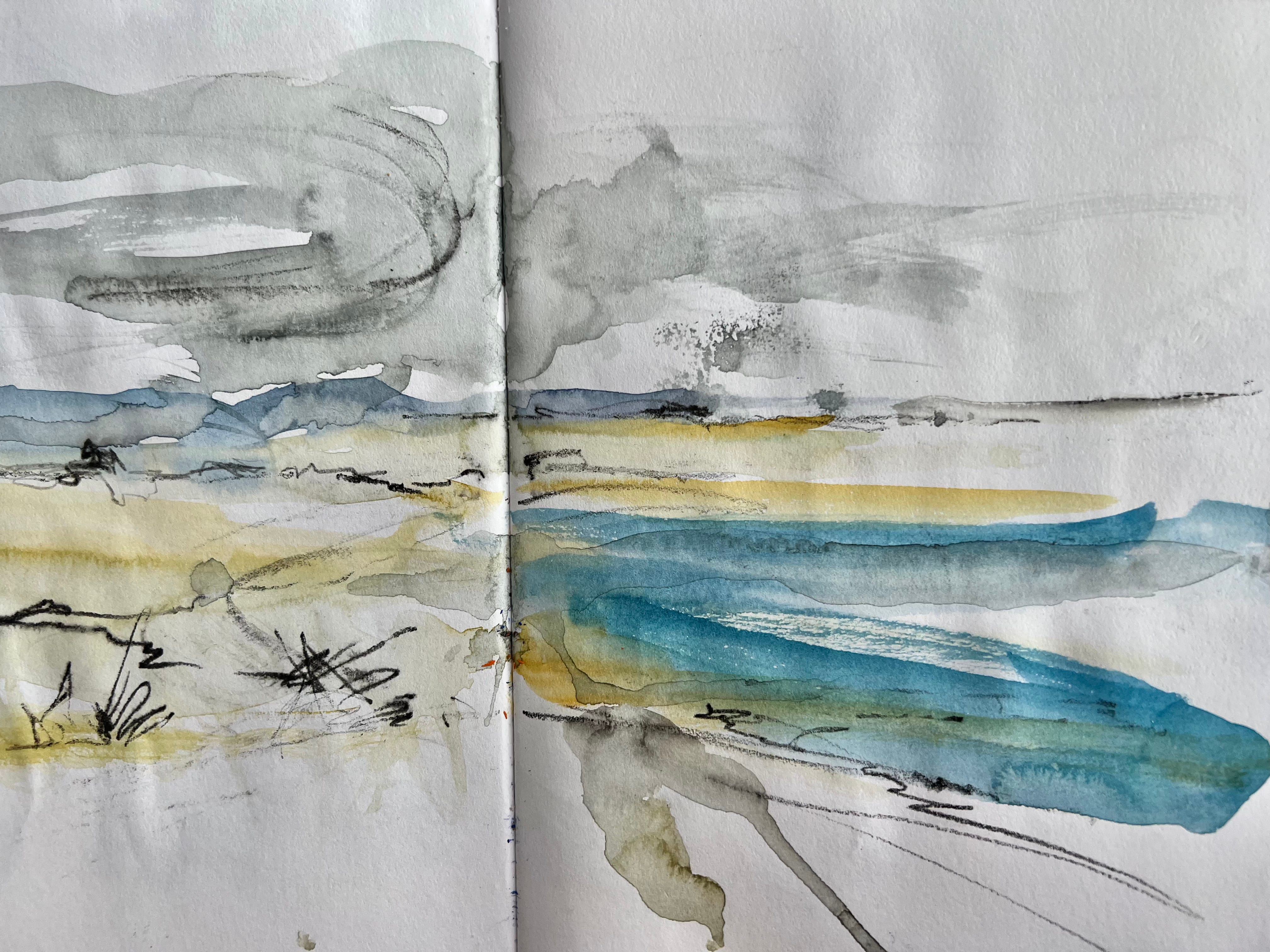
Drawing the beach – sensing the perceptions of my outer environment, sensing the perceptions of experimenting with materials and sensing my internal state. It’s what meditation is, it’s what yoga is.
Why do I sometimes feel the need to capture a past event from a photo?
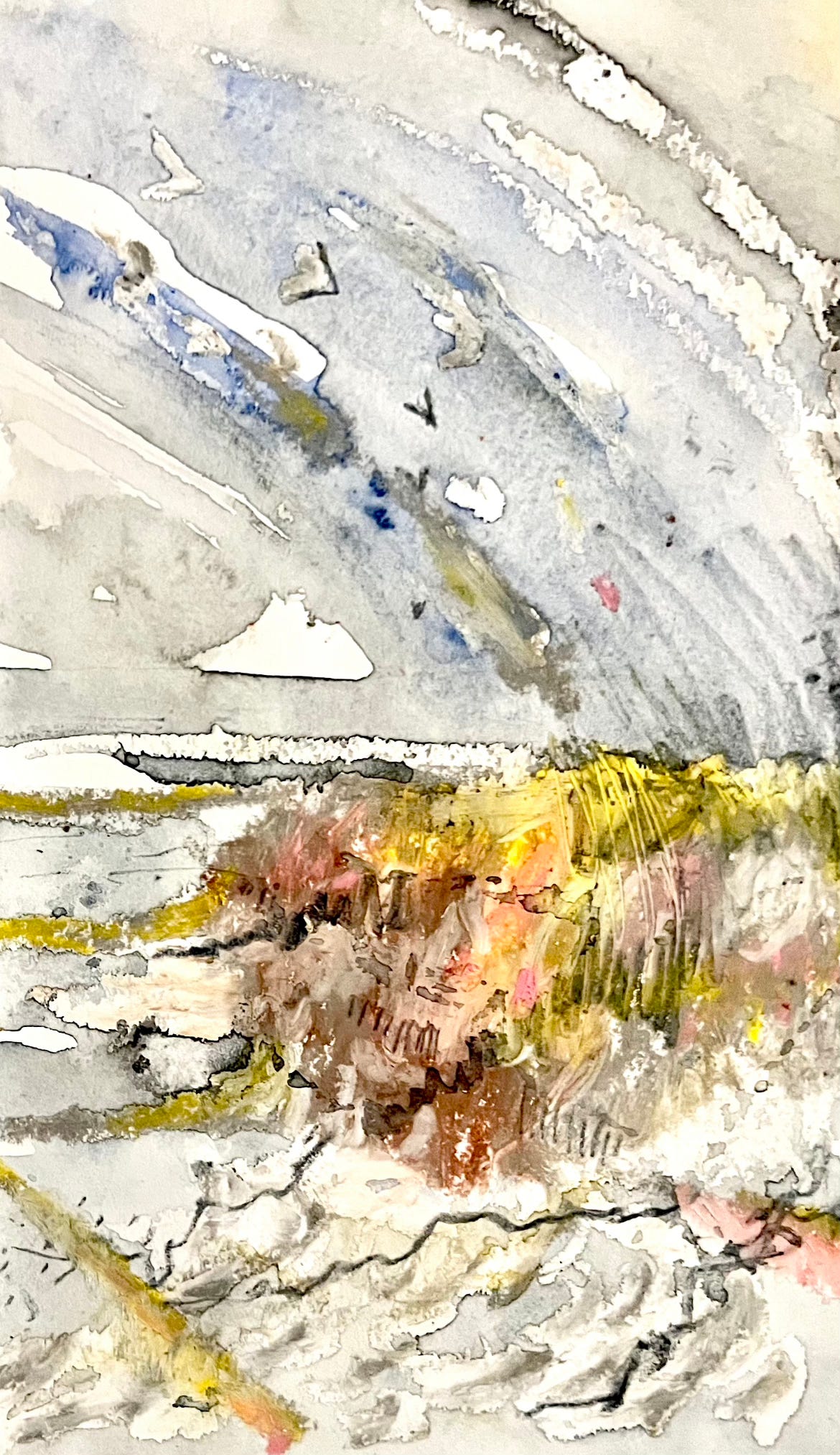
Is it because I wanted to re-capture, relive, recover that sense of awe? I can mention here two examples. The first is a drawing made in Portugal of the experience of walking on the salt flats at Olhão which was about experiencing the sense of the light rather than that of form. The sense of the light was having an awe-inspiring affect on my body.
I used a photo to remind me of the awesome experience of light in the salt flats but the painting is not at all purely representational.
The other example is the drawing made about the feeling of interconnectedness when swimming in the river at Dolanog. This went on to become a resolved painting. I will talk about that in another post. It was profound for me.
Drawing and flow state
How can drawing become an entry point into flow? Because drawing can be a form of voluntary play and play is an intentional portal into flow – more on this in another Substack too!
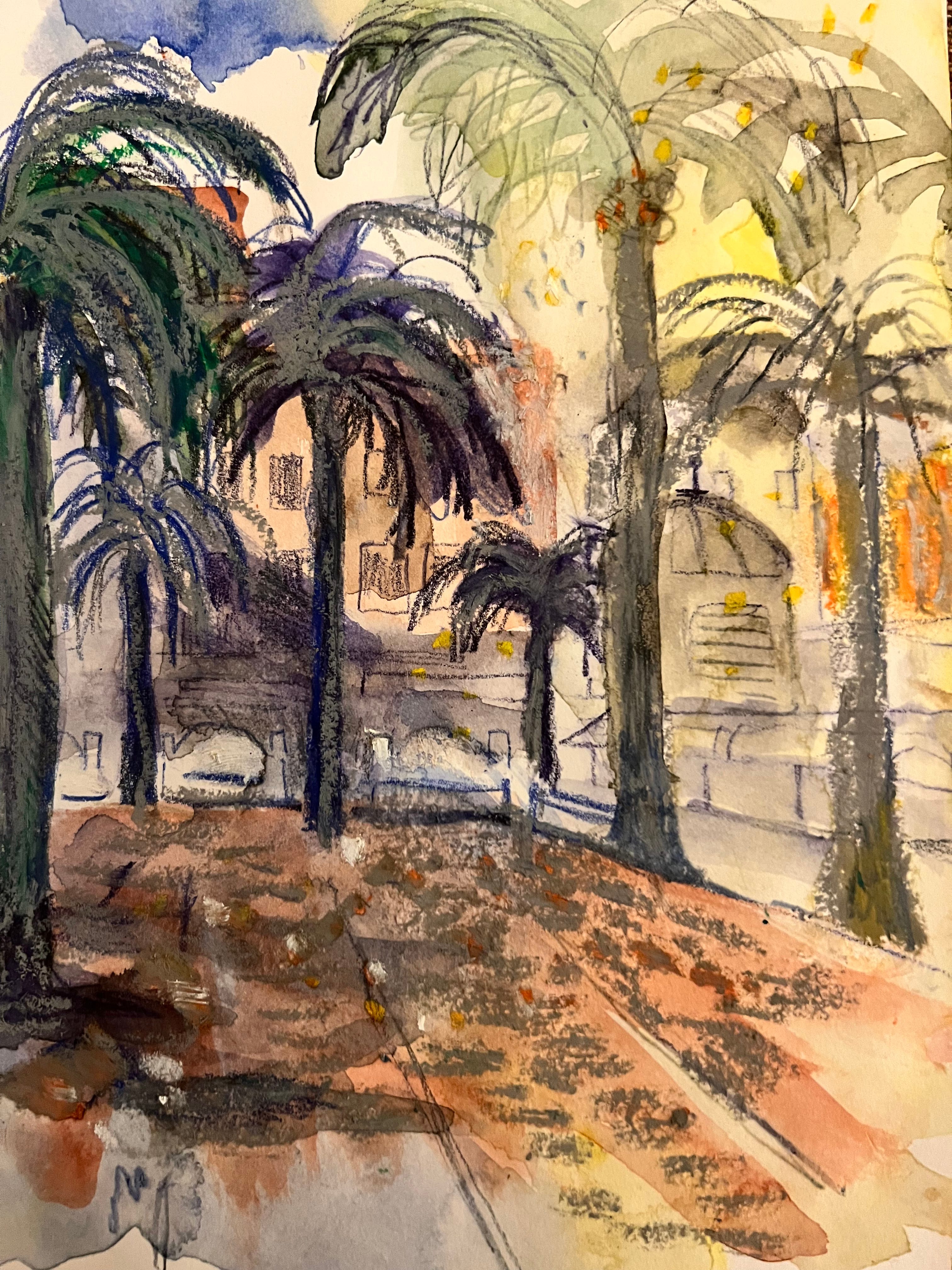
Sketching on an autumnal, orange ripening day in Ayamonte over the border in Spain.
If all of this has become too cerebral, how about this, as a more person to person connection arising from drawing outside last week:
Drawing and people connections
In around 2016 I met Mary Price (of Artist in the Shed on Instagram) on an art workshop in Brighton, tutored by the Australian artist Tracey Verdugo when she was on a world tour. Mary was sitting next to me during the weekend and over a Saturday night curry we made ourselves into friends, but only had an online friendship subsequently over the years, until just last year when we found ourselves in Olhǎo, Portugal at the same time. We spent a couple of happy days then out sketching together and drinking vinho verde of course!
This year she was to be in Olhǎo again at the same time as us. We organised more time to be spent out with sketchbooks and the day before we met up she had by chance encountered, in a cafe, another artist, Roz Beaver, who was travelling light around Portugal with her art materials. Over the next week or two we all bonded through drawing together, talking about art making, connections, and sharing life stories. We united through being in our true happy places, each of us connecting with our environment through drawing and painting in a deep and present way. We will remain friends wherever we are in the world through this true commonality and unity.
Roz, me and Mary – connected
So…
Is it too much to wonder if drawing can be an act of resistance against disconnection and a political act to create unity and peace through presence, mindfulness and interconnectivity?
follow me on Substack : long form writing, no ads, no attention seeking reels! Link: CLARE WASSERMANN
Some refs:
Taussig, Michael (2011), I Swear I Saw This: Drawings in Fieldwork Notebooks, Namely my own, Chicago: University of Chicago Press
Berger, John (2007), John Berger: Life Drawing, Ed. J. Savage, London: Occasional Press.
Let me know if you want the other citations – I need to go and have a custard cream now.
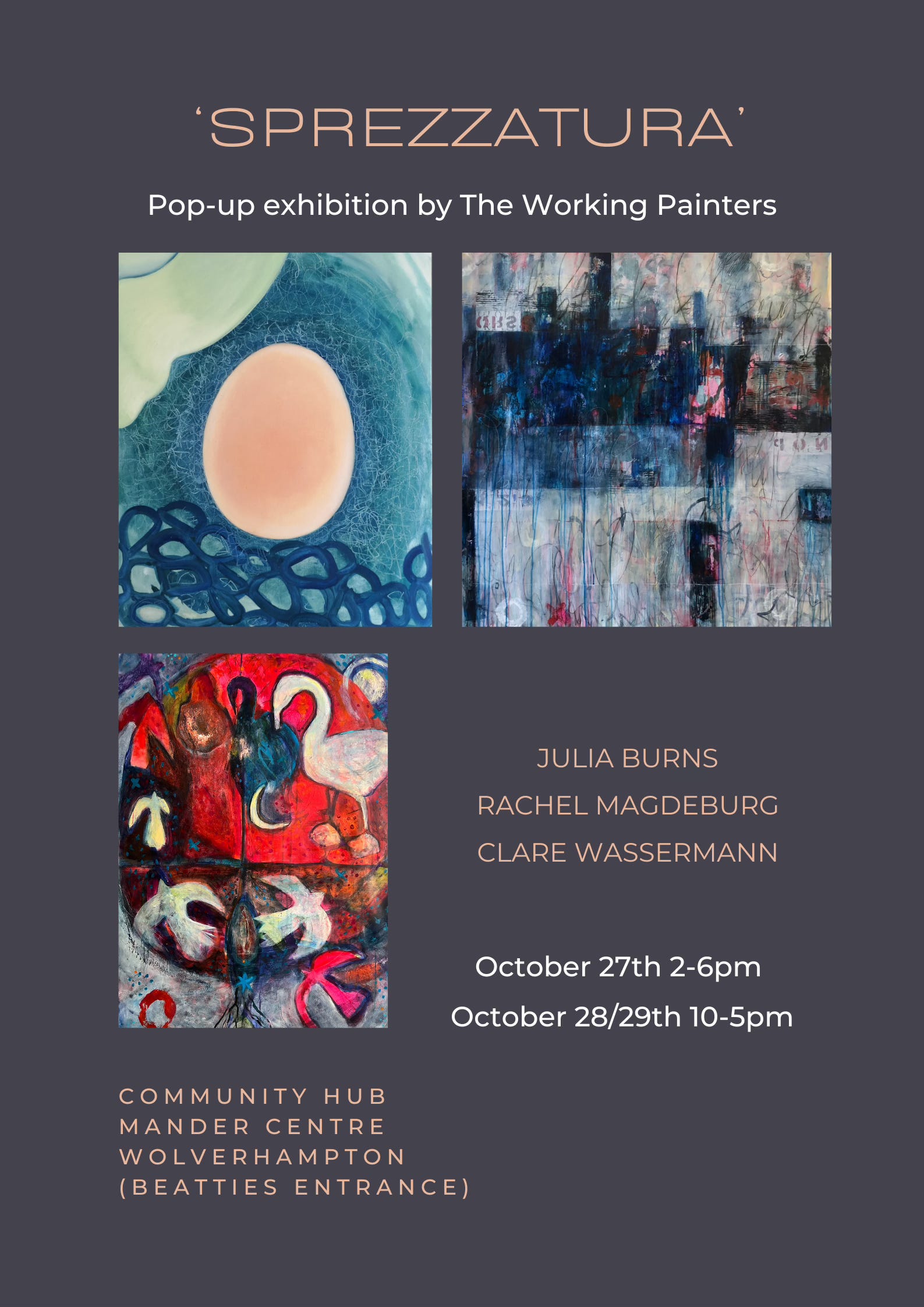
This week has been a full on one but it’s exciting. Two other artists in the studios have teamed up with me and we are going forward as a collective called ‘The Working Painters’. It’s a great boost to have a collaboration, and whereas I have generally worked a solitary bod I have really seen the power of working together this last few weeks. In the past we have loosely critted (is this a nice new word?) our work and thoughts together and now it’s time for a show of this year’s outputs.
Why now?
You know what? …. it’s hard to get gallery representation, or even work shown in the city art gallery where we work, and it’s sooooo easy to moan about that. So we decided to up the energy and organise a pop-up, renting the community hub which is a massive white ex-shop in the Mander Centre our city shopping mall here in Wolverhampton, England. The town is really down on its uppers, struggling to stay alive and the only thing we can do is to contribute to it with colour and hopefully inspiration for others to do the same. We want to buck the system!
Can we inspire?
We hope so – we want to show a way to beautifully curate on a limited budget to encourage others – individuals or groups – to have a go at doing the same. We are not having a catered Private View – but we are having one (!), and we are hanging in a way that others could replicate easily …. you’ll have to come to find out how.
‘Om Kara’ – Clare Wassermann – acrylic on paper – 73 x 73cm
About the title ‘Sprezzatura’
The exhibition title Sprezzatura typically means an appearance or style which assumes to be effortless but hides the endeavour involved in its creation. Many of the paintings exhibited here have been re-worked, painted back, painted over, scrubbed, rubbed, tonked, scratched, smudged, printed on, wrestled with and agonised over, and in fact the paintings often leave traces of these tussles. Some of the paintings came into being with less of a creative struggle as if not made by the artists at all. Nonetheless, the work of painting is always work, a matter of turning up and loading a brush.
The artists
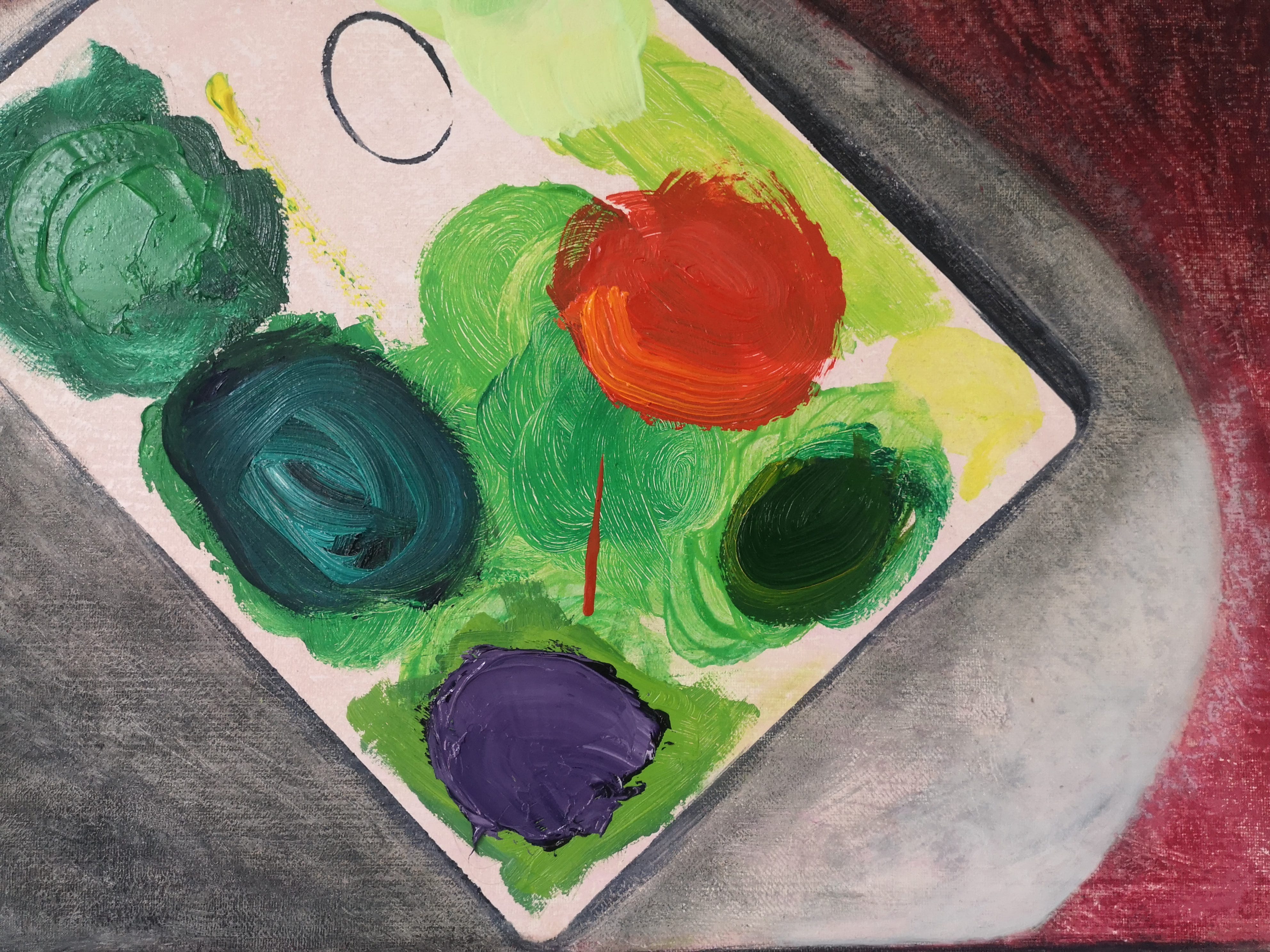
In a series of new work, Rachel Magdeburg has painted objects that have a personal resonance, and obliquely reference the practice, material techniques and processes of painting. Some of the pictorial imagery reveals a semantic playfulness, which is reinforced by the painting’s titles. Other paintings explore formal relationships within a work itself, and in relation to the motifs of other paintings. Rachel has just completed a doctorate in Fine Art and she is glad to be back to painting!
‘UnPalatable’ – Rachel Magdeburg – oil on board – 61 x 51cm.
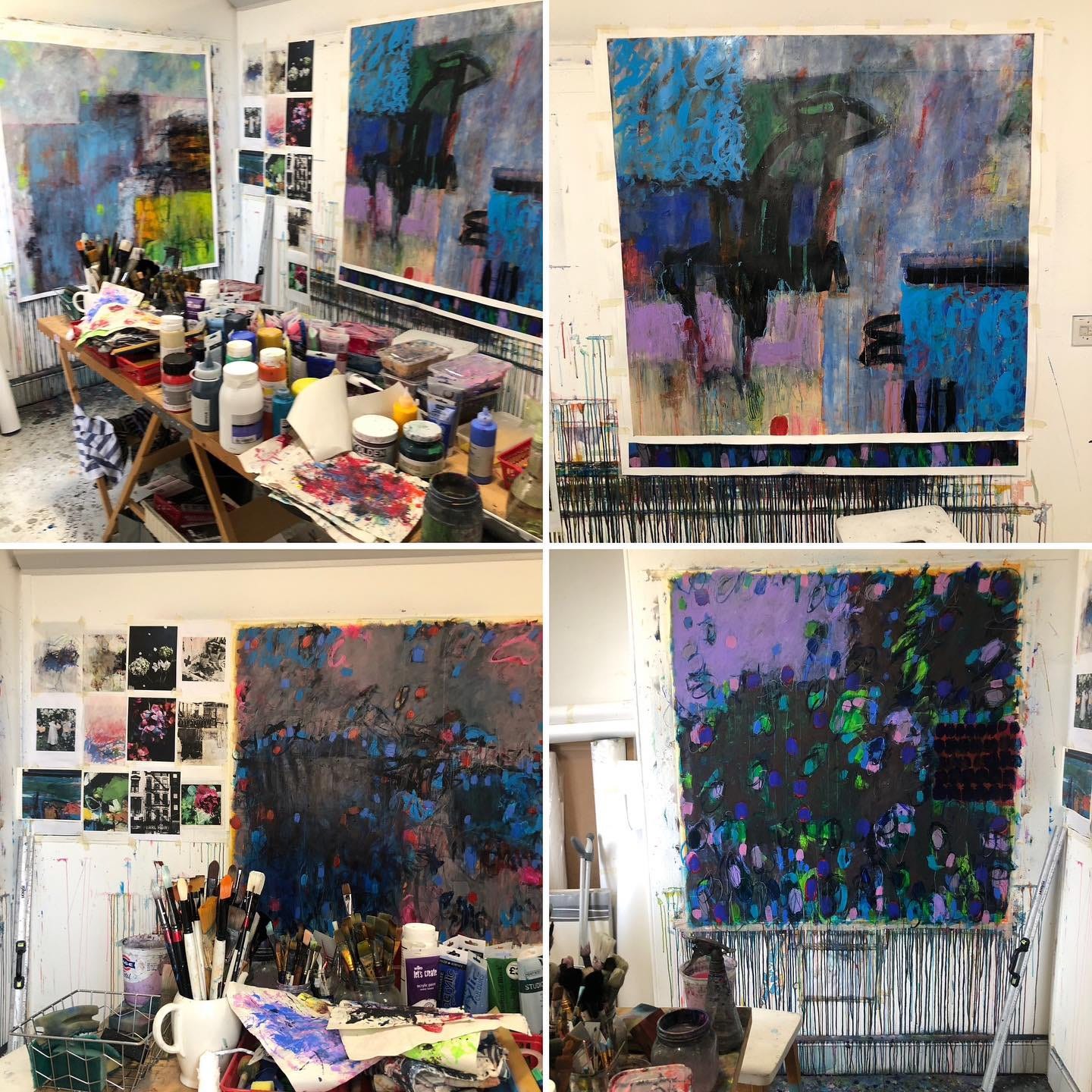
Julia Burns’s recent large scale paintings employ a continuous dialogue, both intuitive and directed, with the very messy process of painting, along with a playful reference to a “mixtape” of Modernist and contemporary abstract painting, to create works that allude to the Urban landscape as an experience and an idea.
Julia Burns’s studio.
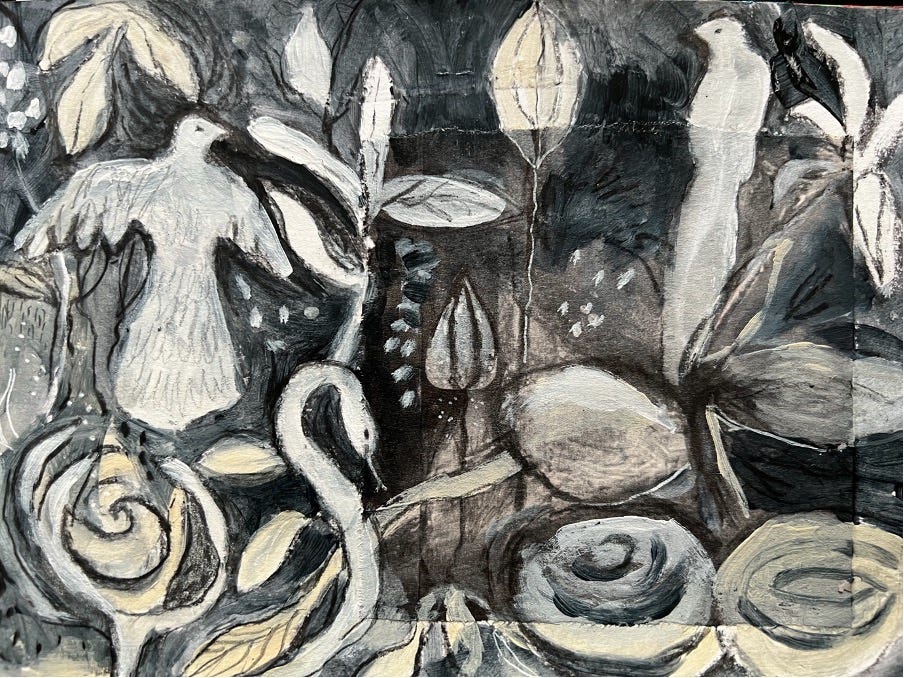
Clare Wassermann has been working with the symbolism of birds in her paintings as part of an ongoing investigation into the concept of liberation and alchemical transformation towards internal freedom as part of her PhD work.
‘River Swimming, Dolanog,’ Clare Wassermann – acrylic on paper, 120 x 79cm.
I you would like to purchase one of Clare’s pieces but can’t get to the exhibition
There is an online catalogue here. Please get in touch to reserve your work – the beauty is there are no gallery fees so the work is affordable (subjective term I know!). The work can be purchased online and posted at cost. Framing advice is available of course.
Please get in touch if you would like to purchase work by Julia or Rachel. Better still, come and meet us and see it in person. A catalogue will also be available online soon.
You can make quite a night of it!
You can go straight on to this if you come at the end of FridayEvery last Friday of the month, the doors of Wolverhampton Art Gallery will be opening after hours to welcome you in.
Each event will be inspired by current exhibitions. Expect live performances, music, workshops and curators talks throughout the gallery spaces.
Plus, the Glaze Café will be opening late to ensure you don’t go hungry or thirsty as you see your way into the night. Lates are adults-only, after-hours theme nights.
This Friday Lates is a double feature! Friday 27th & Saturday 28th October 6-9pm.
Friday 27th: there will be screening a documentary about the life and work of Derek Boshier.
Join British-Jamaican Artist and Educator, Exodus Crooks for an ink and collage workshop inspired by Derek Boshier’s Smile (1968). Throughout the workshop, participants will be invited to recreate an image they have on their phone, using found images, magazines and newspaper cut outs.
We are happy to work to mentor artists who would like to buck the system and put on their own show. We can offer advice and encouragement. Do get in touch with me if you think you would benefit from this service in the future.
And please do subscribe to my newsletter on Substack – I will be adding to it most weeks and I’d love your comments if you like!
Firstly here are some artists I have found particularly inspirational with regard to sketchbooks. Following this are some suggestions for you to ponder as you use your sketchbook.
Inspirational Artists and their Sketchbooks
Kurt Jackson is a British artist who has been using sketchbooks for decades. He uses them to capture the natural beauty of the British Isles, and his work often features nature-inspired elements. He believes that sketchbooks can be used to create works of art that are both beautiful and meaningful. Jackson has said that sketchbooks are a great way for him to document his travels and explore his creative ideas. Jackson’s sketchbooks are vital to the development and completion of his paintings. The pages of his sketchbooks reveal how the hastily executed images can help him to work out what he wants to achieve on canvas, or simply capture a spontaneous image when there is not enough time to paint or draw properly. Insights into his domestic and professional life − not necessarily revealed in his exhibited works − abound from his continual routine of making drawings, marks, notes, poems and scribbles.
Grayson Perry is an artist who has garnered worldwide renown for his unique artwork and his use of sketchbooks to create it. Perry’s sketchbooks are filled with creative drawings, sketches, and ideas that have become the basis for many of his works. Perry uses his sketchbooks to capture his creative process and provide an insight into his thought process. He has said that he finds the practice of sketching and sketchbooking to be incredibly helpful in developing his ideas. Perry’s sketchbooks are full of vibrant images and playful doodles that reflect his unique style and creative vision. Bringing together his favourites for the first time and showing some of the finished works that result from these initial drawings, one result is a rich, beautiful book ‘Sketchbooks’, in print, perfect for those who want to know more about the artist’s creative process.
Grayson Perry
Anthony Gormley is a British sculptor and installation artist who has gained worldwide recognition for his unique and thought-provoking works. Gormley often uses his sketchbooks to explore new techniques and new materials, and to develop his ideas for future sculptures. His tiny passport sized Muji sketchbooks are filled with drawings of his sculptures in progress, as well as detailed notes and diagrams. He also uses his sketchbooks to document his travels and his interactions with other artists. Through his sketchbooks, Gormley is able to capture his creative process and the evolution of his works. His sketchbooks provide an insight into his creative journey and his artistic vision. The long glass cabinets filled with these books on view at his exhibition at the Royal Academy in London in 2019 certainly inspired me. Some examples can be found here and here.
Maya Lin is an American artist and designer who is best known for her iconic Vietnam War Memorial in Washington DC. Lin is also an avid sketchbook artist, using her sketchbooks as a form of creative expression and to document her ideas. She often uses her sketchbooks to explore her own creative process and to work out the details of her artwork. Lin uses her sketchbooks to capture her creative journey and to explore her own creative potential. Her sketchbooks are filled with drawings, sketches, and notes that capture her creative process, as well as her travels and experiences. By using her sketchbooks to document her creative journey, Lin has created some of the most iconic works of our time. Some of her work is in her book ‘Boundaries’.
Frida Kahlo is a renowned Mexican artist known for her vibrant self-portraits and her unique style of painting. Kahlo’s art was deeply personal and often explored her own identity and her Mexican heritage. In addition to her painting, Kahlo was also a prolific user of sketchbooks, some of which are in print in The Diary of Frida Kahlo
Frida’s journal
Baljinder Kaur is an artist and illustrator based in Wolverhampton, UK. Her sketchbooks provide a unique insight into her creative process and her thoughts on art, life, and the everyday. Her sketchbooks are filled with drawings, sketches, and notes that capture her creative journey, travels and her interactions with the world around her notably through explorations of Sikhism. Kaur often uses her sketchbooks to explore new techniques and materials, and to develop her ideas for future book illustrations – take a look here, and here is her wonderful Instagram account – do look at her children’s books.
How we can all benefit from a Sketchbook Practice
Sketchbooks are an essential tool for any artist, offering a convenient and portable workspace for creating, experimenting, and planning. Whether you’re a professional artist or a hobbyist, sketchbooks provide a great outlet for your creativity and help you explore a variety of techniques. Here are 10 different ways that artists use sketchbooks to their advantage:
Drawing: Sketchbooks are an ideal platform for making quick sketches and getting your ideas down on paper. Many artists use sketchbooks to draw out their concepts, designs, and ideas before starting work on a larger piece.
Painting: Just like drawing, sketchbooks allow artists to experiment with colour, composition, and other elements of painting. Most artists use sketchbooks to practice their painting techniques, or to make small paintings before tackling a larger project.
Inspiration: Many artists use their sketchbooks as a source of inspiration, filling the pages with images, quotes, and other things that spark their creativity.
Research: Researching new techniques and sources of inspiration is important for any artist. Sketchbooks provide a great way to collect images, ideas, and other research material in one place.
Illustration: Artist often use sketchbooks to illustrate stories, create comic strips, or even design entire books.
Collage: Sketchbooks can also be used as a canvas for creating interesting collages with a variety of materials.
Journaling: Journaling is a great way to document your creative journey and track your progress. Sketchbooks make it easy to keep a record of your thoughts and ideas.
Planning: Sketchbooks are a great place to plan out future projects. Artists can use sketchbooks to sketch out their ideas and plan out the steps they need to take to complete their projects.
Brainstorming: Sketchbooks provide a great platform for brainstorming and coming up with new ideas.
Reflection: Artists often use their sketchbooks as a place to reflect on past projects and take note of what worked and what didn’t. This helps them to grow as artists and become better at what they do.
From traditional drawing and painting to more experimental techniques, sketchbooks offer a great way for artists to explore their creativity. For any artist, having a sketchbook handy is essential. Using sketchbooks as a creative outlet is a great way for artists to express themselves and improve their artistic skills. They provide an easy and convenient way for artists to experiment with different techniques and materials, and to document their creative journey. With a sketchbook, artists can create unique works of art, record their ideas and explore their creative potential.
My own sketchbooks are part of a daily art practice
They are a repository for collected ephemera, a diary, a planning space and a portable studio for experiments, drawing practice, colour trials and lots of collage. I keep quite a lot of visual records now digitally, but nothing can beat the tactile experience of a nice fat and messy sketchbook! My sketchbook is my discipline and sometimes my obsession. I spend from 10 minutes to several hours a day most days in it.
Here’s a page from my cycling experience along the Llangollen canal in North Wales last week. I have been using the images to begin some larger paintings this week.
Viaducts and Aqueducts pageA large painting as a work in progress February 2023 in the studio – one of a series
I’m giving a talk about Sketchbook use, mine and others, on 7th September 2023 in Swindon near Wombourne, Staffordshire UK, in the afternoon, for Wolverhampton Creative Embroiderers. If you are interested do contact me. This will be followed by a workshop the following week.
Inspiration for you
This Library Has 46,681 SKETCHBOOKS!
This project, housed in Brooklyn, New York and founded in 2006, has now ended but I have seen this and also participated in it. You can find about it here. It’s also reproduced in its entirety digitally. What a resource!
And finally a workshop for you for free?
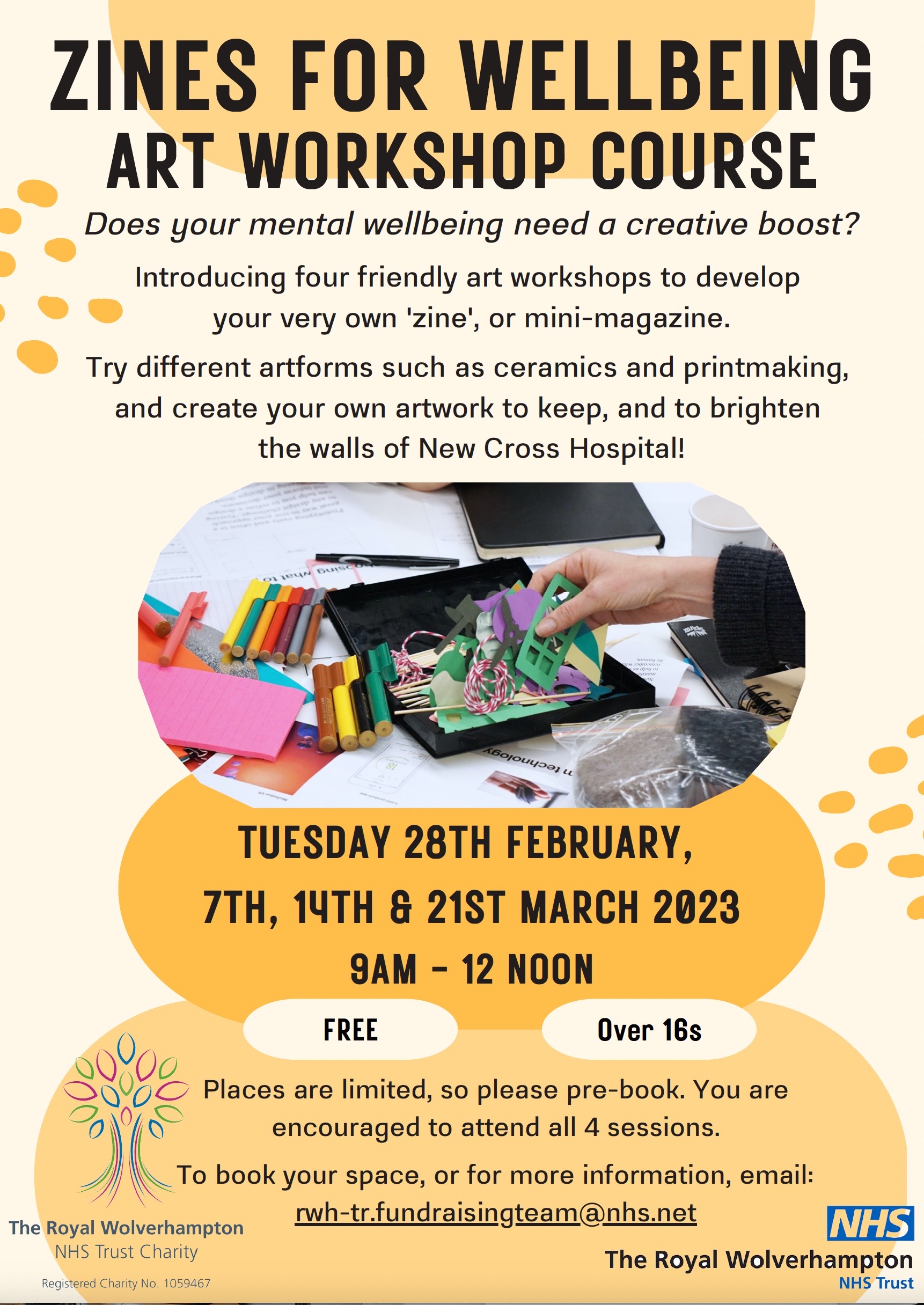
My date is March 14th 2023 from 9-12am, where we will combine fun self portraits, positivity, relaxation and letting go of what no longer serves us well. The venue is Wolverhampton Art Gallery. Please email rah-tr.fundraisingteam@nhs.net to book – not me!
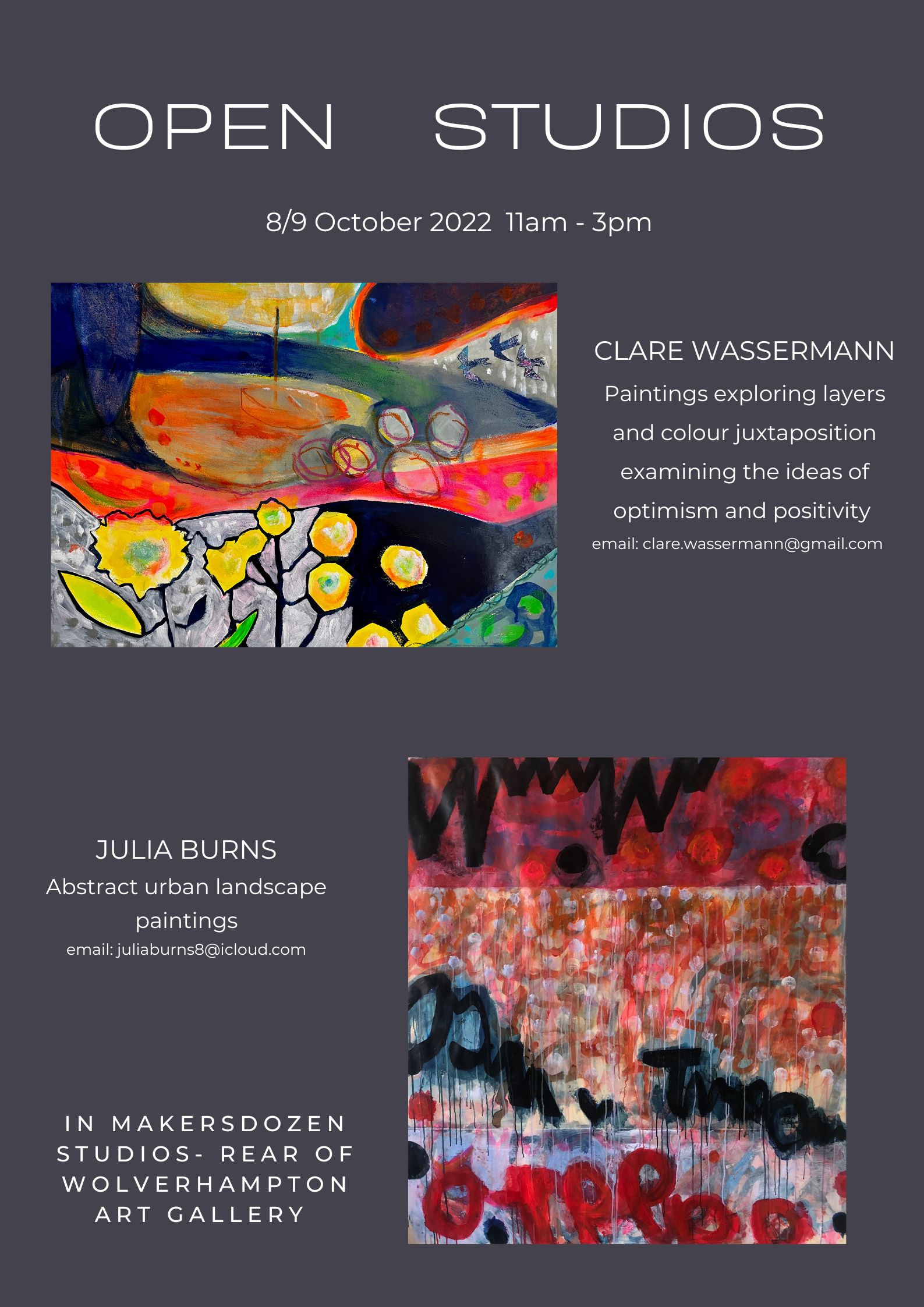
Just a quick post to say my studio at Makers Dozen Studios at the rear of Wolverhampton Art Gallery is open as part of the city wide open studios on October 8th and 9th from 11am – 3pm. If you miss it I can be there by arrangement the week after too – just email me clare.wassermann@gmail.com. The gallery has a new and very lovely cafe ‘Glaze’ on the ground floor overlooking St. Peter’s Gardens which could be a welcome pit stop.
Julia Burns and I have opened next door to each other at Wolverhampton Art Gallery.
Details of more places to visit on the art trail in Wolverhampton can be found here care of Wolverhampton Society of Artists. All venues are free to visit.
Anyway do come and see what I have been busy with this year. I will have cards and paintings for sale but do come and just say hi in our new more normal world.
Julia Burns is opening in the little gallery space next to mine. More of her work can be seen here – she is a wonderful Urban Abstract artist.
I’ve been pondering recently about imaginal thinking and how it can shape change. It involves, for me, more often than not, taking two or more seemingly unrelated images, putting them together and creating meaning from them. An act of ‘wondering and wandering’.
I work a lot this way in my notebooks / sketchbooks. From the semi-intuitively produced image comes larger thinking and access to parts of my consciousness that may be dormant – the subconscious or unconscious and makes it iterative and conscious.
Practice with materials leads to and becomes part of the exploration. Wider aesthetic thinking occurs (something we in the West have largely lost) which leads to thought and words. Afterwards I might write or just ponder as I garden or cook or do the daily tasks. Sometimes there is a notion of an imprinting in the body (embodiment), the book is closed and other life is resumed. Closure….for now.
Here are a few examples from the past week:
and here is a way of going:
Deconstruct / re-construct. Something we need to think about. Transformative thinking comes in here. When there is space after the deconstruction.
You can read a little more about the story of the images on my Instagram here.
I haven’t posted since April – where did the time go? Hope you are all staying well and enjoying some more freedoms than before and some lovely summer weather. I am revelling in the gardens and hedgerows at the moment – literally rolling around in grass like a puppy sometimes – I think it’s just a release from the darkness and enclosure of a strange winter.
There’s plenty of inspiration for shape, colour and pattern down there at welly level!
Much Wenlock, Shropshire – ‘The Spiritual In Nature Exhibition’
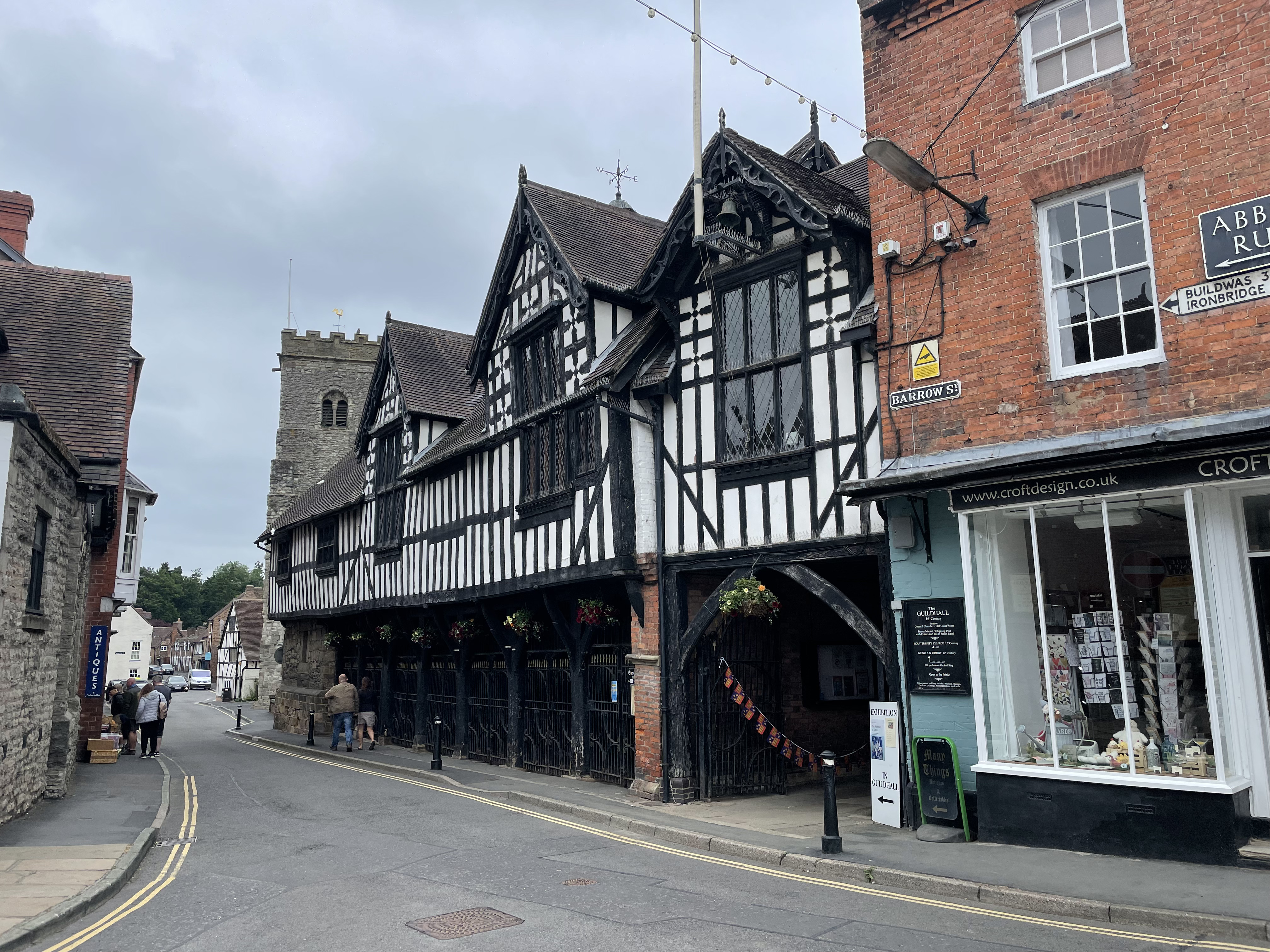
Now we can freely travel and visit places again, you may like to visit this gorgeous village in the heart of some beautiful countryside. There are antiques shops, bookshops, a yarn shop and plenty of lovely food outlets.
Excitingly I have an exhibition there for the whole of July – although please note that the venue, The Guildhall, is open Fridays to Mondays 11am – 4pm. It’s an amazing building itself – built in 1540. You can go into the courtroom and the council chamber which features the most exquisite wood carvings and furniture.
Cards and prints will also be on sale and I will be there on some of the days – this morning, next Friday afternoon and the 11th July. Other times I will drop in too. Let me know if you would like to meet.
The exhibition is my response to lockdown, featuring birds and wildlife that we could see through windows as we felt so trapped inside. But didn’t we come to appreciate it? Didn’t we notice its importance? Also I am addressing in my work, the need for new myths and tales to be told for our future generations about what we have learned about changes to environment through the actions of mankind.
Poster for the exhibition.
The address of the Guildhall is 1 Wilmore St, Much Wenlock TF13 6HR. There are stairs to climb to the first floor. The exhibition and entry to the building is free but please expect to wear a mask. The red blob below on the map is opposite the Guildhall.
Here are a few of the paintings in the exhibition. There are thirteen altogether.
In other news
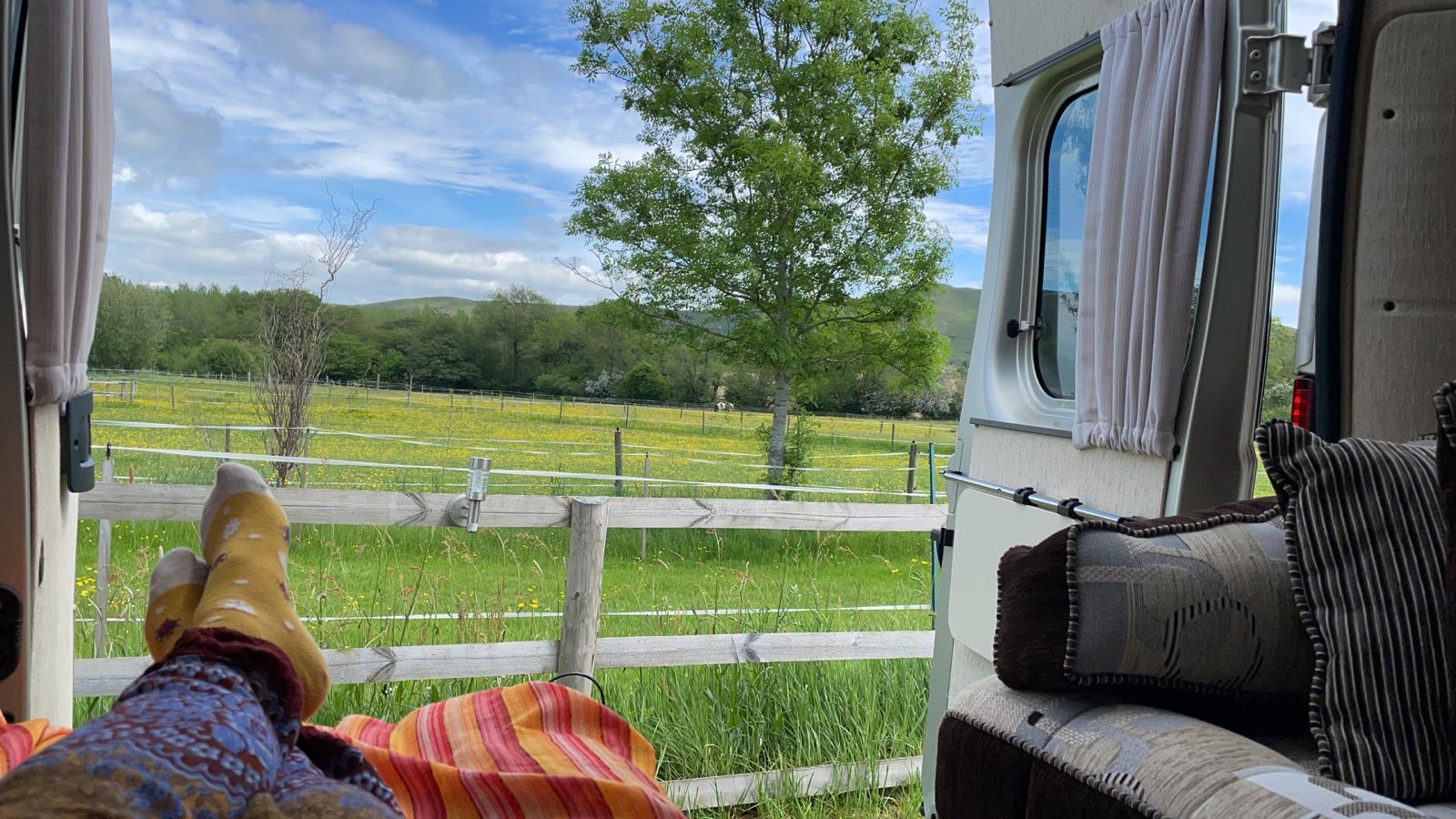
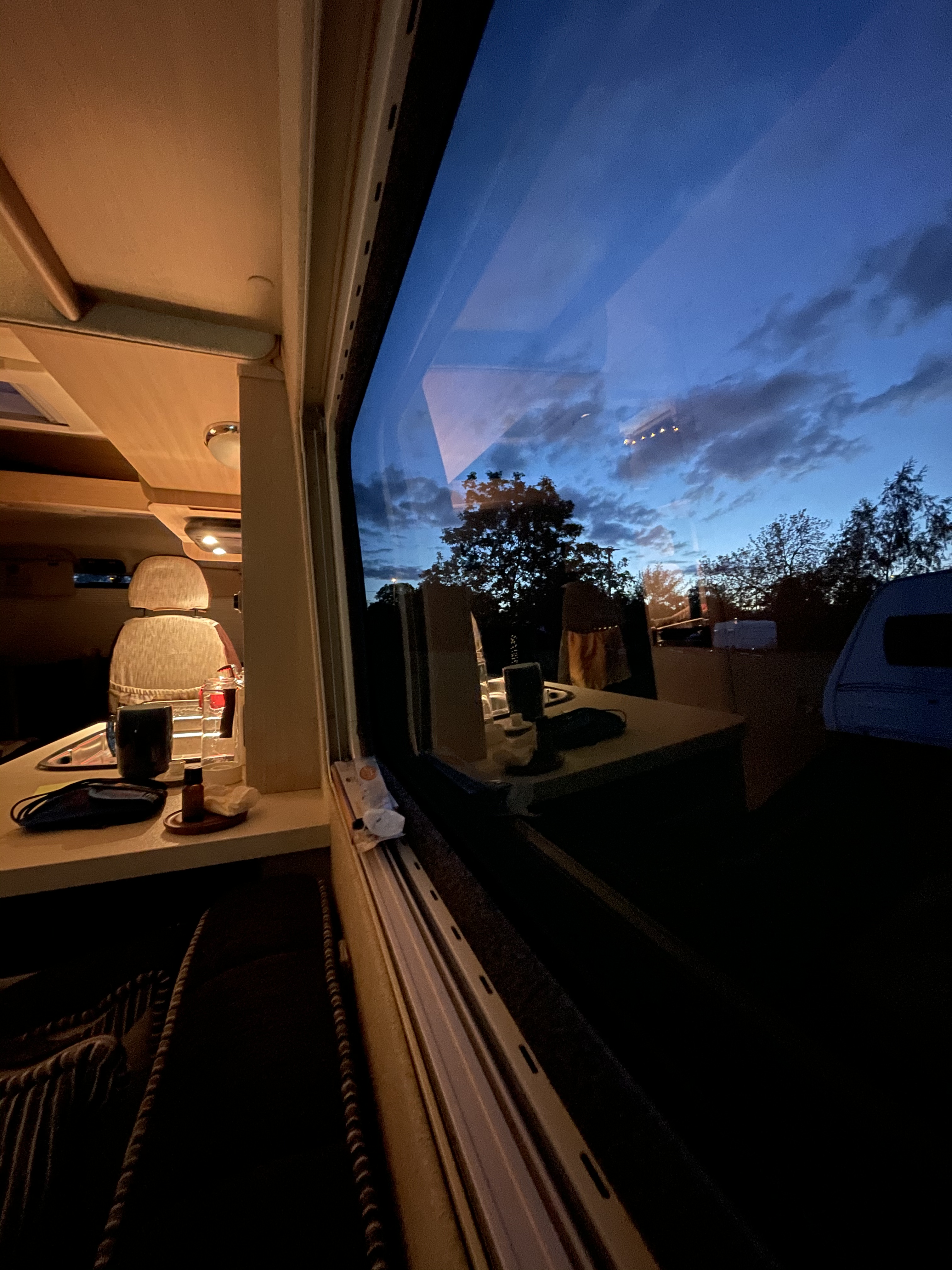
I have achieved the desire of a lifetime which is to by myself a Campervan (not a VW trend-setter one!) to travel, read, write and spend time discovering more of our beautiful natural world. You could call it a mobile ashram and painting studio! There is loads of room for art materials and the potential for lots of silence, stillness and solitude. Expect more of this:
… anyway it’s all too exciting – I am looking for places to park up cheaply, walk and paint. I could deliver a mindfulness and art workshop near you with a group of your friends?
Wolf Town Art Club
I have decided to take a small break from our fabulous art club which has happened monthly online over the past year and we will resume in the latter part of the year. We all need to be out there at the moment, whilst we can!
Community Art Projects
I’m in the middle of two funding bids at the moment for some funding for great projects – watch this space – should know more at the beginning of August.
Meditation and Wellness Sessions
These are still online – you can find out more and book here (Gatis Community Centre) and here (Boundary Way Project).
That’s it folks!
Meanwhile get out there, smell the roses, make some marks, draw some and ENJOY THE SUMMER!
Love and best wishes
Clare Wassermann
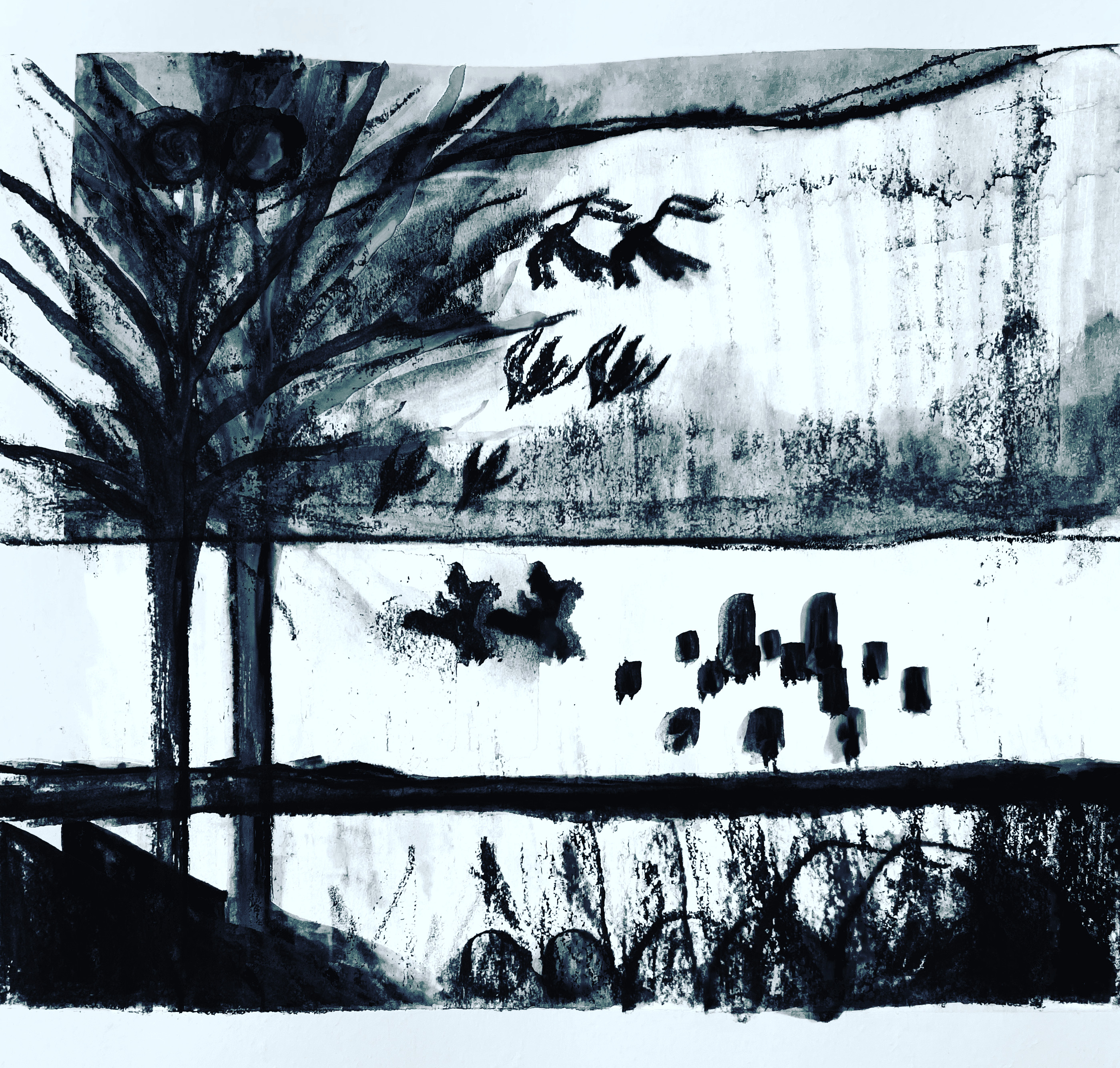
Paintings from the van! Stone Circles and Crows by Clare Wassermann.
Well the lockdown is lifting and we are not sure what the future holds. Many people in shops and pub gardens enjoying themselves but I am wary. Not anxious, but more practising being in the field of the unknown and working on being OK with that.
Fortunately I have a happy hermit mentality for the most part and making art, writing in notebooks and growing plants and veg keep me fairly isolated. What I am looking forward to is a few visitors to the studio and chats in person about art and meaningful stuff. Meaningless babble welcome sometimes. 3D people would be a bonus. In moderation. Introverts unite (well, the unite bit can be tricky!).
So I have enjoyed working on the PhD – very in the head with that but I also need to get out in the air, move my body, practice yoga and sitting in total silence as a contrast. I am working on the balance.
Words Paint Myths #1
Pieces like this run daily at the moment alongside written thoughts.
Burgeoning #1
Burgeoning #2
Studio Work
I am working on some larger oil paintings and small pieces for a solo exhibition in July in Much Wenlock, Shropshire. Some are inspired by new myths created for changed times for we are sorely in need of new narrative.
The exhibition is part of the ‘Word In Edgeways’ storytelling festival which covers July in the town. The paintings can be viewed at The Guildhall, Much Wenlock. More details when I know them.
12″x12″ oil on canvas
in progress 30″x30″ oil on canvas
Art Club
I am still running Wolf Town Art Club online once a month on a Sunday lunchtime – if you fancy a bit of art fun do join us for the cheaper than chips price of £5.80.
Next session is Sunday April 18th 11am-1pm – no experience necessary – the theme is birds this time – read all about it and book here:
Something else I love to do – the practice is my total foundation. I am qualified and overjoyed to share. Please find sessions on the Boundary Way Project events pages and also Gatis Community Centre’s Eventbrite listings. These sessions are competitively priced or free.
Wolverhampton Art Gallery has re-opened
If you are visiting and would like to visit the studio please drop me an email clare.wassermann@gmail.com or call 07976 350062 to see if I am in and covered in paint!

























 Clare Wassermann Art