Is it too much to wonder if drawing can be an act of resistance against disconnection or a political act to create unity and peace through presence, mindfulness and interconnectivity?
22 NOV 2023
This last week I was going to write a piece about drawing and the role that it can play in mindfulness and ‘being present’, but on thinking about it that was put to one side slightly and the importance of drawing as an interconnectedness with all things came up.
How amazing it would be if the simple act of drawing could be used as a transformational process to bring people and their ecosystem (that which forms a network of relationship and interdependence i.e. everything) together?
What if drawing creates union?
What got me thinking
I do a lot of my PhD research about mindfulness, meditation and contemplation in relation to an art practice. It’s always a good excuse to go out and draw anyway; justifying the pleasure with some kind of ridiculous validating argument as if I can’t just have the pleasure. But anyway, in the name of research (!) I was on holiday in Portugal last week and set myself a little goal of painting or drawing to record the trip each day as I generally do when travelling, both as a diary and as something more.
I took a little A5 sized sketchbook and a small pad of watercolour paper and carved niches of time out to use them throughout the trip.
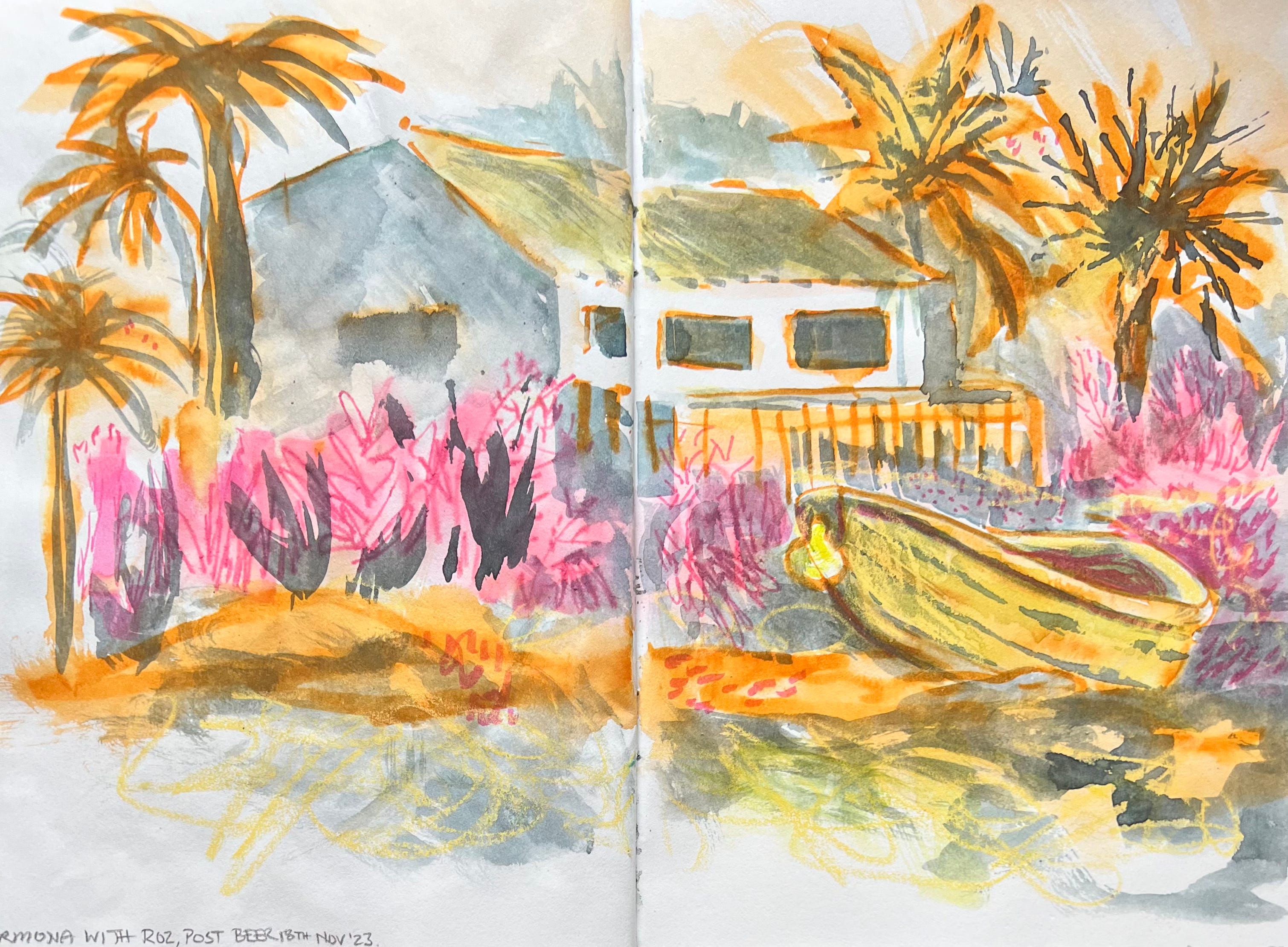
For me, drawing in the landscape is part of a full participation in a location. I take photos, like the rest of us, but the difference between photographing and drawing is enormous.
Michael Taussig, anthrolopologist and field notes maker, in his book “I Swear I Saw This: Drawings in Fieldwork Notebooks, Namely my own”, speaks of drawings:
“folding organically into the writing in the notebook whereas a photograph lives in another sphere altogether, with technology, lying between you and the world”.
He mentions John Berger’s thoughts, with his enigmatic notion that a photograph stops time, while the drawing encompasses it and encompassing is like enclosure. There is an intimacy that Berger finds between the drawer and the drawn, suggesting that drawing is like a conversation with the theme drawn likely to involve prolonged and total immersion. Here the idea is that the person becomes the drawing, you become so close to the object, until you are finally it as it were, the contours you have drawn marking the edge of what you have seen, but also the:
“edge of what you have become, an autobiographical record of one’s discovery of an event, scene, remembered, or imagined.” (Berger 2007:3)
Berger also says that drawing has something that painting, sculpture, installations and videos lack, and that is corporeality. (Berger 2007: 16).
I think mindfulness is a big part of it for me and I like to cultivate and exercise that skill when I can. Here are a couple of definitions of mindfulness:
“Mindfulness […] is generally defined to include focusing one’s attention in a nonjudgmental or accepting way on the experience occurring in the present moment [and] can be contrasted with states of mind in which attention is focused elsewhere, including preoccupation with memories, fantasies, plans, or worries, and behaving automatically without awareness of one’s actions.” (Baer et al. 2004: 191).
“Mindfulness is a process of regulating attention in order to bring a quality of non-elaborative awareness to current experience and a quality of relating to one’s experience within an orientation of curiosity, experiential openness, and acceptance.” (Bishop et al. 2004: 234).
There are two understandings of mindfulness: Western and Buddhist derived. A more Eastern-based idea of mindfulness (sati) is:
“Eastern mindfulness means having the ability to hang to current objects, to remember them, and not to lose sight of them through distraction, wandering attention, associative thinking, explaining away, or rejection.” (Weick & Sutcliffe (2006: 518)
You can see why this is a useful practice to cultivate! It is beneficial to be able to bring this skill to play in all sorts of life situations!
Benefits of mindfulness
The practice of mindfulness, through methods such as body scanning, meditation, and yoga, aims to achieve a state of “being-mode”, characterized by acceptance of change and non-attachment. (This is a confusing idea for Westerners – we can assume too easily that it has connotations of detachment which is not the same – let’s call non-attachment “caring non-attachment” instead because that is more useful). The goal is to master the mind, understand that human suffering is an illusion based on attachment to the nonexistent, and develop compassion and empathy for all beings.
Mindfulness improves mental skills and present-moment awareness by encouraging withdrawal from external factors that cause rumination, complex thinking, and emotional reactions. However, the idea of achieving a purely passive state of mind is paradoxical, as the mind is always interacting with the external environment. Despite this, mindfulness practitioners assert that the practice enhances the ability to remain internally focused and undisturbed by external phenomena.
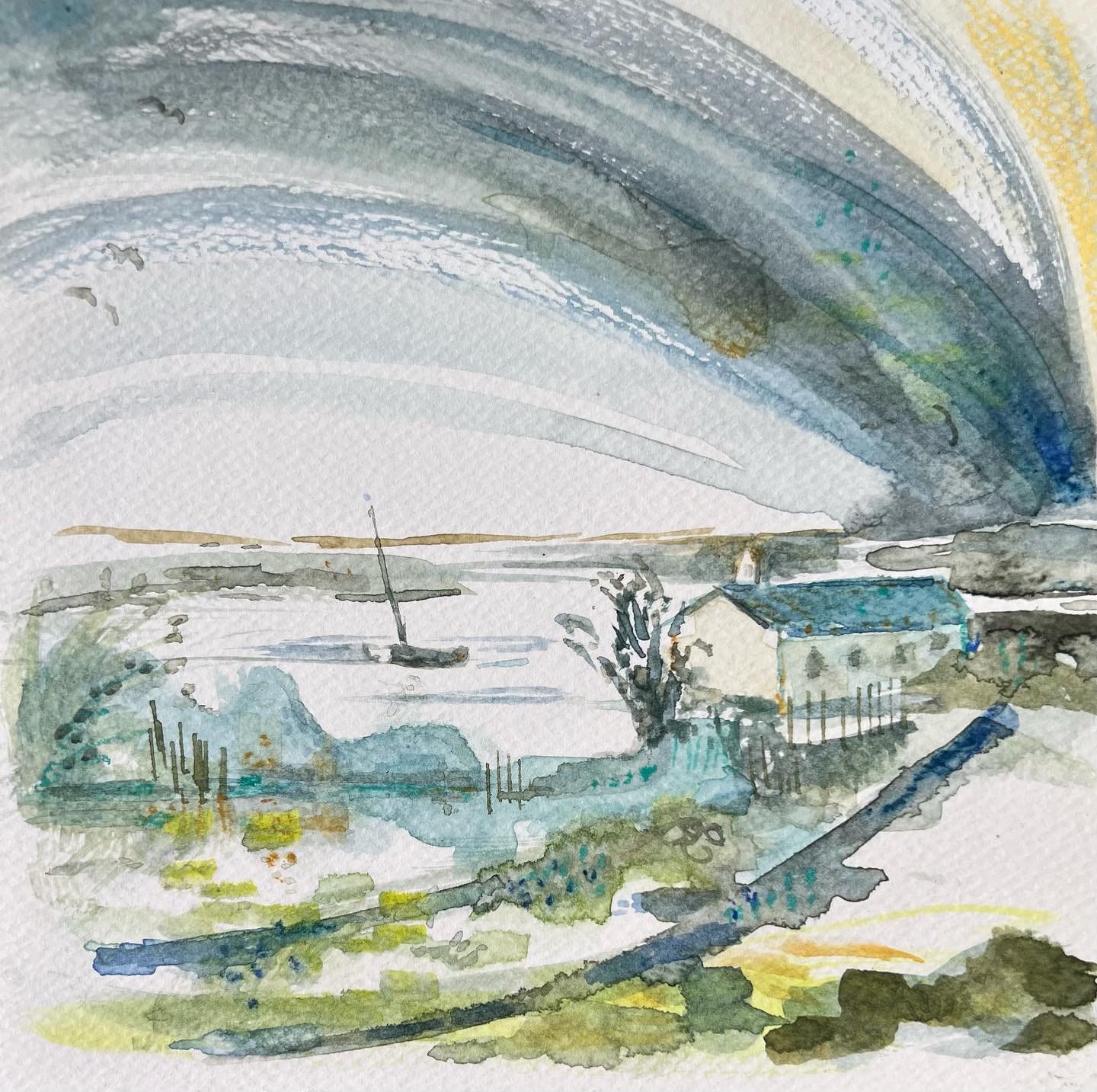
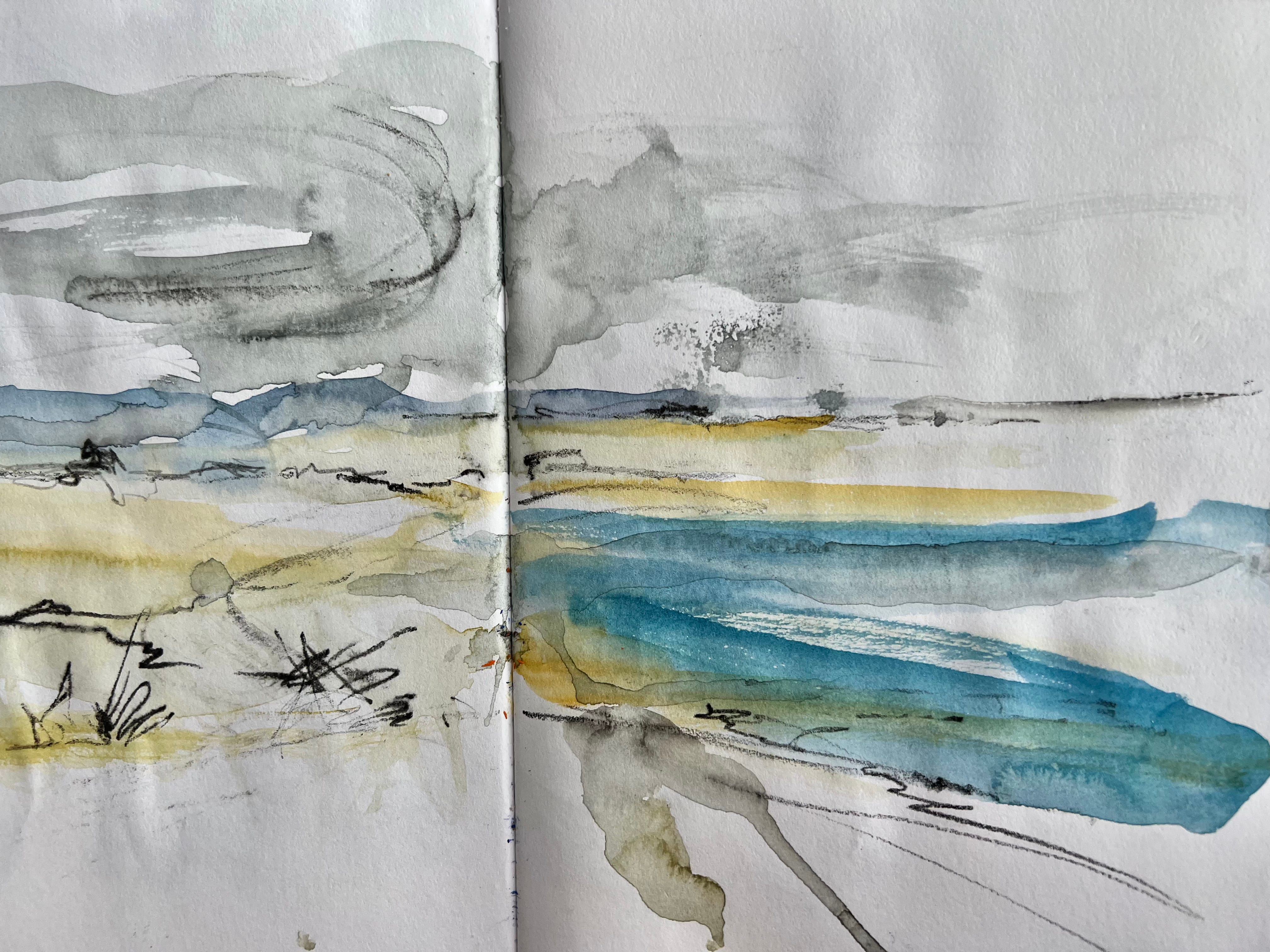
You can see why sitting on a beautiful beach painting this on the island of Armona in Portugal can be argued for!
Mindfulness and Presence
Why are we drawn to being present? Could it be because the awareness of the body knows innately that being present is good for it?
Could being in the present be connected with cultivating a sense of awe? (See my previous Substack on awe).
We know scientifically that people who regularly encounter awe and acknowledge it have certain advantages.
But I got to thinking about what the present moment actually is? There is some literature about what a moment is. How small is it? One idea is that a moment is under six seconds, after which memory and prediction come into the picture.
How deep is it? Does mindfulness give depth to a moment.
What is time anyway? (time is a human construction a space time modality, actually, it doesn’t exist but that is another book – see Deepak Chopra’s outpourings amongst others!).
And what actually is presence?
An experienced moment happens now, for a short extended moment but mental presence encloses a sequence of such moments for the representation of a unified experience of presence. Whereas the experienced moment forms an elementary unit, a temporally unified percept, mental presence involves the experience of a perceiving and feeling agent (“my self”) within a window of extended presence, a phenomenon that is based on working memory function.
“Working memory provides a temporal bridge between events – both those that are internally generated and environmentally presented – thereby conferring a sense of unity and continuity to conscious experience” (Goldman-Rakic, 1997).
My favourite two authors (not academic because so much more relatable!) on presence are Eckhart Tolle and Michael Singer. I read and reread these books (see links) and try to live the ideas there.
Maybe I can think of it this way: Archiving an event
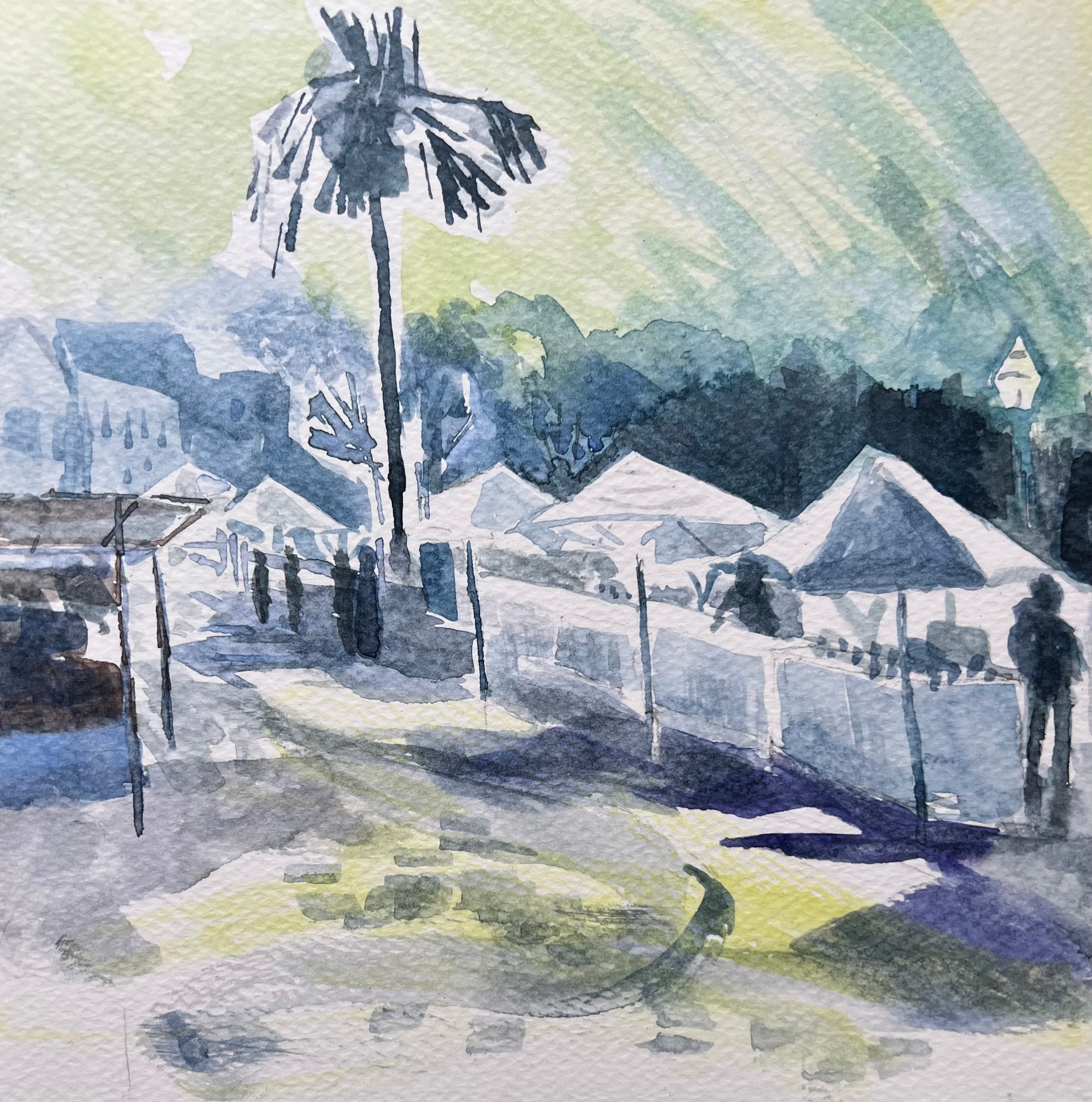
This was a little sketch from Faro – I spent an hour sitting on a bench, fully enjoying the sun, smells, taste and sounds of the market on the marina whilst making this.
If a moment is nebulous in terms of definition then are we talking about an event? Am I archiving an event rather than being present? What is an event made up of? An event has a preparation, and moment, and a memory but can also be made up of smaller moments of consciousness or awareness, which add up to a sense of being present.
How is drawing like yoga?
Honestly I don’t draw or paint in a headstand or the tree pose – that’s not what I mean!
So, recording a feeling of interconnectedness through a medium of art materials is like experiencing the interconnection between my body and mind to something which is greater than me when practising yoga or meditation. In a physical sense, I place my awareness in my body when practising yoga and sense the interconnectedness of, for example, the breath and the position of the body, of which part of me is relaxed and which part of me is tense. When drawing outside I have pockets of attention like this, both of the inside of me (interoception) and outside of me in my (perceived) external environment.
Sometimes this interconnected quality of being feels very profound. I am connected to everything, everything is my ecology. The word ‘yoga’ comes from ‘yuj’ which means ‘union’. The mindful presence of being still and receptive in drawing is like the true meaning of yoga. A connection to my ecology which of course is THE ecology.
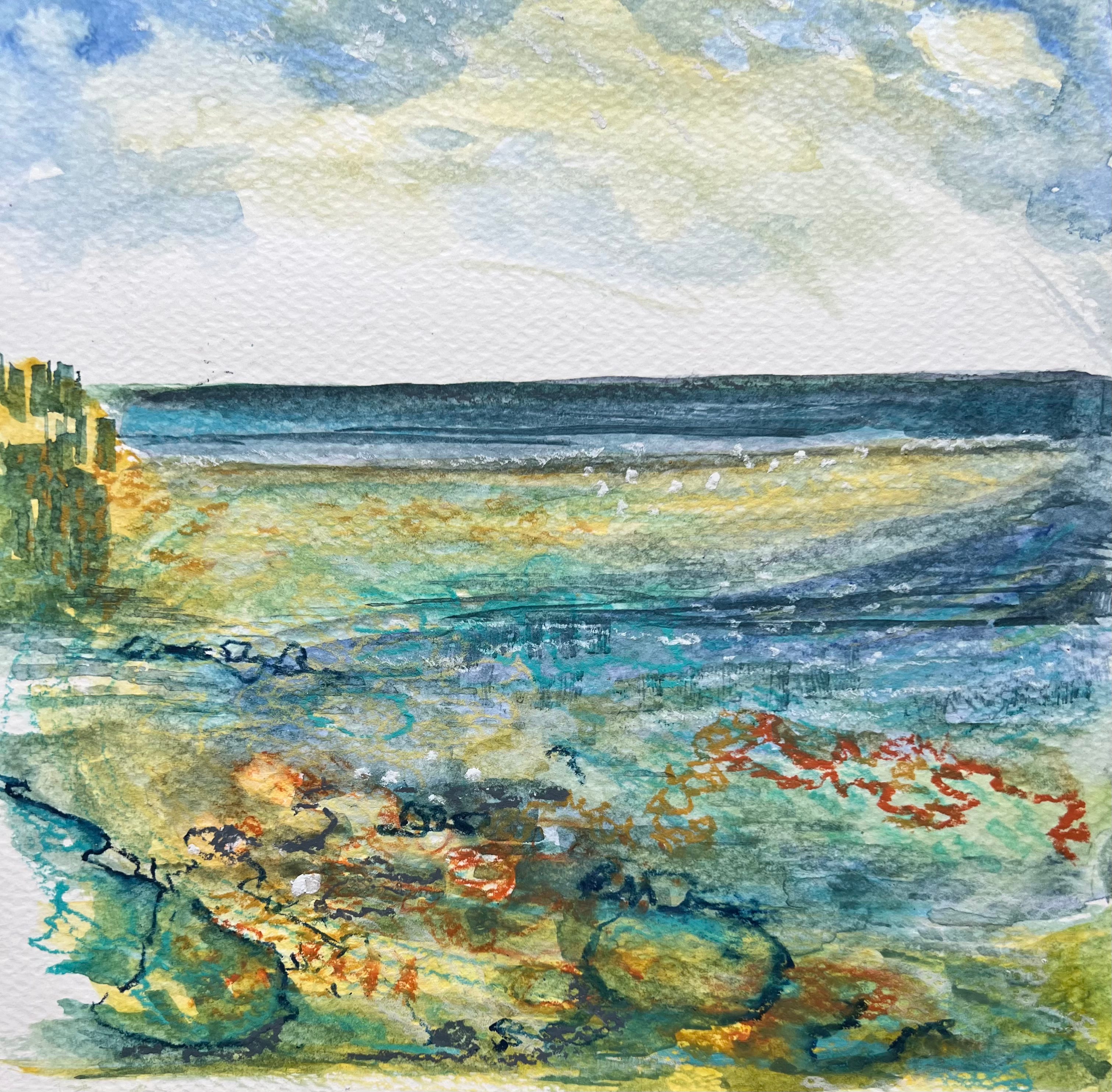
Drawing the beach – sensing the perceptions of my outer environment, sensing the perceptions of experimenting with materials and sensing my internal state. It’s what meditation is, it’s what yoga is.
Why do I sometimes feel the need to capture a past event from a photo?
Is it because I wanted to re-capture, relive, recover that sense of awe? I can mention here two examples. The first is a drawing made in Portugal of the experience of walking on the salt flats at Olhão which was about experiencing the sense of the light rather than that of form. The sense of the light was having an awe-inspiring affect on my body.
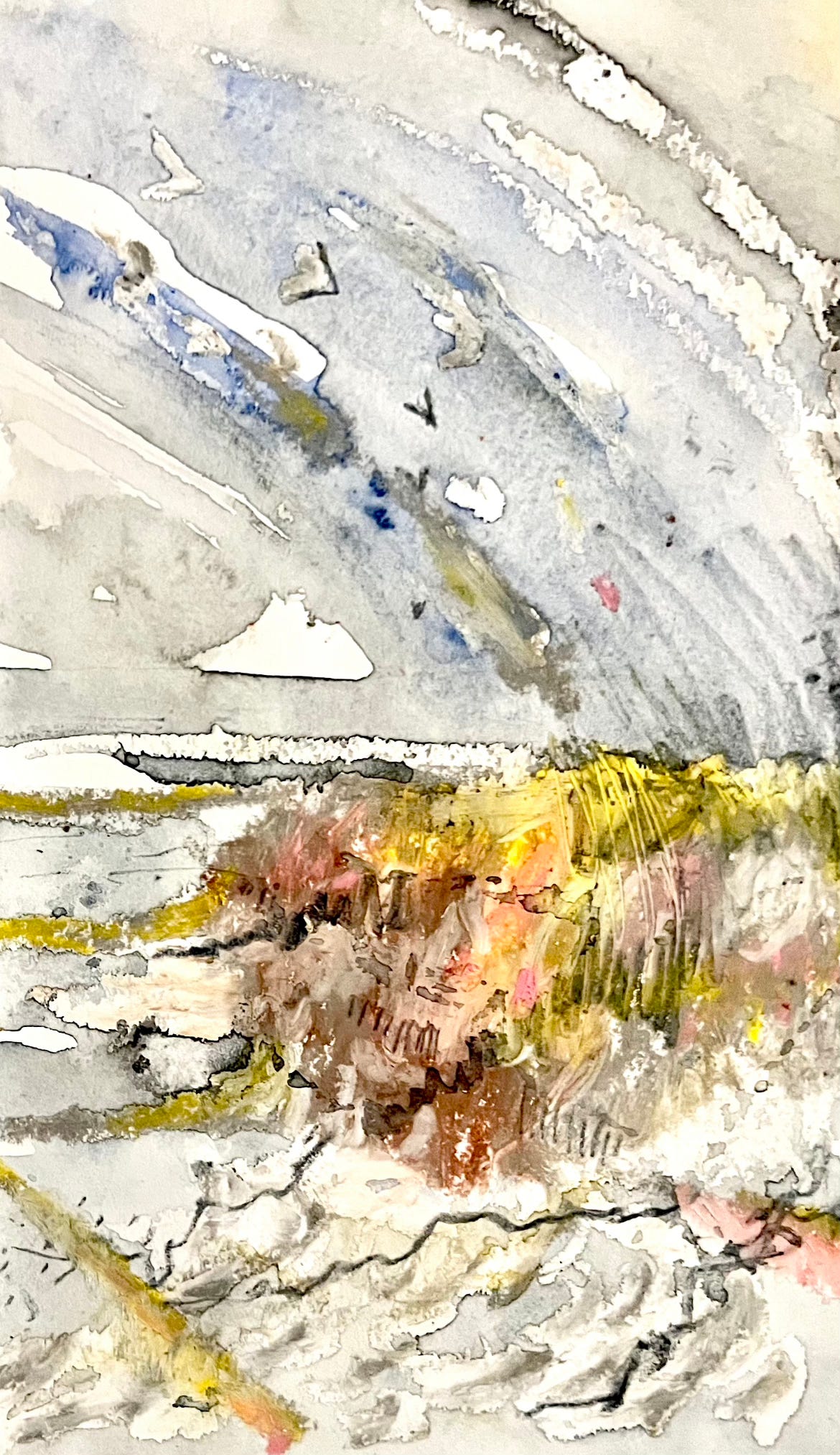
I used a photo to remind me of the awesome experience of light in the salt flats but the painting is not at all purely representational.
The other example is the drawing made about the feeling of interconnectedness when swimming in the river at Dolanog. This went on to become a resolved painting. I will talk about that in another post. It was profound for me.
Drawing and flow state
How can drawing become an entry point into flow? Because drawing can be a form of voluntary play and play is an intentional portal into flow – more on this in another Substack too!
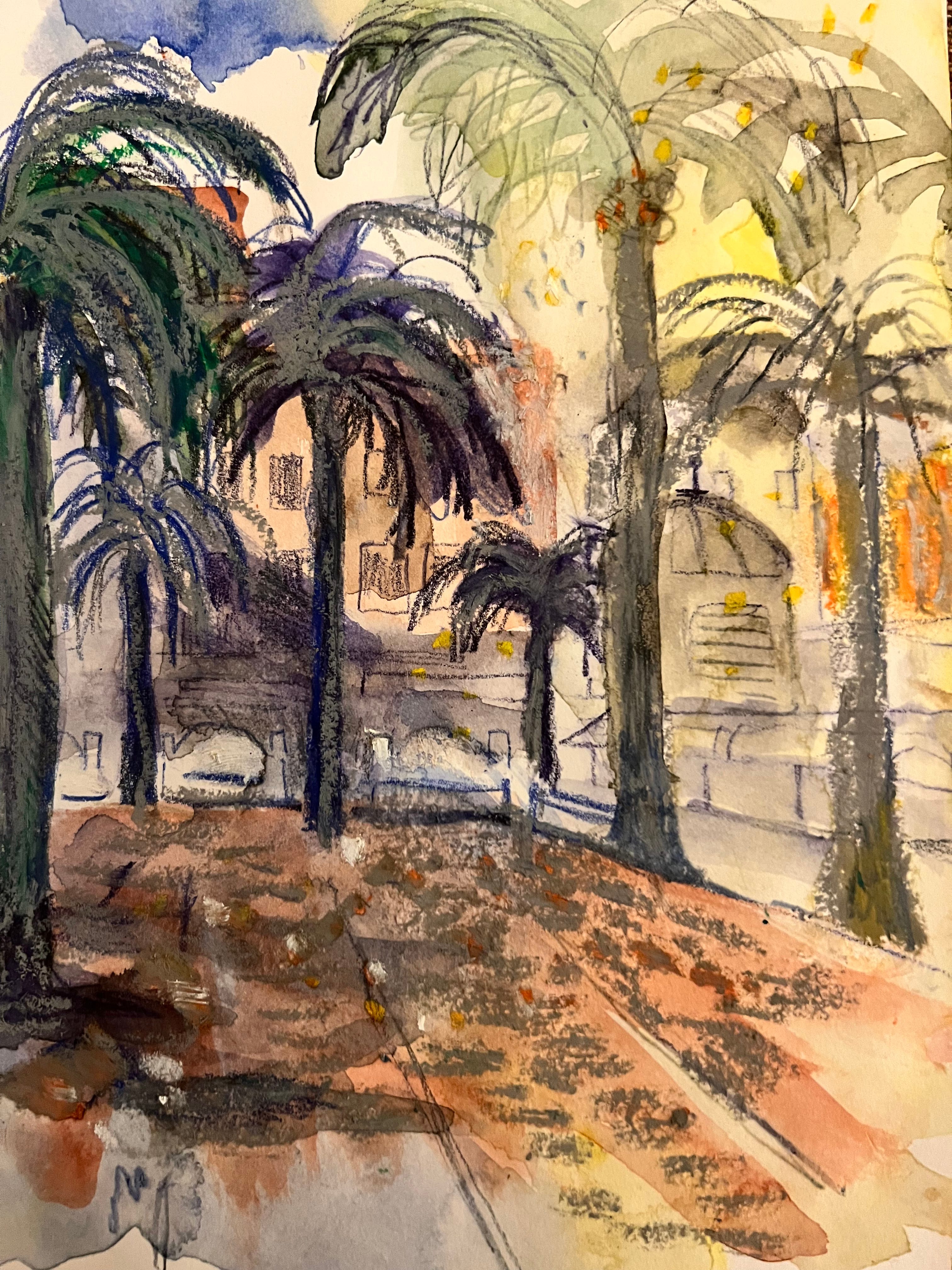
Sketching on an autumnal, orange ripening day in Ayamonte over the border in Spain.
If all of this has become too cerebral, how about this, as a more person to person connection arising from drawing outside last week:
Drawing and people connections
In around 2016 I met Mary Price (of Artist in the Shed on Instagram) on an art workshop in Brighton, tutored by the Australian artist Tracey Verdugo when she was on a world tour. Mary was sitting next to me during the weekend and over a Saturday night curry we made ourselves into friends, but only had an online friendship subsequently over the years, until just last year when we found ourselves in Olhǎo, Portugal at the same time. We spent a couple of happy days then out sketching together and drinking vinho verde of course!
This year she was to be in Olhǎo again at the same time as us. We organised more time to be spent out with sketchbooks and the day before we met up she had by chance encountered, in a cafe, another artist, Roz Beaver, who was travelling light around Portugal with her art materials. Over the next week or two we all bonded through drawing together, talking about art making, connections, and sharing life stories. We united through being in our true happy places, each of us connecting with our environment through drawing and painting in a deep and present way. We will remain friends wherever we are in the world through this true commonality and unity.
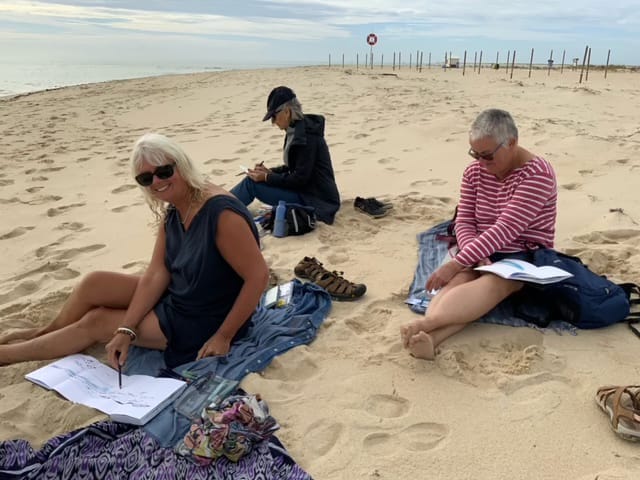
Roz, me and Mary – connected
So…
Is it too much to wonder if drawing can be an act of resistance against disconnection and a political act to create unity and peace through presence, mindfulness and interconnectivity?
follow me on Substack : long form writing, no ads, no attention seeking reels! Link: CLARE WASSERMANN
Some refs:
Taussig, Michael (2011), I Swear I Saw This: Drawings in Fieldwork Notebooks, Namely my own, Chicago: University of Chicago Press
Berger, John (2007), John Berger: Life Drawing, Ed. J. Savage, London: Occasional Press.
Let me know if you want the other citations – I need to go and have a custard cream now.
 Clare Wassermann Art